Sexual Stamina After 40: What Changes, What’s Normal and What Helps
Educational content, not medical advice. This article is general information from a fitness coach. It is not a diagnosis or treatment. If you have a health concern, see a doctor. See “When to see a doctor” below.
Short answer: yes, sexual stamina often changes after 40, and most of those changes are common. Erections can take longer to build and be a little less firm, you may recover more slowly between rounds, and the average time to orgasm drifts down with age. Fitness, weight, sleep, stress and alcohol all play a part, and those are things you can work on.
I’m Sam Smith, a fitness coach, and a large share of the men I hear from are between 40 and 55. They are not broken. They are noticing that the body they had at 28 now needs a better plan. This guide covers what research says changes, what is worth worrying about, and a 12-week approach that fits around a busy life.
Key takeaways
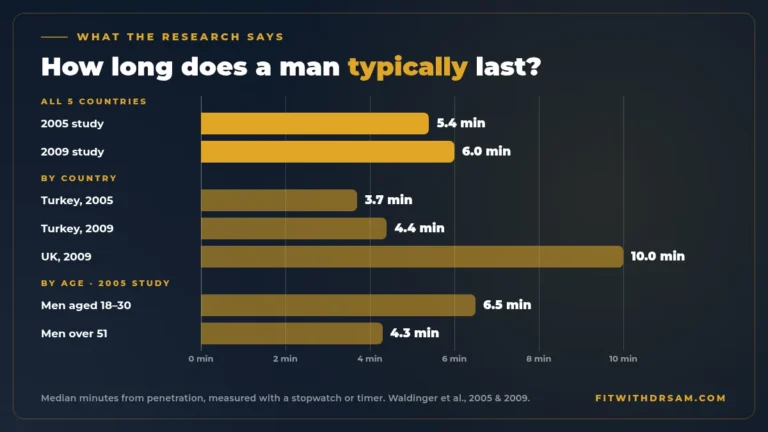
- In a stopwatch study of 500 couples, the median time to ejaculation fell from 6.5 minutes (ages 18 to 30) to 4.3 minutes (over 51). That is a gradual shift, not a collapse.
- Sex therapists surveyed in the US and Canada consider 3 to 13 minutes typical and not a clinical concern.
- Common changes with age include slower arousal, less firm erections, reduced sensitivity and a longer refractory period.
- Weight, fitness, sleep, alcohol, stress and some medicines are the levers you can pull. In one trial, lifestyle change helped about a third of obese men with erectile problems.
- A sudden change, erection trouble or loss of desire deserves a doctor’s check, because it can point to a treatable condition.
What actually changes after 40?
There is no single age when stamina drops. The MSD Manual describes a gradual set of changes in men’s sexual function with age, and notes it is not always clear whether ageing itself or the conditions that come with it are responsible. These are the most common ones (Mayo Clinic also lists less strength or stamina among the changes men notice):
| What changes | What you might notice | What can help |
|---|---|---|
| Erections build more slowly and are a little less firm | Needing more direct touch, losing firmness mid-way | Cardio, weight management, sleep, less alcohol, more relaxed foreplay |
| Penile sensitivity can change | Needing more stimulation, or reacting differently | Slower pace, variety, communication with your partner |
| Less forewarning before orgasm | Orgasm feels like it arrives with less notice | Arousal scale practice, breathing, start-stop (see below) |
| Longer refractory period | Longer wait before you can go again | Patience, non-penetrative intimacy, good recovery |
| Testosterone drifts down gradually | Slightly lower drive or energy in some men | Strength training, sleep, healthy weight; a doctor’s blood test if symptoms are strong |
| Life load rises | Stress, poor sleep, less exercise | Planning, routines, a stress outlet |
On testosterone, Harvard Health notes that levels fall by about 1% a year on average from a man’s late 30s, and that a blood test from your doctor is the way to tell whether your levels are low. Please don’t self-diagnose from stamina alone, and be careful with over-the-counter “booster” claims.
Is it normal to last less long as you get older?
For many men, yes. Waldinger and colleagues timed intercourse with a stopwatch in 500 couples across the Netherlands, the UK, Spain, Turkey and the US. The overall median was 5.4 minutes, and the median fell significantly with age, from 6.5 minutes in men aged 18 to 30 to 4.3 minutes in men over 51 (Waldinger et al., 2005). The spread between men was huge, from about half a minute to 44 minutes.
Sex therapists asked what counts as “adequate” gave a range of 3 to 7 minutes, “desirable” 7 to 13 minutes, and “too short” 1 to 2 minutes (Corty and Guardiani, 2008). So if you are lasting a few minutes, you are within the typical range, even if it feels short to you. If you want more detail, I broke it down in how long a man should last.
There is one distinction worth knowing. The American Urological Association describes acquired premature ejaculation as consistently poor control, with bother, where the time to ejaculation is markedly shorter than your own past experience. If that matches your situation, it is worth a conversation with a doctor, because there can be a physical or psychological cause that is treatable (AUA/SMSNA guideline, 2020).
The levers you can actually pull
1. Fitness and body weight
This has the best evidence. In 11 randomised trials, aerobic exercise raised erectile-function scores by about 2.8 points on average (Khera et al., 2023). In a trial of 110 obese men aged 35 to 55 with erectile dysfunction, two years of weight loss and activity advice moved 17 men into a normal-range score, versus 3 in the control group (Esposito et al., 2004). I go through the studies in does exercise help you last longer in bed.
2. Strength training
Lifting two to three times a week helps you keep muscle, manage weight and sleep better. Start with my 3-day workout plan for men over 40 or the 30-minute home plan. For the hormone side, see strength training and testosterone.
3. Sleep and alcohol
Poor sleep and heavy drinking both make stamina worse, and both creep up as life gets busier. Aim for a regular bedtime and seven or more hours, and cut back on drinks on the nights it matters. Read more in sleep and testosterone and alcohol and testosterone.
4. Pelvic floor and breathing
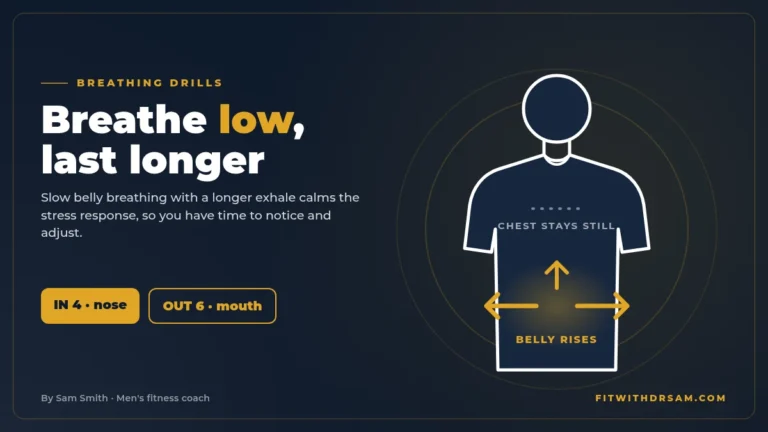
These train the control side. Pelvic floor rehabilitation helped 33 of 40 men with lifelong premature ejaculation in a small uncontrolled study (Pastore et al., 2014), but a 2026 meta-analysis of randomised trials found it works best alongside other tools, not alone. Learn the basics in the Kegel guide for men, the reverse kegel guide and breathing techniques to last longer.
5. Stop-start practice and pacing
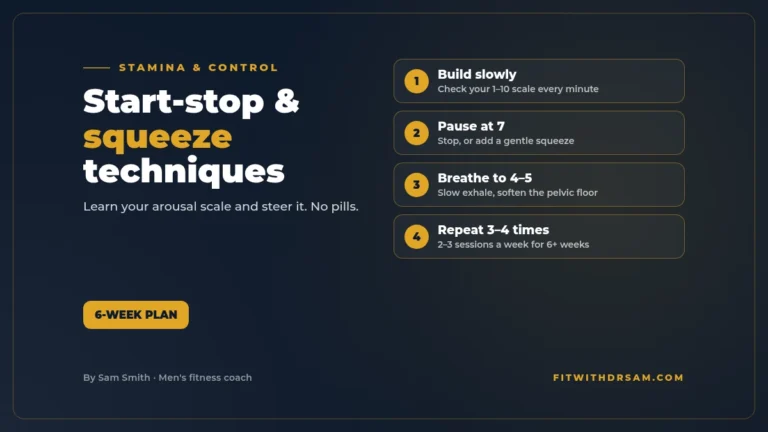
The stop-start and squeeze techniques are standard behavioural methods. As reaction time to the “point of no return” gets shorter with age, practising your arousal scale becomes more useful. My step-by-step guide to the stop-start and squeeze techniques walks through it.
6. Stress, confidence and your partner
Worry about “performing” feeds on itself, and it often grows after the first few off nights. Talking openly with your partner and widening what counts as good sex (touch, oral, time) takes pressure off. See performance anxiety in men and how to reconnect with your partner.
Some medicines, such as certain antidepressants and blood-pressure drugs, can affect sex. Don’t stop any prescribed medicine on your own. Ask your doctor or pharmacist whether it could be playing a part (NHS).
A 12-week plan for men over 40
| Weeks | Body | Control and mind | Lifestyle |
|---|---|---|---|
| 1 to 4 | Walk 30 min on 5 days; 2 full-body strength sessions | 5 min pelvic floor and 5 min slow breathing daily | Same bedtime; 2 alcohol-free days; talk to your partner about what you’re doing |
| 5 to 8 | Add one interval session; 3 strength sessions | Arousal scale practice (rate 1 to 10); start-stop practice solo | Seven hours sleep; limit alcohol on the nights it matters |
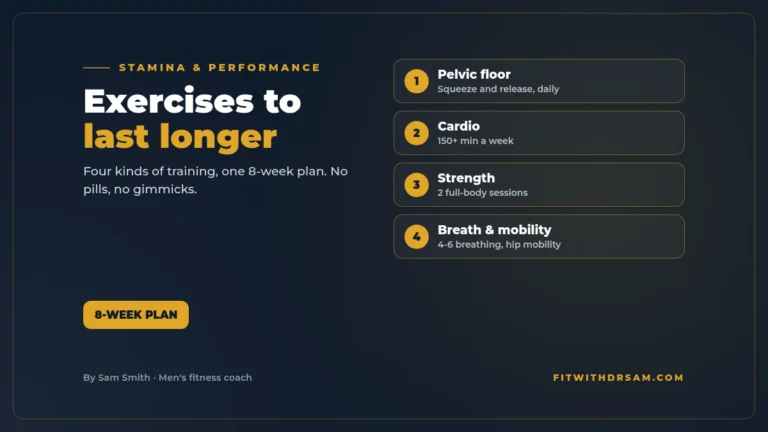
| 9 to 12 | Keep 150 min cardio and 2 to 3 strength sessions | Use start-stop with your partner; slow pace and breathing | Review: weight, energy, confidence, then book a check-up if little has changed |
Total time is roughly 4 to 5 hours a week. The goal is consistency, not intensity. If you want everything laid out day by day, my book Increase Stamina in Bed is a 30-day program built around the same pieces (111-page guide, 15 to 25 minutes a day, no pills). For an endurance challenge you can do at home, see The Warrior’s Stamina.
When to see a doctor
It is worth booking a check-up with your doctor (GP in the UK, Hausarzt in Germany) or a urologist if:
- the change was sudden, or you have never lasted long and it bothers you
- erections are unreliable or you can’t keep one most of the time
- your desire has dropped, and you feel constantly tired or low
- you have pain, blood in your semen, or urinary symptoms
- you have risk factors such as diabetes, high blood pressure or high cholesterol
Erection problems can be linked to conditions such as high blood pressure, diabetes, hormone problems or depression (NHS), so a check can be about much more than sex.
What I would not do
- Don’t buy unregulated “stamina pills” online. They are not tested and can interact with medicines.
- Don’t assume that stamina equals your testosterone level. Test, don’t guess.
- Don’t turn it into a performance review. Watching the clock tends to make things quicker, not slower.
- Don’t avoid the conversation. Partners usually care more about connection than about minutes.
Free: the 7-Day Stamina Starter
A gentle week of breathing, pelvic floor control, mobility and short bodyweight sessions. Get the free plan. The full topic map is in my complete guide to male sexual stamina.
Frequently asked questions
Does sexual stamina decrease with age?
For many men it changes gradually. A stopwatch study found the median time to ejaculation was 6.5 minutes for men aged 18 to 30 and 4.3 minutes for men over 51. Erections may also build more slowly and recovery between rounds gets longer. Fitness, weight, sleep and stress can influence how noticeable this is.
How long should a 45-year-old man last in bed?
There is no required number. Sex therapists surveyed in North America called 3 to 7 minutes adequate and 7 to 13 minutes desirable, and said anything from about 3 to 13 minutes is typical. What matters is that you and your partner are satisfied.
How can I increase my stamina after 40 or 50?
Build a base of cardio and strength training, protect your sleep, limit alcohol, and add pelvic floor, breathing and start-stop practice. Be patient: the studies measure change over roughly 8 to 12 weeks.
Does premature ejaculation get worse with age?
Typical timing shortens a little with age, and some men notice a clear drop compared with their past. If it is a consistent, bothersome change, see a doctor to look for causes such as anxiety, erection difficulty, medicines or prostate issues.
Should I get my testosterone tested?
If you have low drive, constant tiredness or other symptoms, ask your doctor. A blood test is the only way to know your level, and low stamina on its own isn’t enough to tell.
Can lifestyle changes really make a difference?
They can for many men. In one trial of obese men with erectile problems, weight loss and more activity helped about a third. They are low-risk and good for your health overall, and you can use them alongside medical care.
About the author. Sam Smith is a fitness coach with more than 10 years of experience and the author of five books on men’s stamina, fitness, nutrition and relationships. He is not a medical doctor and does not give medical advice.
Sources
- Waldinger MD, Quinn P, Dilleen M, et al. A multinational population survey of intravaginal ejaculation latency time. J Sex Med. 2005;2(4):492-497. PubMed
- Corty EW, Guardiani JM. Canadian and American sex therapists' perceptions of normal and abnormal ejaculatory latencies: how long should intercourse last? J Sex Med. 2008. PubMed
- MSD Manual Consumer Version. Effects of aging on the male reproductive system. MSD Manual
- Harvard Health Publishing. Increasing energy levels for sex. Harvard Health
- Mayo Clinic. Senior sex: tips for older men. Mayo Clinic
- American Urological Association. Disorders of ejaculation: AUA/SMSNA guideline (2020). AUA
- Khera M, Bhattacharyya S, Miller LE. Effect of aerobic exercise on erectile function: systematic review and meta-analysis of randomized controlled trials. J Sex Med. 2023;20(12):1369-1375. PubMed
- Esposito K, Giugliano F, Di Palo C, et al. Effect of lifestyle changes on erectile dysfunction in obese men: a randomized controlled trial. JAMA. 2004;291(24):2978-2984. PubMed
- Pastore AL, Palleschi G, Fuschi A, et al. Pelvic floor muscle rehabilitation for patients with lifelong premature ejaculation. Ther Adv Urol. 2014;6(3):83-88. PubMed
- de Oliveira FA, Lima LB, da Costa MO, et al. Efficacy of pelvic floor muscle training in the management of premature ejaculation: a systematic review and meta-analysis of randomized controlled trials. J Sex Med. 2026;23(6):qdag131. PubMed
- NHS. Erection problems (erectile dysfunction). NHS
- NHS. Ejaculation problems. NHS
All links checked 28 October 2026.