How Long Should a Man Last in Bed? What the Research Actually Says
Educational content, not medical advice. This article is general information from a fitness coach. It’s not a diagnosis or treatment. If you have a health concern, see a doctor. See “When to see a doctor” below.
Short answer: in the largest stopwatch studies, the typical (median) man lasted about 5 to 6 minutes from penetration to ejaculation, and sex therapists consider 3 to 7 minutes “adequate” and 7 to 13 minutes “desirable.” Movies and locker-room talk set expectations far higher than real life. Below, we look at what the research actually measured, what counts as “too fast,” and what to do if you’d like more control. For the full training approach, see our guide on how to last longer in bed naturally.
Key takeaways
- Median time in a 5-country stopwatch study: 5.4 minutes; a follow-up study found 6.0 minutes.
- The range is huge, from under 1 minute to more than 40 minutes, so “average” isn’t a target.
- Experts call 1 to 2 minutes “too short” and 3 to 13 minutes normal.
- A medical diagnosis depends on time, lack of control and distress, not on a stopwatch alone.
- Control is trainable. Breathing, start-stop practice and pelvic-floor work all help.
What the research says about average time
Researchers measure this as intravaginal ejaculation latency time (IELT), the time from penetration to ejaculation. Foreplay isn’t included, which is important: intimacy is much more than this one number.
The two best-known studies used a stopwatch or a timer device, rather than asking men to guess (men tend to misjudge time when they’re anxious):
| Study | Who | Method | Median time | Range |
|---|---|---|---|---|
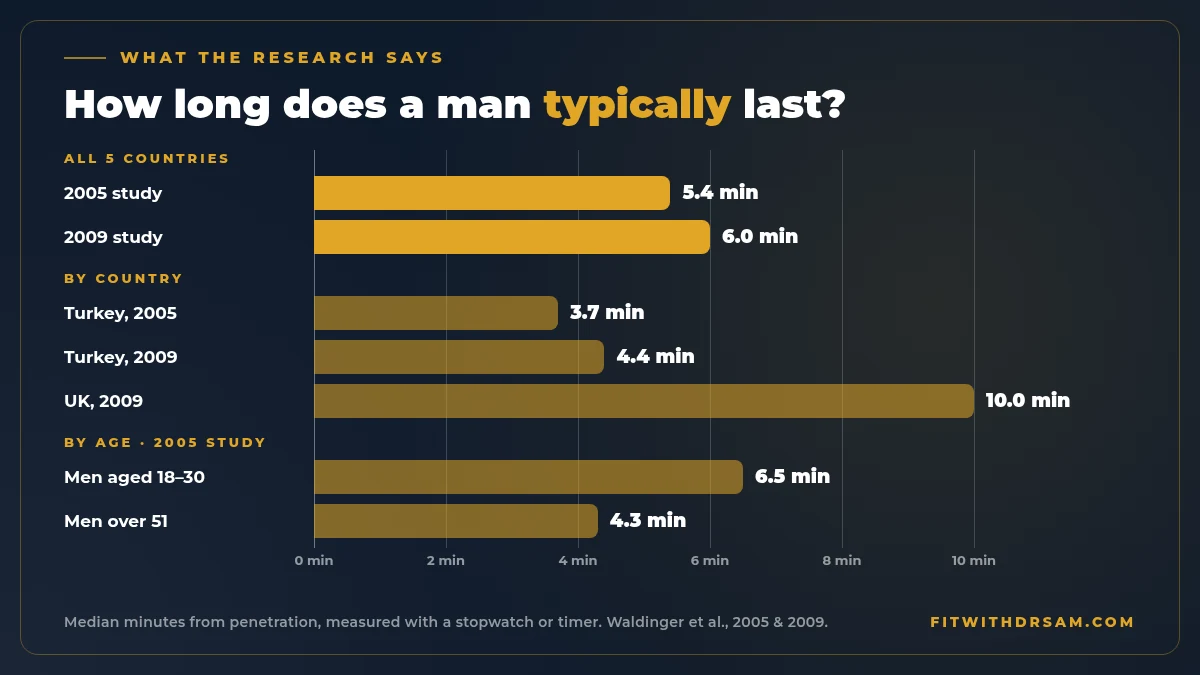
| Waldinger et al., 2005 | 500 couples in the Netherlands, UK, Spain, Turkey and the US | Stopwatch, 4 weeks | 5.4 min | 0.55 to 44.1 min |
| Waldinger et al., 2009 | 474 men, same five countries | Blinded timer device, 4 weeks | 6.0 min | 0.1 to 52.1 min |
A few details stand out:
- Age matters. In the 2005 study, the median dropped from 6.5 minutes in men aged 18 to 30 to 4.3 minutes in men over 51.
- Countries differ. Turkey had the shortest median in both studies (3.7 and 4.4 minutes). In 2009, the UK had the longest (10.0 minutes).
- Condoms and circumcision made no significant difference to the median in either study.
- Worry doesn’t always match reality. In 2009, men who were unhappy with their timing had a median of 5.2 minutes, only slightly below everyone else.
Why “median” and not “average”? The data is skewed: a few very long times would pull a simple average up. The median is the middle value. Half of men were above it and half were below.
How long should sex last? What experts consider normal
Knowing what’s typical is one thing. What’s satisfying is another. In a survey of members of the Society for Sex Therapy and Research in the US and Canada, therapists rated (Corty and Guardiani, 2008):
| Rating | Time from penetration |
|---|---|
| Too short | 1 to 2 minutes |
| Adequate | 3 to 7 minutes |
| Desirable | 7 to 13 minutes |
| Too long | 10 to 30 minutes |
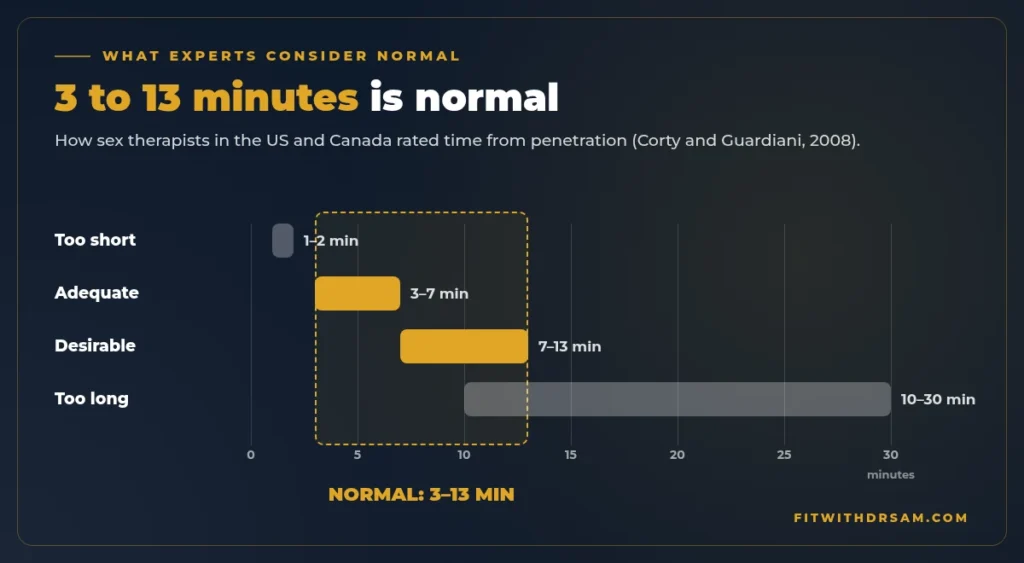
The authors’ conclusion: intercourse lasting 3 to 13 minutes is normal and not a cause for clinical concern. They also
suggested that sharing these numbers with the public could prevent needless distress. That’s exactly why this article exists.
Free plan
Get the 7-Day Stamina Starter
10 to 15 minutes a day: breathing, pelvic-floor basics, mobility and three short bodyweight sessions, with a tick-box tracker. No gym, no pills.
Send me the free planFree. No spam. Unsubscribe anytime.
When is it premature ejaculation?
The International Society for Sexual Medicine (ISSM) defines premature ejaculation by three things together (Serefoglu et al., 2014):
- Time: ejaculation that always or nearly always happens within about 1 minute of penetration since your first sexual experiences (lifelong), or a clear and bothersome drop to about 3 minutes or less (acquired).
- Control: you can’t delay ejaculation on all or nearly all occasions.
- Consequences: it causes distress, frustration, or makes you avoid intimacy.
In other words, finishing quickly now and then is normal. The NHS says occasional episodes are common and not a cause for concern (NHS).
How common is it? Self-reported problems are common: in a large internet survey of more than 12,000 men in the US, Germany and Italy, 22.7% said they had low control causing distress (Porst et al., 2007). But lifelong premature ejaculation by the strict 1-minute definition is much rarer, with researchers estimating it’s unlikely to exceed about 4% of men (Cooper et al., 2015).
What matters more than the number
Chasing a time target usually backfires. The more you watch the clock, the more anxious you get, and anxiety is one of the main things that speeds men up. Here’s what tends to matter more to both partners:
- Connection and foreplay. The studies above only timed penetration. For many couples, the time before it is just as important.
- Feeling in control. Men who feel they can slow down when they want to are usually far less worried about the exact minutes.
- Communication. A partner who knows what you’re working on removes most of the pressure. Ask what they enjoy rather than guessing.
- Being present. Paying attention to touch and sensation, not to “how am I doing?”, makes intimacy better and gives you more time to notice your arousal.
If you’d like a specific goal, make it this: notice when you reach about 7 out of 10 and be able to pause. That skill matters more than any stopwatch number.
Why some men finish faster than they’d like
- Anxiety and pressure, especially with a new partner or after a few “bad” experiences
- Stress, depression or relationship problems
- Learned speed from years of rushing
- Long gaps between sex, which raise sensitivity
- Erection worries, which make men hurry before they “lose it”
- Physical factors such as prostate or thyroid problems, or recreational drugs (NHS)
5 ways to build more control
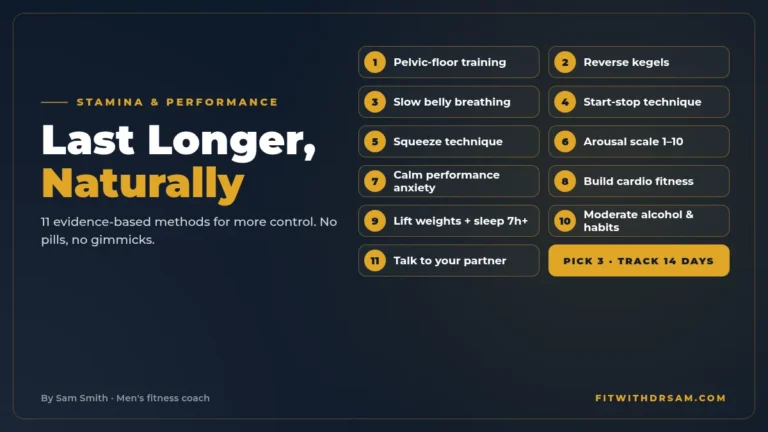
You don’t need to aim for a number. Aim to feel more in control and less anxious. These are the methods with the best support:
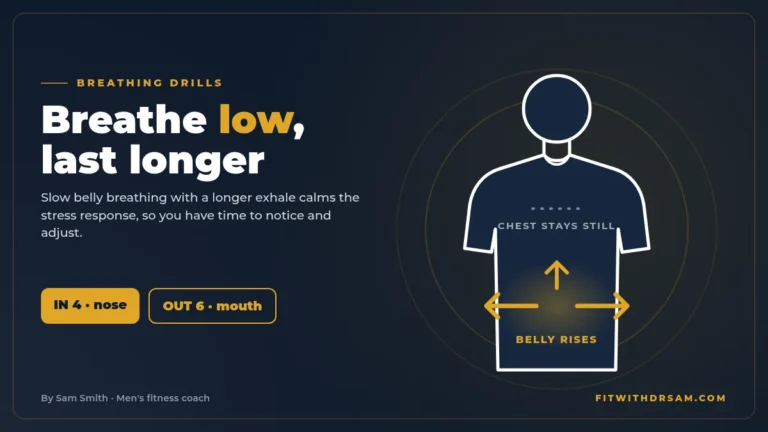
- Slow your breathing. A longer exhale calms the stress response. Try our 4 breathing drills to last longer. Releasing tension helps too: learn how to do reverse kegels on a slow breath.
- Practice start-stop. Build arousal to about 7 out of 10, pause for about 30 seconds, and repeat 3 or 4 times. A review of randomized trials found behavioral programs like this improved timing compared with no treatment (Cooper et al., 2015).
- Train your pelvic floor. In a small 12-week study, 33 of 40 men with lifelong early ejaculation gained control with pelvic-floor rehabilitation (Pastore et al., 2014).
- Take the pressure off. Spend more time on touch and closeness, and less on the clock. Talking to your partner usually helps more than you’d expect.
- Get fitter. Regular cardio supports circulation and erection quality (Khera et al., 2023), and confidence in your erection takes away a big reason to rush.
The full 11-method plan, with a 4-week schedule, is in our complete guide to lasting longer naturally. And if you’d like it all in one structured program, my book Increase Stamina in Bed takes you through it step by step.
When to see a doctor
Self-help is a good first step, but book an appointment with your doctor (GP in the UK) or a urologist if:
- it has almost always happened within about a minute since your first sexual experiences and it distresses you or your partner
- it started suddenly after years without problems
- you also have erection problems, pain, blood in your semen, or urinary symptoms
- you feel anxious or low most days, or it’s affecting your relationship
- you’ve started a new medication and noticed changes
- nothing has improved after about 3 months of regular practice
Doctors see this every day. There are effective treatments, and a quick check can rule out problems such as thyroid or prostate issues.
Frequently asked questions
What is the average time a man lasts in bed?
In a 5-country stopwatch study of 500 couples, the median time from penetration to ejaculation was 5.4 minutes. A follow-up study using a timer device found a median of 6.0 minutes. Times ranged from under a minute to more than 40 minutes.
Is 2 minutes too fast?
Sex therapists surveyed in the US and Canada rated 1 to 2 minutes as “too short” and 3 to 7 minutes as “adequate.” A medical diagnosis of premature ejaculation usually means about 1 minute or less, a lack of control and distress. If 2 minutes bothers you or your partner, it’s worth working on, and control can be trained.
Is 5 minutes good in bed?
Yes. Five minutes is close to the median in stopwatch studies and within the 3 to 7 minutes that therapists rated as adequate. Satisfaction depends far more on connection, foreplay and communication than on a stopwatch.
Does how long a man lasts change with age?
In the 2005 study, the median time fell from 6.5 minutes in men aged 18 to 30 to 4.3 minutes in men over 51. Men who develop problems later in life should see a doctor, as it can be linked to erection problems or other health issues.
Do condoms make you last longer?
In the two largest stopwatch studies, condom use made no significant difference to the median time. Some men find thicker condoms reduce sensitivity, and the NHS lists them as something you can try.
Bestseller · ★ 5.0 from 94 reviews on Gumroad
Increase Stamina in Bed
My complete 30-day stamina and confidence program: a 111-page guide (PDF + EPUB) with 9 bonus files and 3 videos. It covers training routines, breathing and pelvic-floor practice, energy habits and how to stay present instead of anxious. Practical, drug-free and non-explicit.
Get the book on GumroadResults vary. Educational content, not a medical treatment.
References
- Waldinger MD, Quinn P, Dilleen M, et al. A multinational population survey of intravaginal ejaculation latency time. J Sex Med. 2005;2(4):492-497. PubMed
- Waldinger MD, McIntosh J, Schweitzer DH. A five-nation survey to assess the distribution of the intravaginal ejaculatory latency time among the general male population. J Sex Med. 2009;6(10):2888-2895. PubMed
- Corty EW, Guardiani JM. Canadian and American sex therapists’ perceptions of normal and abnormal ejaculatory latencies: how long should intercourse last? J Sex Med. 2008;5(5):1251-1256. PubMed
- Serefoglu EC, McMahon CG, Waldinger MD, et al. An evidence-based unified definition of lifelong and acquired premature ejaculation (ISSM). Sex Med. 2014;2(2):41-59. PubMed Central
- Porst H, Montorsi F, Rosen RC, et al. The Premature Ejaculation Prevalence and Attitudes (PEPA) survey. Eur Urol. 2007;51(3):816-823. PubMed
- Cooper K, Martyn-St James M, Kaltenthaler E, et al. Behavioral therapies for management of premature ejaculation: a systematic review. Sex Med. 2015;3(3):174-188. PubMed Central
- Pastore AL, Palleschi G, Fuschi A, et al. Pelvic floor muscle rehabilitation for patients with lifelong premature ejaculation: a novel therapeutic approach. Ther Adv Urol. 2014;6(3):83-88. PubMed Central
- Khera M, Bhattacharyya S, Miller LE. Effect of aerobic exercise on erectile function: systematic review and meta-analysis of randomized controlled trials. J Sex Med. 2023;20(12):1369-1375. PubMed
- NHS. Ejaculation problems. Read online
All links checked October 10, 2026.