How to Last Longer in Bed Naturally: 11 Evidence-Based Methods (Without Pills)
Educational content, not medical advice. This article is general information from a fitness coach. It’s not a diagnosis or treatment. If you have a health concern, see a doctor. See “When to see a doctor” below.
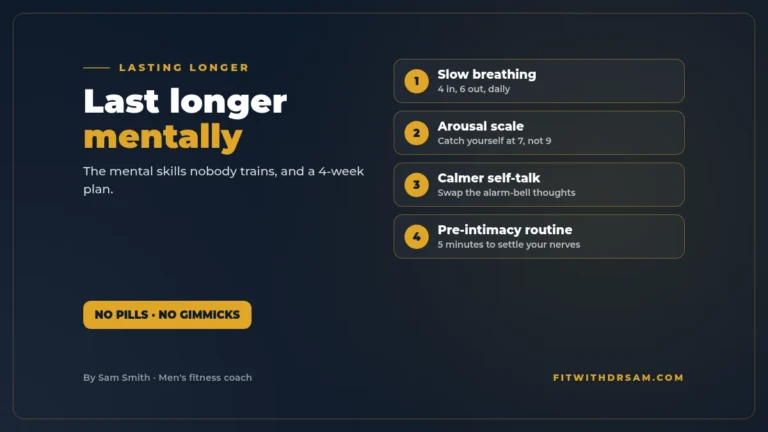
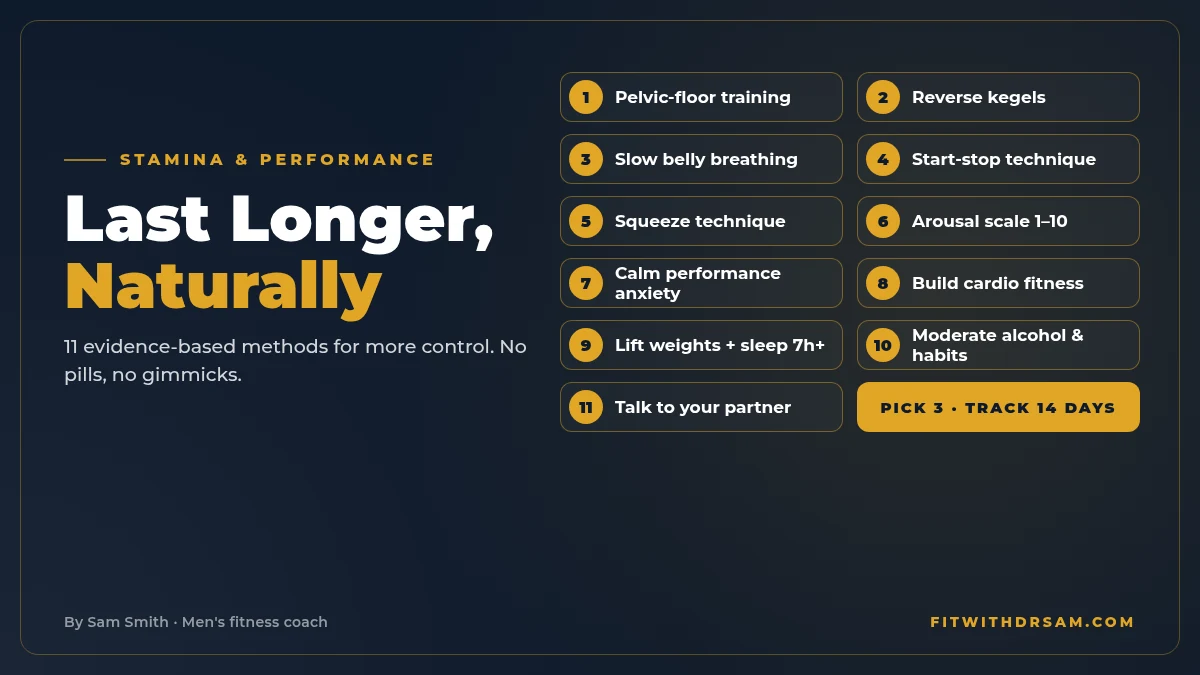
You can learn to last longer in bed without pills. For most men, ejaculatory control is a trainable skill, not a fixed trait. It’s built from four things: knowing your arousal level, keeping your nervous system calm, having a pelvic floor that can both tighten and relax, and being fit enough that your heart rate and breathing don’t run away from you. This guide walks you through 11 drug-free methods, tells you honestly how strong the evidence is for each one, and gives you a 4-week plan you can start tonight.
A quick reality check first. In a stopwatch study of 500 couples across five countries, the median time from penetration to ejaculation was 5.4 minutes (Waldinger et al., 2005). If you’re curious where you stand, read our breakdown of how long a man should last in bed. Many men who worry are closer to normal than they think. Feeling more in control still matters, though, and that’s what the methods below are for.
Key takeaways
- Lasting longer is mostly about arousal awareness and calm, not willpower.
- The best-studied drug-free methods are start-stop, the squeeze technique and pelvic-floor training.
- Slow breathing, fitness, sleep and lower anxiety support everything else.
- Expect to practice for 4 to 12 weeks. Results vary.
- If it has always happened within about a minute, or it suddenly changed, talk to a doctor.
Why it happens: arousal, anxiety, habits and pelvic-floor control
Ejaculation is a reflex. Once arousal passes a certain point (often called the “point of no return”), it runs on autopilot. Lasting longer is about noticing your arousal earlier and keeping it in the zone below that point for longer.
Four things usually speed things up more than men would like:
- High stress and anxiety. Your “fight or flight” system speeds everything up. Performance anxiety creates a loop: you worry about finishing fast, the worry raises arousal, and you finish fast. The NHS lists stress, depression, relationship problems and anxiety about sexual performance among the common psychological causes (NHS).
- Low arousal awareness. Many men only notice their arousal at 9 out of 10, when it’s too late to adjust.
- Learned habits. If you’ve spent years rushing (for example, finishing quickly to avoid being interrupted), your body has learned that speed.
- Physical factors. Prostate problems, thyroid problems and recreational drugs can all play a role (NHS), and erection worries can trigger rushing too. This is one reason it’s worth seeing a doctor if things change suddenly.
11 natural ways to last longer in bed
Each method below includes what it is, how to do it, how strong the evidence is, and how long it usually takes. Evidence grades are my plain-English summary: A = supported by clinical guidelines or controlled trials, B = some trial evidence or strong physiological reasoning, C = sensible and low-risk, but little direct research.
1. Pelvic-floor (kegel) training
Your pelvic-floor muscles sit between your tailbone and pubic bone, and they help control urination and ejaculation. To find them, squeeze as if you’re stopping yourself from passing gas, or briefly stop the flow of urine (only to identify the muscles; don’t make a habit of training while urinating, as the NIDDK advises).
How: Squeeze for 3 to 5 seconds, then fully relax for the same time. Do 10 reps, 3 times a day. Breathe normally and keep your glutes, thighs and abs loose.
Evidence: B. In a small study, 33 of 40 men (82.5%) with lifelong early ejaculation gained control after 12 weeks of pelvic-floor rehabilitation, with average time rising from about 40 seconds to about 146 seconds (Pastore et al., 2014). It had no control group, and the program was supervised, so home results may differ. Time: 6 to 12 weeks. For a full walkthrough, see our pelvic-floor guide.
2. Reverse kegels (learning to relax)
A pelvic floor that’s always tense can make control harder, not easier. Reverse kegels teach the muscles to let go.
How: Breathe in slowly through your nose and let your belly and pelvic floor gently drop and widen, like the moment you start to urinate. Don’t push or strain. Do 10 slow breaths after each kegel set.
Evidence: C. It’s widely used by pelvic-health physiotherapists, but there’s little research specific to lasting longer. Time: noticeable awareness within 1 to 2 weeks.
3. Slow diaphragmatic breathing
Slow breathing (under 10 breaths a minute) is linked to more parasympathetic, “rest and digest” activity and fewer feelings of anxiety and arousal (Zaccaro et al., 2018).
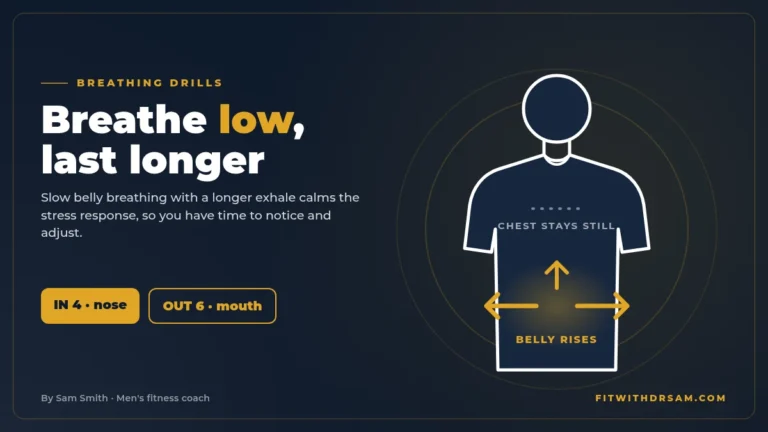
How: Breathe in through your nose for 4 seconds, letting your belly rise, then breathe out for 6 seconds. Practice for 3 to 5 minutes a day, then use 2 or 3 of these breaths whenever you feel yourself speeding up.
Evidence: B for calming stress, C for lasting longer directly. Time: calmer within days. Our guide to breathing techniques to last longer has 4 progressive drills.
Free plan
Get the 7-Day Stamina Starter
10 to 15 minutes a day: breathing, pelvic-floor basics, mobility and three short bodyweight sessions, with a tick-box tracker. No gym, no pills.
Send me the free planFree. No spam. Unsubscribe anytime.
4. The start-stop technique
This is the classic behavioral method, recommended by the NHS, MedlinePlus and Cleveland Clinic.
How: During solo practice or with a partner, build arousal until you feel you’re getting close (around 7 out of 10). Stop all stimulation for about 30 seconds until the urge fades, then start again. Repeat 3 or 4 times before allowing yourself to finish (MedlinePlus).
Evidence: A. A systematic review of 10 randomized trials found that programs using start-stop, squeeze and sensate focus improved timing compared with no treatment, although study quality was mixed (Cooper et al., 2015). Time: 4 to 12 weeks of regular practice. As the NHS puts it, these techniques “may sound simple, but they require lots of practice.”
5. The squeeze technique
How: Same as start-stop, but when you’re close, you or your partner gently squeeze the head of the penis, where it meets the shaft, for several seconds until the urge passes. Wait about 30 seconds, then continue (MedlinePlus).
Evidence: A (same review as above). Some men prefer start-stop because it’s simpler. Try both and keep the one you’ll actually use.
6. The arousal scale (1 to 10)
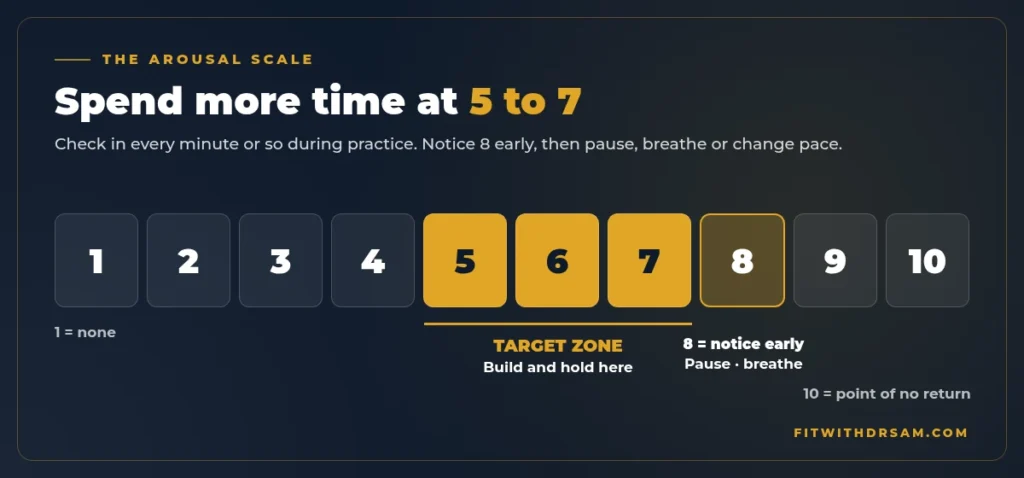
How: Rate your arousal from 1 (none) to 10 (point of no return). During practice, check in every minute or so. Your goal is to spend more time at 5 to 7 and to notice 8 early, then use a pause, a breath or a change of pace.
Evidence: C on its own, but it’s the skill that makes start-stop and squeeze work. Time: 2 to 4 weeks.
7. Manage performance anxiety
If your mind is busy with “Am I going to finish too fast?”, your body is already halfway there.
How: Shift your attention to physical sensations (touch, temperature, your breath) instead of the outcome. Make sex less “goal-based”: more touching and closeness, less pressure to perform. If performance anxiety is strong or ongoing, a psychosexual therapist can help. The NHS and EAU guidelines both include counseling as an option.
Evidence: B. European urology guidelines note that start-stop combined with education and mindfulness improves symptoms and the distress around them (EAU Guidelines).
8. Build your cardio fitness
Cardio won’t directly delay ejaculation, but it improves circulation, stress tolerance and erection quality. A meta-analysis of 11 randomized trials found aerobic exercise improved erectile-function scores, especially in men who started with more difficulty (Khera et al., 2023). That matters, because erection worries can make men rush.
How: Aim for at least 150 minutes of moderate activity a week, such as 30 minutes of brisk walking 5 days a week (CDC).
Evidence: B (indirect). Time: 6 to 12 weeks.
9. Lift weights and protect your sleep
Strength training at least 2 days a week (CDC) and 7 or more hours of sleep support energy, mood, stress control and healthy hormone levels. None of this is a quick fix, but tired, stressed men tend to have less control. Read more in our guide to increasing testosterone naturally.
Evidence: C for lasting longer directly, A for general health.
10. Moderate alcohol, nicotine and adult-content habits
A drink may seem to relax you, but heavy drinking and recreational drugs are linked to sexual problems, and the NHS lists recreational drugs as a physical cause of early ejaculation. If most of your arousal comes from fast, high-intensity adult content, your body may be trained for speed. In my coaching, one of the first changes I suggest is slowing solo practice down and using it for start-stop training instead.
Evidence: C. Low risk, and worth trying.
11. Talk to your partner
This one sounds soft, but it’s often the most powerful. When your partner knows you’re working on this, the pressure drops, practice gets easier, and you can use pauses without awkwardness. The NHS recommends involving your partner as much as possible.
How: Pick a calm moment (not in bed). Try: “I want to make things better for both of us, and I’m practicing some techniques. Can we take it slower for a few weeks?”
Evidence: B (part of most couples-based programs).
Coach’s tip from Sam
Don’t try all 11 methods at once. Pick three you’ll actually do this week (I usually suggest breathing, kegels and start-stop practice), track them for 14 days, then add more. Consistency beats intensity here, the same as in the gym.
Coaching case study: “J.”, 20
J. came to me worried that he finished too quickly, was losing confidence with women and thought his habits had “broken” something. He didn’t exercise, felt anxious most of the time and had tried numbing sprays without much success.
We kept it simple: short workouts 3 times a week, daily pelvic-floor practice, slow breathing before intimacy, better sleep and food, and dropping the guilt and pressure he’d built up. The biggest change came from consistency and a calmer mind, not from any single trick.
Details changed to protect privacy. One person’s experience; results vary. If early ejaculation is lifelong, worsening or causing distress, see a doctor.
A 4-week starter plan
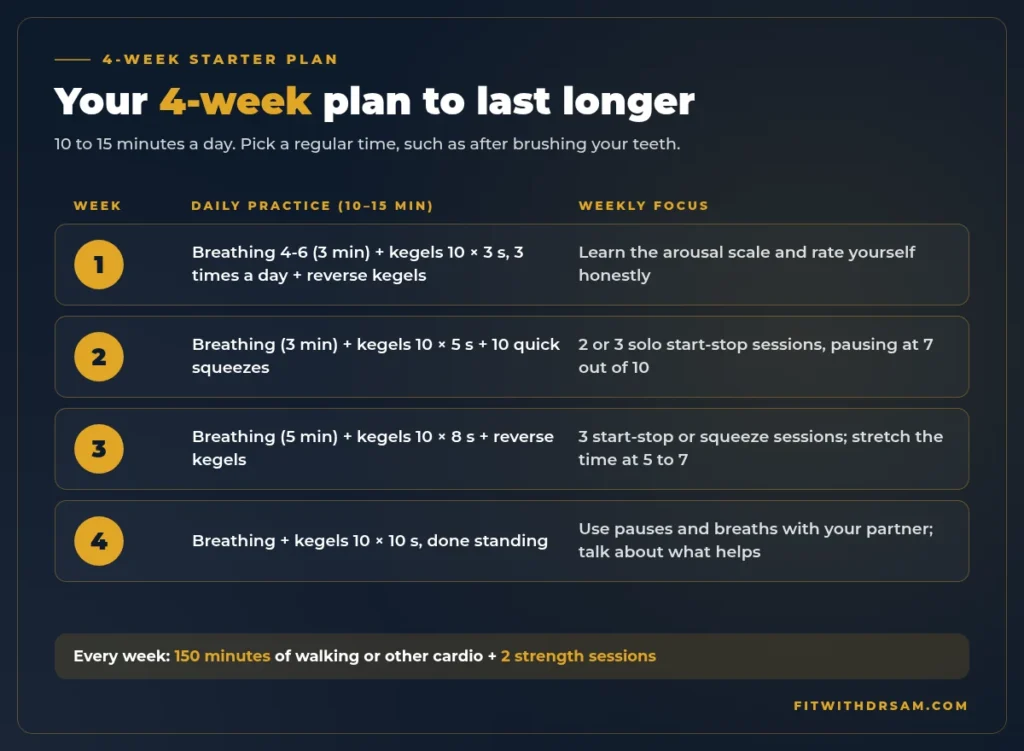
Spend 10 to 15 minutes a day. Pick a regular time, such as after brushing your teeth.
| Week | Daily practice (10 to 15 min) | Weekly focus |
|---|---|---|
| 1 | Breathing 4-6 (3 min) + kegels 10 x 3 s, 3 times a day + reverse kegels | Learn the arousal scale and rate yourself honestly |
| 2 | Breathing (3 min) + kegels 10 x 5 s + 10 quick squeezes | 2 or 3 solo start-stop sessions, pausing at 7 out of 10 |
| 3 | Breathing (5 min) + kegels 10 x 8 s + reverse kegels | 3 start-stop or squeeze sessions; stretch the time at 5 to 7 |
| 4 | Breathing + kegels 10 x 10 s, done standing | Use pauses and breaths with your partner; talk about what helps |
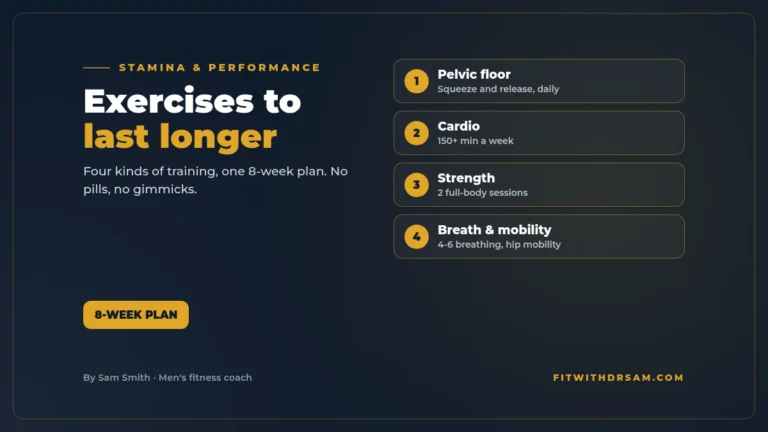
Add 150 minutes of walking or other cardio and 2 strength sessions across each week. Want a printable version with a daily checklist? The free 7-Day Stamina Starter covers week 1 for you.
What doesn’t work (or isn’t worth the risk)
- “Natural” pills sold online. The FDA warns that many “stamina” and sexual-enhancement pills are contaminated with hidden prescription-drug ingredients (FDA). Don’t take anything that hasn’t been checked by a doctor or pharmacist.
- Viral “tricks” like salt rituals or one-time hacks. There’s no evidence for them.
- Numbing sprays and creams without advice. These are real treatments, but they can reduce sensation for both partners. Talk to a pharmacist or doctor before you use one.
- Trying to “think about something else” the whole time. Brief distraction can help, but disconnecting from sensation makes it harder to learn your arousal levels.
When to see a doctor
Self-help is a good first step, but book an appointment with your doctor (GP in the UK) or a urologist if:
- it has almost always happened within about a minute since your first sexual experiences and it distresses you or your partner
- it started suddenly after years without problems
- you also have erection problems, pain, blood in your semen, or urinary symptoms
- you feel anxious or low most days, or it’s affecting your relationship
- you’ve started a new medication and noticed changes
- nothing has improved after about 3 months of regular practice
Doctors see this every day. There are effective treatments, and a quick check can rule out problems such as thyroid or prostate issues.
Go deeper
- How long should a man last in bed? What the research says
- Breathing techniques to last longer in bed: 4 drills
- The pelvic-floor guide for men
If you want a complete, structured program, my book Increase Stamina in Bed brings these methods together with training routines, breathing and pelvic-floor practice, and confidence work. It has 94 five-star reviews on Gumroad. Results vary, and it’s education, not medical treatment.
Frequently asked questions
Can you train yourself to last longer in bed?
Yes, for most men. Ejaculatory control is largely a learned skill. Methods like start-stop practice, the squeeze technique and pelvic-floor training are supported by clinical guidance and trials, and they work best with regular practice over 4 to 12 weeks. Results vary from person to person.
Do kegels help you last longer?
They can. In a small study, 33 of 40 men with lifelong early ejaculation gained control after 12 weeks of supervised pelvic-floor rehabilitation. Kegels work best when you also learn to relax the muscles (reverse kegels) and combine them with arousal-awareness practice.
How long does it take to last longer naturally?
Most men notice calmer, more controlled responses within 2 to 4 weeks of daily breathing and start-stop practice. Pelvic-floor strength usually takes 6 to 12 weeks. If nothing improves after about 3 months of consistent practice, talk to a doctor.
Does ejaculating earlier in the day help you last longer?
For some men, yes. The NHS lists ejaculating on your own an hour or two before sex as one of the things you can try yourself. It doesn’t build long-term control, so use it alongside training methods rather than instead of them.
Do numbing sprays or thicker condoms work?
They can reduce sensitivity, and the NHS mentions both as options. Numbing products can transfer to a partner and reduce sensation for both of you, so ask a pharmacist or doctor before using them.
When should I see a doctor about finishing too fast?
See a doctor if it has almost always happened within about a minute since your first sexual experiences and it bothers you, if it started suddenly after years without problems, or if you also have pain, erection problems, urinary symptoms or low mood.
Bestseller · ★ 5.0 from 94 reviews on Gumroad
Increase Stamina in Bed
My complete 30-day stamina and confidence program: a 111-page guide (PDF + EPUB) with 9 bonus files and 3 videos. It covers training routines, breathing and pelvic-floor practice, energy habits and how to stay present instead of anxious. Practical, drug-free and non-explicit.
Get the book on GumroadResults vary. Educational content, not a medical treatment.
References
- Waldinger MD, Quinn P, Dilleen M, et al. A multinational population survey of intravaginal ejaculation latency time. J Sex Med. 2005;2(4):492-497. PubMed
- NHS. Ejaculation problems. Read online
- NIDDK (National Institutes of Health). Kegel exercises. Read online
- Pastore AL, Palleschi G, Fuschi A, et al. Pelvic floor muscle rehabilitation for patients with lifelong premature ejaculation: a novel therapeutic approach. Ther Adv Urol. 2014;6(3):83-88. PubMed Central
- Zaccaro A, Piarulli A, Laurino M, et al. How breath-control can change your life: a systematic review on psycho-physiological correlates of slow breathing. Front Hum Neurosci. 2018;12:353. PubMed Central
- MedlinePlus (U.S. National Library of Medicine). Premature ejaculation. Read online
- Cooper K, Martyn-St James M, Kaltenthaler E, et al. Behavioral therapies for management of premature ejaculation: a systematic review. Sex Med. 2015;3(3):174-188. PubMed Central
- European Association of Urology. EAU Guidelines on Sexual and Reproductive Health: Disorders of ejaculation. Read online
- Khera M, Bhattacharyya S, Miller LE. Effect of aerobic exercise on erectile function: systematic review and meta-analysis of randomized controlled trials. J Sex Med. 2023;20(12):1369-1375. PubMed
- CDC. Adult activity: an overview (Physical Activity Guidelines). Read online
- U.S. Food and Drug Administration. Sexual enhancement and energy product notifications. Read online
All links checked October 10, 2026.