Kegel Exercises for Men: How to Find, Train and Relax Your Pelvic Floor

Educational content, not medical advice. This article is general information from a fitness coach. It’s not a diagnosis or treatment. If you have a health concern, see a doctor. See “When to see a doctor” below.
Your pelvic floor is a hammock of muscles at the base of your pelvis. In men it supports the bladder and bowel, helps you stay dry, and plays a direct part in erections and ejaculation. Training it with Kegel exercises is one of the simplest, best-studied things a man can do for bladder control and sexual performance, and it takes about 10 minutes a day. This guide shows you how to find the right muscles, a 6-week Kegel plan for men, the mistakes to avoid, and why learning to relax the pelvic floor matters just as much. It’s part of our complete guide to lasting longer in bed naturally.
Key takeaways
- The pelvic floor helps control urine, erections and ejaculation. In men it’s often weak and tense at the same time.
- Find the muscles by imagining you’re holding in wind and stopping urine at once. Your testicles should lift slightly.
- Start with 3 sets of 10 squeezes a day, holding 3 to 5 seconds, and build up to 10 seconds over 6 weeks.
- Studies show benefits for erections, ejaculatory control and urine leaks, usually after 6 to 12 weeks.
- Always relax fully between squeezes, and pair Kegels with reverse kegels if you tend to clench.
What is the pelvic floor in men?
The pelvic floor is a group of muscles that stretches from your pubic bone at the front to your tailbone at the back, and between your sit bones on each side. Three things matter for men:
- Bladder and bowel control. The muscles wrap around the urethra and back passage and squeeze to keep them closed.
- Erections. Muscles at the base of the penis (the bulbocavernosus and ischiocavernosus) contract to help trap blood and keep an erection firm.
- Ejaculation. The same muscles contract rhythmically during ejaculation, so better awareness and control can help you manage arousal.
The pelvic floor also works as a team with your deep abs, your diaphragm and your back muscles. That’s why breathing and posture affect it, and why it’s part of a strong core.
Why pelvic-floor training matters for men
Most men never think about these muscles until something goes wrong. Here’s what the research supports:
- Better erections. In a randomised trial of 55 men with erection problems, 40% regained normal erectile function and another 35.5% improved after 6 months of pelvic-floor exercises (with biofeedback and lifestyle advice).
- More ejaculatory control. In a small study, 33 of 40 men (82.5%) with lifelong early ejaculation gained control after 12 weeks of pelvic-floor rehabilitation.
- Fewer leaks. Pelvic-floor training is a first-line treatment for urine leaks and after-dribble, and is routinely used before and after prostate surgery. See the NHS guide to urinary incontinence.
- A stronger core. A pelvic floor that switches on at the right time supports your lower back during lifting and sport.
Trouble with control in bed? Pelvic-floor work is one of the methods in our guide on how long a man should last and what to do about it.
How to find your pelvic floor muscles
This is the step most men get wrong, so take a minute here. Cleveland Clinic and the NIH suggest these cues:
- Sit or lie down comfortably and let your belly, buttocks and thighs go soft.
- Imagine you’re trying to stop yourself passing wind. Gently squeeze and lift the muscles around your back passage.
- At the same time, imagine stopping the flow of urine. You should feel the base of your penis draw in and your testicles lift slightly.
- Hold for 2 to 3 seconds, then let go completely and feel the muscles drop back down.
Checks: your breathing keeps going, your buttocks don’t clench, your belly doesn’t push out, and you aren’t squeezing your thighs together. A mirror helps: when you contract correctly, the base of your penis moves slightly in and up.
Don’t train by stopping your urine
Stopping your stream once to find the muscles is fine. Doing it regularly can stop your bladder emptying properly and raise the risk of infection, so the NIH advises against using it as an exercise.

How to do Kegel exercises (step by step)
- Get set. Start lying on your back with knees bent. It’s the easiest position to feel the muscles.
- Breathe out and squeeze. As you exhale, tighten and lift your pelvic floor as described above.
- Hold for 3 to 5 seconds while breathing normally.
- Relax fully for the same amount of time, or longer. The release is part of the exercise.
- Repeat 10 times. Finish with 5 to 10 quick 1-second squeezes and releases.
That’s one set. Do 3 sets a day, for example morning, afternoon and evening. As you get stronger, progress from lying down to sitting and then standing, which is harder because the muscles work against gravity. Urologists also recommend practising “the knack”: a quick squeeze just before you cough, sneeze or lift something heavy.
A 6-week Kegel plan for men
| Week | Position | Hold / relax | Daily volume |
|---|---|---|---|
| 1 | Lying down | 3 s / 3 s | 3 sets of 10, plus 5 quick squeezes |
| 2 | Lying down | 5 s / 5 s | 3 sets of 10, plus 5 quick squeezes |
| 3 | Sitting | 5 s / 5 s | 3 sets of 10, plus 10 quick squeezes |
| 4 | Sitting | 8 s / 8 s | 3 sets of 10, plus 10 quick squeezes |
| 5 | Standing | 8 s / 8 s | 3 sets of 10, plus 10 quick squeezes; start using “the knack” |
| 6 | Standing and walking | 10 s / 10 s | 3 sets of 10, plus 10 quick squeezes |
After week 6, keep one or two sets a day as maintenance. If you can’t hold for the full time, hold for as long as you can with good form. Quality beats quantity.
Free plan
Get the 7-Day Stamina Starter
10 to 15 minutes a day: breathing, pelvic-floor basics, mobility and three short bodyweight sessions, with a tick-box tracker. No gym, no pills.
Send me the free planFree. No spam. Unsubscribe anytime.
Don’t forget the release: reverse kegels
Many men, especially those who sit a lot, lift heavy or carry stress in their body, have a pelvic floor that is tight rather than weak. Squeezing more won’t fix that. Signs include pelvic or perineal aching, a slow or hesitant stream, needing to strain, or finishing too fast when you’re tense. A tight pelvic floor can also be linked to chronic pelvic pain, which needs a doctor’s check.
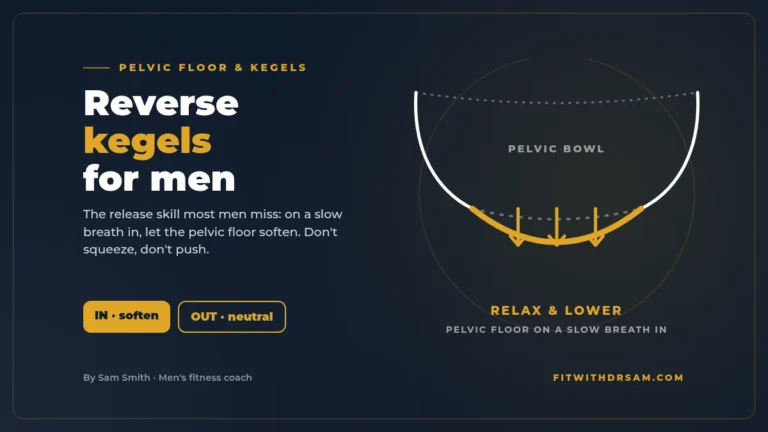
Reverse kegels teach the opposite skill: on a slow breath in, you let the pelvic floor soften and drop slightly. Learn them step by step in our guide to reverse kegels for men, and pair them with the breathing techniques to last longer. Control means being able to squeeze and let go.
4 exercises that support your pelvic floor
Once you can do a clean Kegel, add these to your workouts 2 to 3 times a week. Gently engage your pelvic floor on the effort and relax it on the way back.
1. Glute bridge
Lie on your back, knees bent, feet hip-width apart. Breathe out, lightly lift your pelvic floor and press through your heels to raise your hips until your body is in a straight line from shoulders to knees. Hold 3 seconds, lower slowly. 2 sets of 10.

2. Bodyweight squat
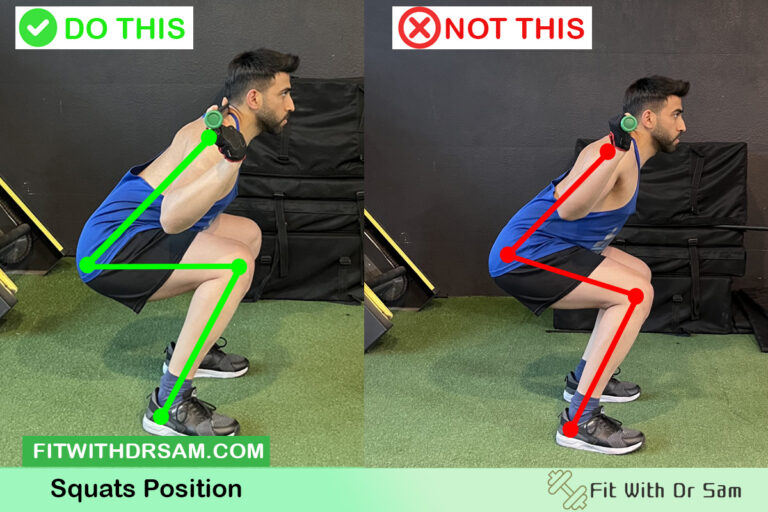
Stand with feet shoulder-width apart. Sit back and down with your chest up, then breathe out and drive up through your whole foot, lightly lifting your pelvic floor as you stand. 2 sets of 10 to 15.
3. Bird dog
On hands and knees, reach your right arm forward and left leg back while keeping your back flat. Hold 5 seconds while breathing, then switch. 2 sets of 8 per side. This trains the pelvic floor with your deep core.

4. Dead bug
Lie on your back with arms up and knees bent at 90 degrees. Breathe out and slowly lower the opposite arm and leg towards the floor without arching your back, then return. 2 sets of 8 per side.
Want more core work? See our guide to building abs and a six-pack, or the equipment-free home workout.
Common Kegel mistakes
- Squeezing the wrong muscles: clenching your buttocks, thighs or belly instead of lifting the pelvic floor.
- Holding your breath. Keep breathing throughout every squeeze.
- Pushing down instead of lifting. A Kegel lifts and draws in. Bearing down is the opposite.
- Not relaxing between reps. Always let go fully, for at least as long as you squeezed.
- Doing too much too soon. Hundreds of squeezes a day can leave the muscles tight and sore.
- Giving up after a week. Most men need 4 to 6 weeks to notice a change.
Tips for long-term pelvic-floor health
- Stay at a healthy weight. Extra belly fat puts constant pressure on the pelvic floor. Our guide to increasing testosterone naturally covers fat loss, training and sleep together.
- Avoid straining on the toilet. Eat enough fibre and drink enough water.
- Breathe out on the effort when you lift, rather than holding your breath on every rep.
- Get up and move every 30 to 60 minutes if you sit for work. Drivers, see our guide to prostate health for driving jobs.
- Keep moving: walking, cycling (with a well-fitted saddle) and strength training all help.
When to see a doctor
Kegels are safe for most men, but see your doctor (GP in the UK, Hausarzt in Germany), a urologist or a pelvic-health physiotherapist if you have:
- Urine leaks, a weak or interrupted stream, or needing to go urgently or often
- Pain in your pelvis, perineum, testicles, penis or lower back, or pain when you ejaculate
- Blood in your urine or semen
- Erection problems or very early ejaculation that keep happening or cause distress
- Recent prostate or pelvic surgery (ask your care team for a supervised programme)
A specialist physiotherapist can check your technique and tailor the plan. The NHS also has guidance on ejaculation problems.
Frequently asked questions
Do Kegel exercises work for men?
Yes. Pelvic-floor training is a standard first-line treatment for men with urine leaks, including after prostate surgery. Small trials also show benefits for erections and ejaculatory control: in one study, 40% of men with erection problems regained normal function after 6 months of pelvic-floor exercises, and in another, 33 of 40 men with lifelong early ejaculation gained control after 12 weeks.
How do I find my pelvic floor muscles as a man?
Imagine you’re trying to stop yourself passing wind and, at the same time, stop the flow of urine. The muscles that tighten and lift are your pelvic floor. Your penis should pull in slightly and your testicles lift. Your buttocks, thighs and belly should stay relaxed. Don’t practise by stopping your urine flow regularly; use it only once to find the muscles.
How many Kegels should a man do a day?
A common starting point is 3 sets a day of 10 squeezes, holding each for 3 to 5 seconds with equal rest. Build up to 10-second holds over several weeks, and add a few fast 1-second squeezes at the end of each set.
How long does it take for Kegels to work for men?
Most men notice better control in 4 to 6 weeks of daily practice, with bigger changes by about 3 months. Keep going after that, because the benefits fade if you stop completely.
Can you do too many Kegels?
Yes. Over-training or squeezing all day can leave the muscles tight and tired, which can cause pelvic pain, urgency or a weak stream. Stick to the plan, always relax fully between reps, and add reverse kegels if you tend to clench.
The bottom line
Your pelvic floor is a small muscle group with a big job: bladder control, erections, ejaculatory control and core stability. Learn to find it, train it for about 10 minutes a day with the 6-week plan, and always relax fully between squeezes. Add reverse kegels and slow breathing if you tend to be tense. Most men feel a difference in 4 to 6 weeks.
Next step: get the free 7-Day Stamina Starter, or read the full guide to lasting longer in bed naturally.
Bestseller · ★ 5.0 from 94 reviews on Gumroad
Increase Stamina in Bed
My complete stamina and confidence program in a 52-page ebook, with bonus guides and videos. It covers pelvic-floor strength and release, breathing and arousal-control drills, training routines and how to stay present instead of anxious. Practical, drug-free and non-explicit.
Get the book on GumroadResults vary. Educational content, not a medical treatment.
References
- National Institute of Diabetes and Digestive and Kidney Diseases (NIH). Kegel exercises. Read online
- Cleveland Clinic. Kegel exercises for men: benefits and how to do them. Read online
- Memorial Sloan Kettering Cancer Center. Pelvic floor muscle (Kegel) exercises for males. Read online
- Siegel AL. Pelvic floor muscle training in males: practical applications. Urology. 2014;84(1):1-7. PubMed
- Dorey G, Speakman MJ, Feneley RCL, et al. Pelvic floor exercises for erectile dysfunction. BJU Int. 2005;96(4):595-597. PubMed
- Pastore AL, Palleschi G, Fuschi A, et al. Pelvic floor muscle rehabilitation for patients with lifelong premature ejaculation: a novel therapeutic approach. Ther Adv Urol. 2014;6(3):83-88. PubMed Central
- NHS. Urinary incontinence. Read online
- NHS. Ejaculation problems. Read online
- NHS. Prostatitis. Read online
All links checked October 10, 2026.