Breathing Techniques to Last Longer in Bed: 4 Drills That Calm Arousal
Educational content, not medical advice. This article is general information from a fitness coach. It’s not a diagnosis or treatment. If you have a health concern, see a doctor. See “When to see a doctor” below.
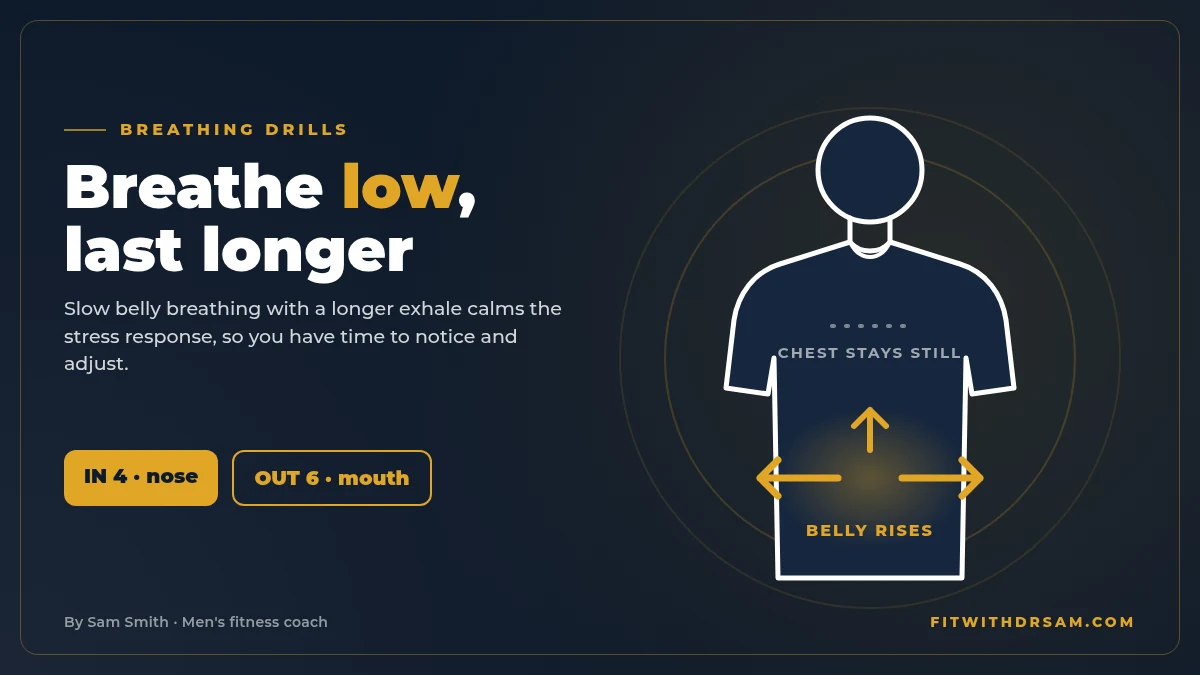
Breathing techniques can help you last longer in bed because they work on the thing that speeds you up most: a stressed, over-aroused nervous system. Slow breathing with a longer exhale shifts your body toward “rest and digest” mode, which gives you more time to notice your arousal and adjust. Breathing works best as part of a bigger plan. Our complete guide to lasting longer naturally covers the other pieces. Below are 4 simple drills, a 7-day practice plan, and an honest look at what the research does and doesn’t show.
Key takeaways
- Slow breathing (under 10 breaths a minute) is linked to calmer, less anxious states.
- The key is a longer exhale than inhale, through a relaxed belly.
- Practice when you’re calm first, so it works automatically when you need it.
- Combine it with start-stop practice and pelvic-floor relaxation for the best results.
- There are few studies on breathing for lasting longer specifically, so treat it as a support skill.
Why breathing affects how long you last
Your nervous system has two main modes. The sympathetic system (“fight or flight”) raises your heart rate and tension. The parasympathetic system (“rest and digest”) slows things down. Arousal involves both, but anxiety, shallow chest breathing and tension push you toward the fast lane, and toward finishing sooner.
A systematic review of slow-breathing studies found that breathing at fewer than 10 breaths a minute increased heart rate variability (a marker of parasympathetic activity) and was linked to more relaxation and fewer feelings of anxiety and arousal (Zaccaro et al., 2018). Harvard Health and the NHS both recommend breath control as a way to calm the stress response (Harvard Health, NHS).
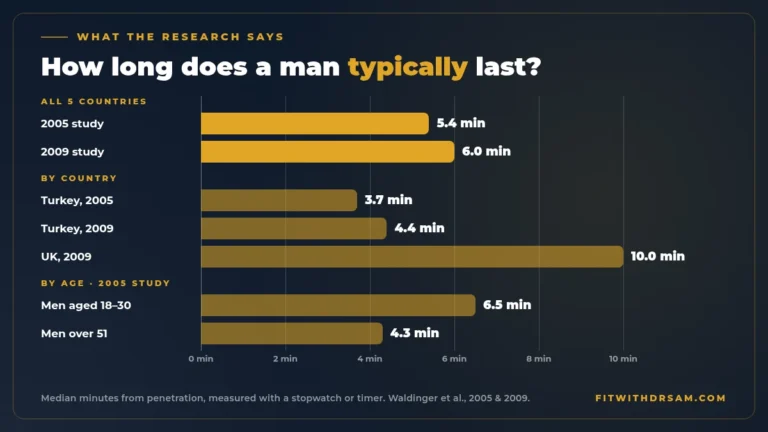
The honest part: there are very few trials testing breathing alone for lasting longer. The strongest evidence is for behavioral methods like start-stop practice (Cooper et al., 2015). Breathing is the tool that makes those methods easier, because it keeps you calm enough to notice your arousal and pause in time.
There’s also a physical link. When you hold your breath or breathe into your chest, you tend to brace your abs, glutes and pelvic floor. A relaxed belly breath lets that tension go.
Drill 1: Diaphragmatic belly breathing (3 minutes)
This is the foundation. Do it lying down at first (Cleveland Clinic).
- Lie on your back with your knees bent. Put one hand on your chest and one just below your ribs.
- Breathe in slowly through your nose so your lower hand rises. Your chest hand should barely move.
- Breathe out gently through slightly pursed lips and feel your belly fall.
- Continue for 3 minutes. Don’t force it. Comfortable is the goal.
Common mistakes: lifting your shoulders, sucking your stomach in on the inhale, or breathing too deeply and feeling dizzy. If you feel lightheaded, return to normal breathing.
Drill 2: 4-6 breathing (longer exhale)
Once belly breathing feels natural, lengthen the exhale. This is the same drill as Day 1 of our free 7-Day Stamina Starter.
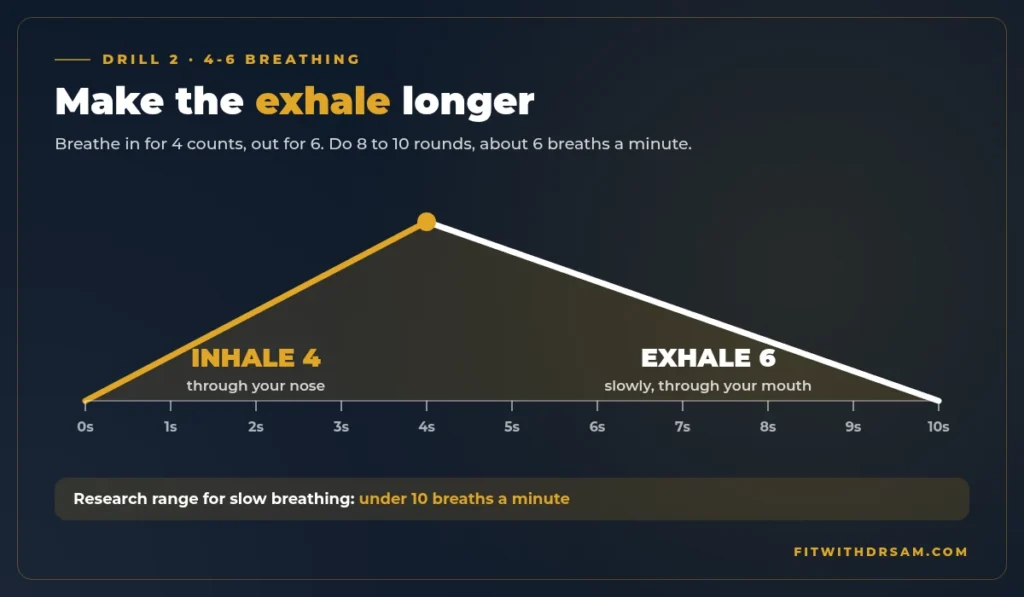
- Breathe in through your nose for 4 counts, letting your ribs widen to the sides.
- Breathe out through your mouth for 6 counts, slowly and smoothly.
- Do 8 to 10 rounds. That’s about 6 breaths a minute.
Why it works: 4-6 breathing gives you about 6 breaths a minute, well inside the slow-breathing range (under 10 a minute) studied in research. Making the exhale the longer half keeps the pace slow without straining.
Drill 3: Breath ladder with pelvic-floor release
This drill connects your breathing to your pelvic floor, which is where many men hold tension without noticing.
- Sit or lie comfortably.
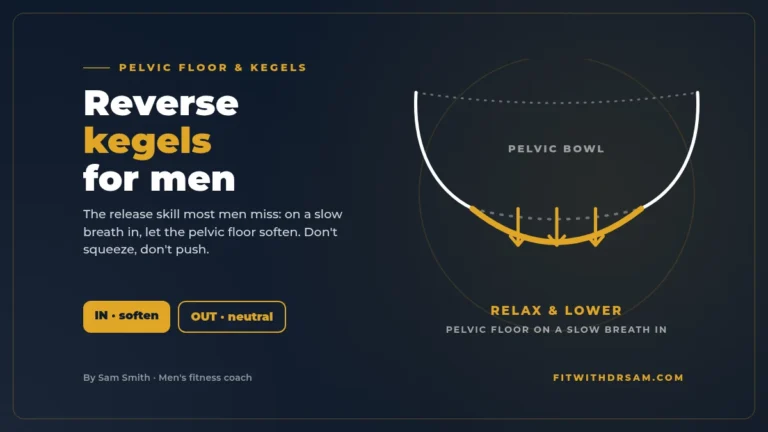
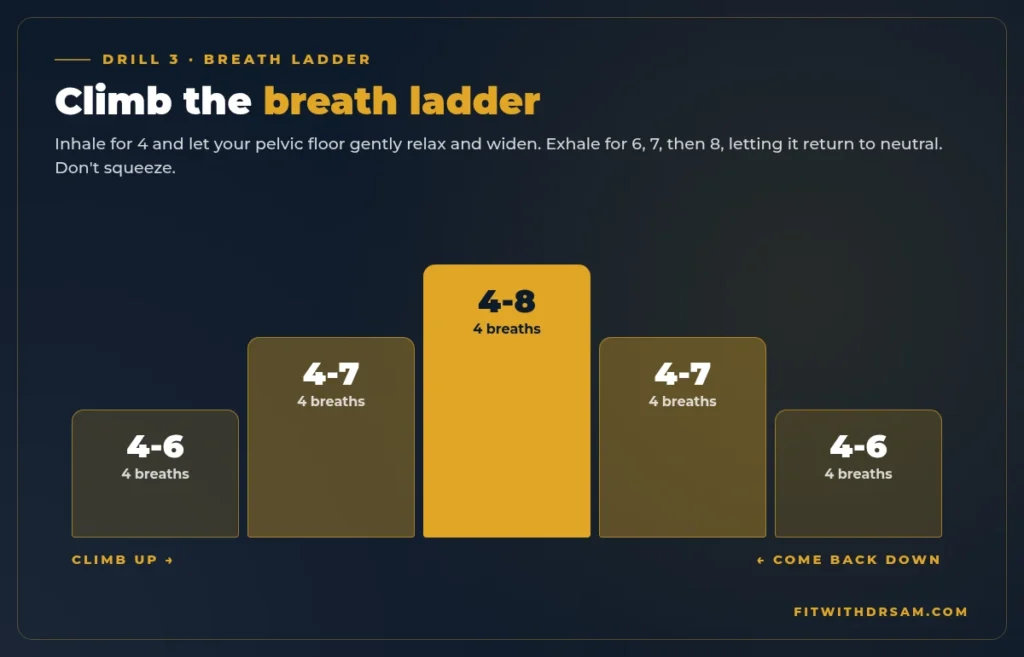
- Inhale (4 counts): let your belly expand and your pelvic floor gently drop and widen, as if you were starting to urinate. This is a “reverse kegel.” Don’t push.
- Exhale (6 counts): let your pelvic floor return to neutral. Don’t squeeze.
- Climb the ladder: 4 breaths at 4-6, then 4 at 4-7, then 4 at 4-8. Then come back down.
If you also train kegels, this drill balances them. Strength is only half of control. The ability to relax on demand is the other half. Our pelvic-floor guide explains both.
Free plan
Get the 7-Day Stamina Starter
10 to 15 minutes a day: breathing, pelvic-floor basics, mobility and three short bodyweight sessions, with a tick-box tracker. No gym, no pills.
Send me the free planFree. No spam. Unsubscribe anytime.
Drill 4: The in-the-moment reset
This is the drill you actually use during intimacy. It takes about 10 to 20 seconds.
- Pause or slow down as soon as you notice your arousal at around 7 out of 10.
- Take one long exhale through your mouth, longer than feels natural.
- Drop your shoulders and unclench your jaw.
- Soften your belly and pelvic floor. Let go, don’t squeeze.
- Take 1 or 2 more slow breaths, then continue at a slower pace.
It may feel awkward at first. That’s normal. Practice it during solo sessions before you use it with a partner. Telling your partner what you’re working on makes pauses feel natural instead of strange.
A 7-day breathing practice plan
| Day | Practice (5 to 10 min) | Focus |
|---|---|---|
| 1 | Drill 1 (3 min) + Drill 2 (8 rounds) | Belly rises, chest stays still |
| 2 | Drill 1 + Drill 2 (10 rounds) | Smooth, quiet exhale |
| 3 | Drill 2 + Drill 3 (one ladder) | Feel the pelvic floor relax on the inhale |
| 4 | Drill 2 + Drill 3 (two ladders) | Notice where you hold tension during the day |
| 5 | Drill 3 + practice Drill 4 five times | Reset in under 20 seconds |
| 6 | Drill 2 before a solo start-stop session; use Drill 4 at each pause | Pause at 7 out of 10 |
| 7 | Repeat Day 6, or practice with your partner | Stay present, not on the clock |
After day 7, keep 3 to 5 minutes of Drill 2 daily and use Drill 4 whenever you need it.
Combine breathing with start-stop practice
Breathing alone helps you stay calm. Breathing plus start-stop practice teaches your body a new pattern. When you pause during start-stop practice (as the NHS and MedlinePlus describe), use Drill 4. Over time, many men find they need fewer and shorter pauses. The full method is in our guide to lasting longer naturally, and if you’re wondering what’s normal, read how long a man should last in bed.
Breathing for performance anxiety
If your main issue is nerves rather than physical sensitivity, breathing is even more useful. Use Drill 2 for 2 minutes before intimacy and Drill 4 whenever your mind starts racing. If anxiety is constant, or affects other parts of your life, talk to your doctor or a therapist. You don’t have to manage it alone.
For a structured program that combines breathing, pelvic-floor practice, training and confidence work, see my book Increase Stamina in Bed.
When to see a doctor
Self-help is a good first step, but book an appointment with your doctor (GP in the UK) or a urologist if:
- it has almost always happened within about a minute since your first sexual experiences and it distresses you or your partner
- it started suddenly after years without problems
- you also have erection problems, pain, blood in your semen, or urinary symptoms
- you feel anxious or low most days, or it’s affecting your relationship
- you’ve started a new medication and noticed changes
- nothing has improved after about 3 months of regular practice
Doctors see this every day. There are effective treatments, and a quick check can rule out problems such as thyroid or prostate issues.
Frequently asked questions
Can breathing really help you last longer?
It can help, mainly by lowering anxiety and tension so you can notice your arousal and pause in time. Slow breathing is linked to calmer, less aroused states, but there are few trials on breathing alone for lasting longer, so combine it with start-stop practice and pelvic-floor work.
What is the best breathing technique to last longer in bed?
Slow belly breathing with a longer exhale, such as breathing in for 4 counts and out for 6, is the easiest to learn and use. During intimacy, a single long exhale while you relax your shoulders, jaw and pelvic floor works as a quick reset.
Should I breathe through my nose or my mouth?
Breathing in through your nose helps keep the breath slow and low in your belly. Breathing out through your mouth, gently, makes a long exhale easier. Use whatever keeps you relaxed and quiet.
How long does it take for breathing exercises to work?
Many people feel calmer within a few minutes of slow breathing. To use it automatically during intimacy, practice daily for at least 1 to 2 weeks, starting when you’re relaxed.
Does breathing help with performance anxiety?
Yes, it’s one of the simplest tools for nerves. Two minutes of slow 4-6 breathing beforehand and a long exhale whenever your mind starts racing can help. If anxiety is constant or affects daily life, talk to a doctor or therapist.
Bestseller · ★ 5.0 from 94 reviews on Gumroad
Increase Stamina in Bed
My complete 30-day stamina and confidence program: a 111-page guide (PDF + EPUB) with 9 bonus files and 3 videos. It covers training routines, breathing and pelvic-floor practice, energy habits and how to stay present instead of anxious. Practical, drug-free and non-explicit.
Get the book on GumroadResults vary. Educational content, not a medical treatment.
References
- Zaccaro A, Piarulli A, Laurino M, et al. How breath-control can change your life: a systematic review on psycho-physiological correlates of slow breathing. Front Hum Neurosci. 2018;12:353. PubMed Central
- Harvard Health Publishing. Relaxation techniques: breath control helps quell errant stress response. Read online
- NHS. Breathing exercises for stress. Read online
- Cooper K, Martyn-St James M, Kaltenthaler E, et al. Behavioral therapies for management of premature ejaculation: a systematic review. Sex Med. 2015;3(3):174-188. PubMed Central
- Cleveland Clinic. Diaphragmatic breathing. Read online
- NHS. Ejaculation problems. Read online
- MedlinePlus (U.S. National Library of Medicine). Premature ejaculation. Read online
All links checked October 10, 2026.