Reverse Kegels for Men: How to Do Them and When You Need Them
Educational content, not medical advice. This article is general information from a fitness coach. It’s not a diagnosis or treatment. If you have a health concern, see a doctor. See “When to see a doctor” below.
A reverse kegel is the opposite of a regular kegel. Instead of squeezing and lifting your pelvic-floor muscles, you gently relax and lower them as you breathe. It’s a release skill, not a push. Men use it to undo constant tension, to stay looser and calmer during intimacy, and to balance out strength work. This guide shows you how to do it, who needs it most, and how it fits into our complete guide to lasting longer in bed naturally.
Key takeaways
- A reverse kegel is a gentle, controlled release of the pelvic floor, timed with a slow breath. Never strain or bear down hard.
- It matters most for men whose pelvic floor is often tight: desk workers, heavy lifters, anxious “clenchers” and men who do lots of kegels without rest.
- Strength (kegels) and release (reverse kegels) work together. Real control means you can do both.
- Start with 5 minutes once or twice a day, lying down. Many men feel the movement within 1 to 2 weeks.
- Pelvic pain, or urinary or bowel symptoms, are a reason to see a doctor or pelvic-health physical therapist first.
What is a reverse kegel?
Your pelvic floor is a sling of muscles at the base of your pelvis, running from your pubic bone to your tailbone. It supports your bladder and bowel, helps with continence, and plays a part in erections and ejaculation.
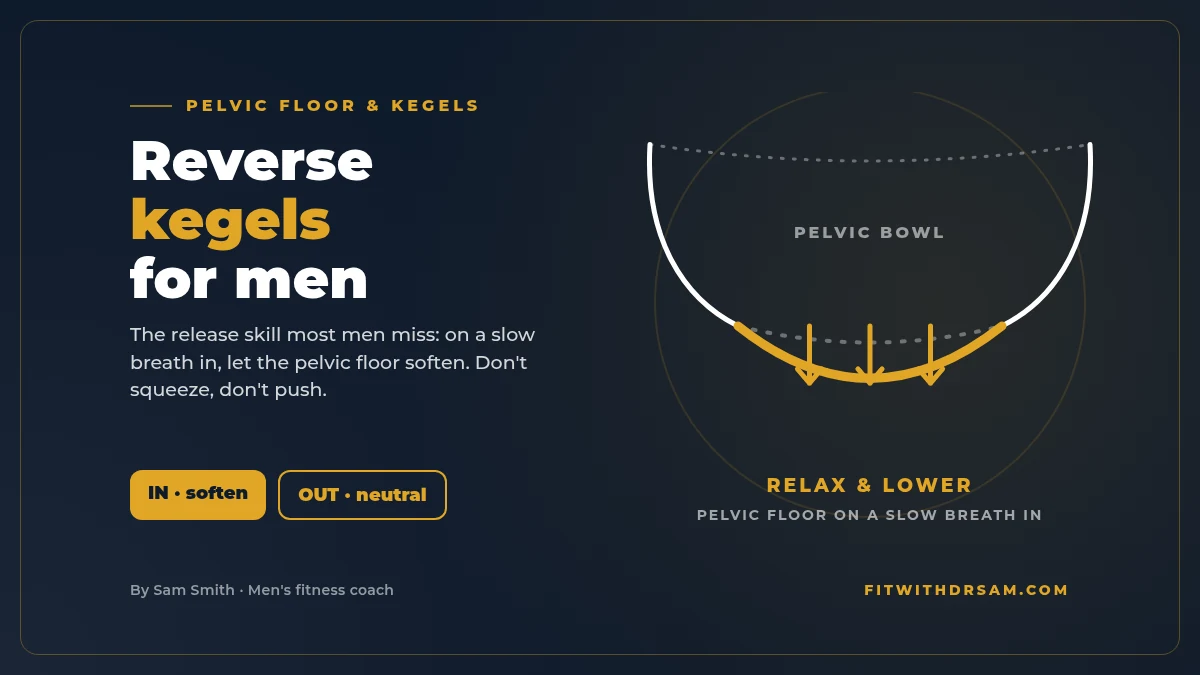
A regular kegel contracts these muscles: you squeeze as if stopping the flow of urine or holding in gas, and lift slightly up and in (Cleveland Clinic). A reverse kegel does the opposite. You let the same muscles soften, widen and drop slightly. Done right, it feels subtle: a sense of space and heaviness at the base of your pelvis, not effort.
Think of your biceps. A strong arm can curl a weight, but it also needs to straighten fully. A pelvic floor that can only squeeze, or that never fully lets go, isn’t well controlled.
Reverse kegels vs regular kegels
| Regular kegel | Reverse kegel | |
|---|---|---|
| What happens | Muscles squeeze, lift up and in | Muscles relax, lengthen and lower slightly |
| Breathing | Breathe normally; many people squeeze on the exhale | Slow belly breath; the release rides on the breath |
| Feels like | Stopping urine or holding in gas | A gentle letting go, like the moment just before you start to urinate, without pushing |
| Main goal | Strength and endurance | Relaxation, coordination, letting go of tension |
| Best for | A weak or under-active pelvic floor | A tight or over-active pelvic floor, men who clench |
| Common mistake | Squeezing glutes, abs or thighs | Pushing or straining like a bowel movement |
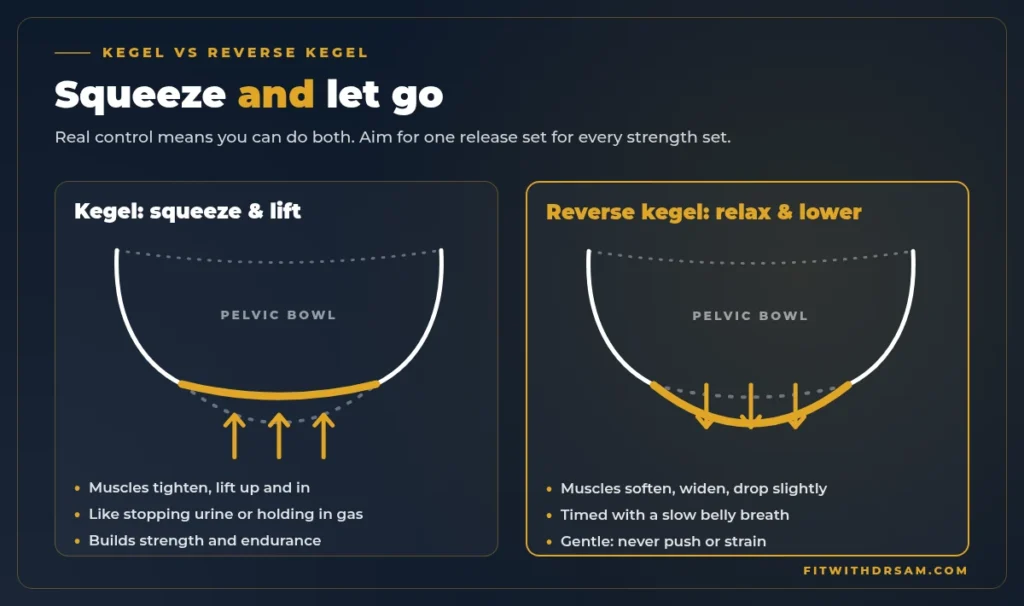
For most men, the answer isn’t “one or the other” but “both, in the right ratio”. Even standard kegel instructions build the release in: Cleveland Clinic suggests squeezing for about 5 seconds and then relaxing for 5 seconds, and Memorial Sloan Kettering tells men to “slowly and completely relax” after every hold (Cleveland Clinic, MSKCC). The relaxation is part of the exercise, not a break from it.
Who needs reverse kegels most?
The men who benefit most from learning to release are rarely the ones who expect it. They usually think they need more squeezing. Signs your pelvic floor may be holding too much tension include:
- You sit for long hours, drive a lot, or brace your stomach all day out of habit.
- You lift heavy and hold your breath on big lifts like squats and deadlifts, or you do lots of kegels without rest.
- You carry stress in your body: a clenched jaw, tight shoulders, shallow chest breathing.
- You tense your legs and glutes during intimacy, and your arousal climbs very fast.
- You notice a weak or hesitant urine stream, a feeling of not emptying fully, or discomfort after sitting. These need a medical check first (see “When to see a doctor” below).
Doctors and physical therapists take pelvic-floor tension seriously. In a multicenter trial of people with chronic pelvic pain, 57% responded to hands-on pelvic-floor physical therapy aimed at releasing tight muscles, compared with 21% who received general massage (FitzGerald et al., 2009). Sheffield Teaching Hospitals in the UK gives men with pelvic pain a reverse kegel leaflet for a simple reason: muscles that are held tense for long periods become uncomfortable, and learning to let go helps (Sheffield Teaching Hospitals NHS).
Can reverse kegels help you last longer?
Here’s the honest answer. Most research on pelvic-floor training for ejaculatory control has tested strength and coordination programs, not reverse kegels on their own. In one 12-week pelvic-floor rehabilitation study, 33 of 40 men with lifelong early ejaculation gained better control, though there was no comparison group (Pastore et al., 2014). A 2026 review of 5 randomized trials found that pelvic-floor training on its own had smaller effects than some other approaches, and that combining it with methods such as diaphragmatic breathing may work better than exercise alone (de Oliveira et al., 2026).
That combination is exactly where reverse kegels fit. In a 2025 randomized trial of 62 men, adding daily diaphragmatic breathing to behavioral therapy and pelvic-floor training gave better results after 8 weeks, and the gains held better at 1 year, than the same program without the breathing (Erkut et al., 2025). It’s one small trial, but it fits what many coaches see: arousal and muscle tension tend to rise together. Many men clench their pelvic floor, glutes and abs as excitement builds without noticing. Learning to release on a slow breath gives you a way to bring arousal down a notch without stopping completely.
Treat reverse kegels as one piece of a control system, not a magic switch. Expect weeks of practice, not one session, and results vary.
How to do a reverse kegel: step by step
Start lying down. It’s the easiest position to feel the release.
- Set up. Lie on your back with your knees bent and feet flat, or with your lower legs resting on a chair. Put one hand on your belly and one on your chest.
- Find the area. Do one gentle kegel: squeeze as if stopping urine and holding in gas, then let go. That’s the area you’ll relax. Don’t practice while you’re actually urinating.
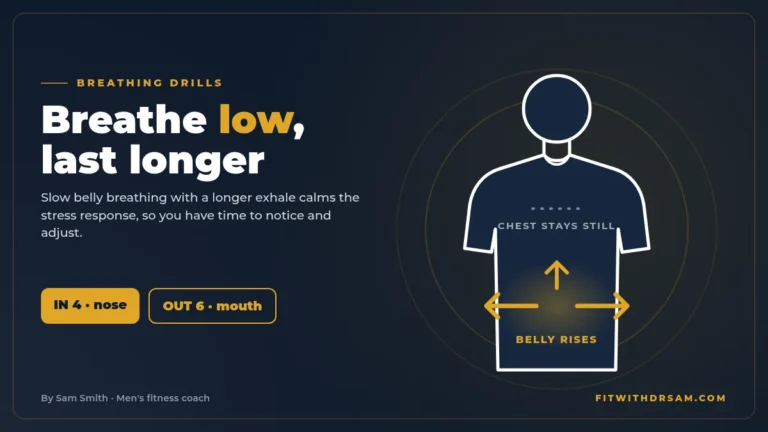
- Breathe low. Breathe in slowly through your nose for 4 to 5 seconds. Let your belly and lower ribs expand while your chest hand barely moves.
- Release. As you breathe in, imagine the base of your pelvis softening, widening and dropping slightly, as if the space between your sit bones grows. The feeling is subtle. Think “let go”, not “push”.
- Return. Breathe out slowly for 5 to 6 seconds and let everything come back to a relaxed neutral. Don’t squeeze back up.
- Repeat for 8 to 10 slow breaths. Rest, then do a second round if it felt good.
Inhale or exhale? In most people the pelvic floor naturally lowers a little as the diaphragm moves down on a deep breath in, so this guide times the release with the inhale, the same as Drill 3 in our breathing techniques to last longer. Some clinic leaflets, including Sheffield’s, teach the gentle drop on the out-breath instead (STH NHS). Either is fine. What matters is that the movement stays gentle and is never forced.
Coaching cues that help:
- “Relax the jaw, relax the floor.” The jaw and pelvic floor often tense together. Let your mouth fall slightly open.
- “Let the belly be soft.” If your abs are braced, the pelvic floor can’t drop.
- “Imagine the moment just before you start to urinate.” That gentle letting-go feeling is the target, with no pushing.
- If it feels like straining on the toilet, you’re using too much effort. Halve it.
Free plan
Get the 7-Day Stamina Starter
10 to 15 minutes a day: breathing, pelvic-floor basics, mobility and three short bodyweight sessions, with a tick-box tracker. No gym, no pills.
Send me the free planFree. No spam. Unsubscribe anytime.
A 4-week reverse kegel plan
| Week | Position | What to do | How often |
|---|---|---|---|
| 1 | Lying on your back, knees bent | 2 rounds of 8 slow release breaths | 1 to 2 times a day, 5 min |
| 2 | Lying, then sitting upright | 6 kegels (3-second squeeze, 6-second full release), then a round of release breaths | 2 times a day |
| 3 | Sitting and standing | 8 kegels, then 8 reverse kegels. Add a few release breaths during the day, at your desk or after lifting | 2 times a day, plus short breaks |
| 4 | Standing, walking, deep squat hold | A reverse kegel on every breath in for 1 minute while walking slowly. Use the release cue during start-stop practice | Daily |
A good ratio for most men is roughly one release set for every strength set. If you already feel tense, spend more time on release. If you have signs of a weak pelvic floor, such as dribbling after urinating, lean more toward strength, ideally with guidance from a pelvic-health physical therapist.
Common mistakes to avoid
- Pushing too hard. Bearing down hard and often isn’t the goal and puts extra pressure on the pelvic floor. Keep it gentle.
- Holding your breath. The release rides on slow breathing. Holding your breath brings the tension back.
- Tensing everything else. Your glutes, inner thighs, abs and jaw should stay quiet.
- Rushing. Each full breath should take around 10 seconds. Slow is the point.
- Only doing kegels. Hundreds of squeezes with no full release can leave you with a tired, tight pelvic floor.
Where reverse kegels fit with breathing and training
Reverse kegels pair naturally with belly breathing, so practice them alongside the 4 drills in breathing techniques to last longer in bed. The in-the-moment reset there (a long exhale, shoulders down, jaw loose, pelvic floor soft) is the reverse kegel in action.
Your general fitness matters too. Hip mobility (hip-flexor stretches, deep squat holds, cat-cow), regular walking and sensible strength training all support a pelvic floor that can both work and rest. If you lift, breathe out through the hardest part of each rep instead of holding your breath on every set, and finish your session with a few release breaths. For the strength side, our pelvic-floor strength guide covers kegels, bridges, squats and bird dogs.
If you want context on timing first, read how long a man should last in bed. Many men find they’re already in the normal range and simply want more control. The full plan, including start-stop practice, is in our guide to lasting longer in bed naturally.
For a structured program that combines pelvic-floor strength and release, breathing, training and confidence work, see my book Increase Stamina in Bed.
When to see a doctor
Reverse kegels are a gentle self-help skill, but book an appointment with your doctor (GP in the UK, Hausarzt in Germany), a urologist or a pelvic-health physical therapist if:
- you have pain in your pelvis, perineum, testicles, penis or lower back, or pain during or after ejaculation
- you have urinary symptoms: burning, urgency, getting up often at night, a weak stream, or blood in your urine or semen
- you have bowel symptoms: constipation, pain when opening your bowels, or bleeding
- you’ve had recent pelvic, prostate or hernia surgery
- symptoms are new, getting worse, or come with a fever
- early ejaculation has been lifelong and distressing, or nothing has improved after about 3 months of regular practice
Doctors see these issues every day. A quick check can rule out problems such as infection or prostate issues, and effective treatments exist.
Frequently asked questions
What is a reverse kegel?
A reverse kegel is a gentle, controlled relaxation of the pelvic-floor muscles. Instead of squeezing and lifting, you let the muscles soften, widen and lower slightly, usually in time with a slow breath. It’s a release skill, not a push.
How do I know if I’m doing a reverse kegel correctly?
You should feel a subtle softening and slight lowering at the base of your pelvis, with your belly relaxed and no straining. Your breathing stays smooth, and your glutes, thighs and jaw stay loose. If it feels like pushing for a bowel movement, you’re using too much effort. A pelvic-health physical therapist can check your technique if you’re unsure.
Should I do reverse kegels or regular kegels?
Most men benefit from both, because control means being able to squeeze and to let go. If you tend to clench, sit a lot or feel tense, start with more release work. If you have signs of a weak pelvic floor, such as dribbling after urinating, put more focus on strength, ideally with guidance.
How long do reverse kegels take to work?
Many men can feel the movement within 1 to 2 weeks of daily practice. Changes in tension, comfort and control usually build over 4 to 8 weeks. Progress is gradual, and results vary.
Are reverse kegels safe?
Gentle reverse kegels are generally safe for healthy men. Never force or strain, and stop if you feel pain or pressure. If you have pelvic pain, a hernia, hemorrhoids, recent surgery, or urinary or bowel problems, get advice from a doctor or pelvic-health physical therapist first.
The bottom line
Reverse kegels teach your pelvic floor to let go. For men who clench, sit a lot, lift heavy or feel tense, that release can be the missing half of pelvic-floor control. Keep the movement gentle, pair it with slow breathing and regular kegels, and give it a few weeks. If anything hurts, or you have urinary, bowel or pelvic symptoms, get checked first.
Next step: get the free 7-Day Stamina Starter, or read the full guide to lasting longer in bed naturally.
Bestseller · ★ 5.0 from 94 reviews on Gumroad
Increase Stamina in Bed
My complete 30-day stamina and confidence program: a 111-page guide (PDF + EPUB) with 9 bonus files and 3 videos. It covers pelvic-floor strength and release, breathing and arousal-control drills, training routines and how to stay present instead of anxious. Practical, drug-free and non-explicit.
Get the book on GumroadResults vary. Educational content, not a medical treatment.
References
- Cleveland Clinic. Kegel exercises for men: benefits and how to do them. Read online
- Memorial Sloan Kettering Cancer Center. Pelvic floor muscle (Kegel) exercises for males. Read online
- Sheffield Teaching Hospitals NHS Foundation Trust. How to relieve male pelvic pain. Exercise two: reverse kegels (patient leaflet PIL5220, PDF). Read online
- FitzGerald MP, Anderson RU, Potts J, et al. Randomized multicenter feasibility trial of myofascial physical therapy for the treatment of urological chronic pelvic pain syndromes. J Urol. 2009;182(2):570-580. PubMed Central
- Pastore AL, Palleschi G, Fuschi A, et al. Pelvic floor muscle rehabilitation for patients with lifelong premature ejaculation: a novel therapeutic approach. Ther Adv Urol. 2014;6(3):83-88. PubMed Central
- de Oliveira FA, Lima LB, da Costa MO, et al. Efficacy of pelvic floor muscle training in the management of premature ejaculation: a systematic review and meta-analysis of randomized controlled trials. J Sex Med. 2026;23(6):qdag131. PubMed
- Erkut U, Karagozoglu Coskunsu D, Erkut K, Ozden AV. The effects of diaphragmatic breathing exercises on individuals with premature ejaculation: a randomized controlled trial. J Sex Med. 2025;22(8):1422-1429. PubMed
- Cooper K, Martyn-St James M, Kaltenthaler E, et al. Behavioral therapies for management of premature ejaculation: a systematic review. Sex Med. 2015;3(3):174-188. PubMed Central
- NHS. Ejaculation problems. Read online
- MedlinePlus (U.S. National Library of Medicine). Premature ejaculation. Read online
All links checked October 10, 2026.