Performance Anxiety in Men: 9 Techniques to Feel Calm and Confident
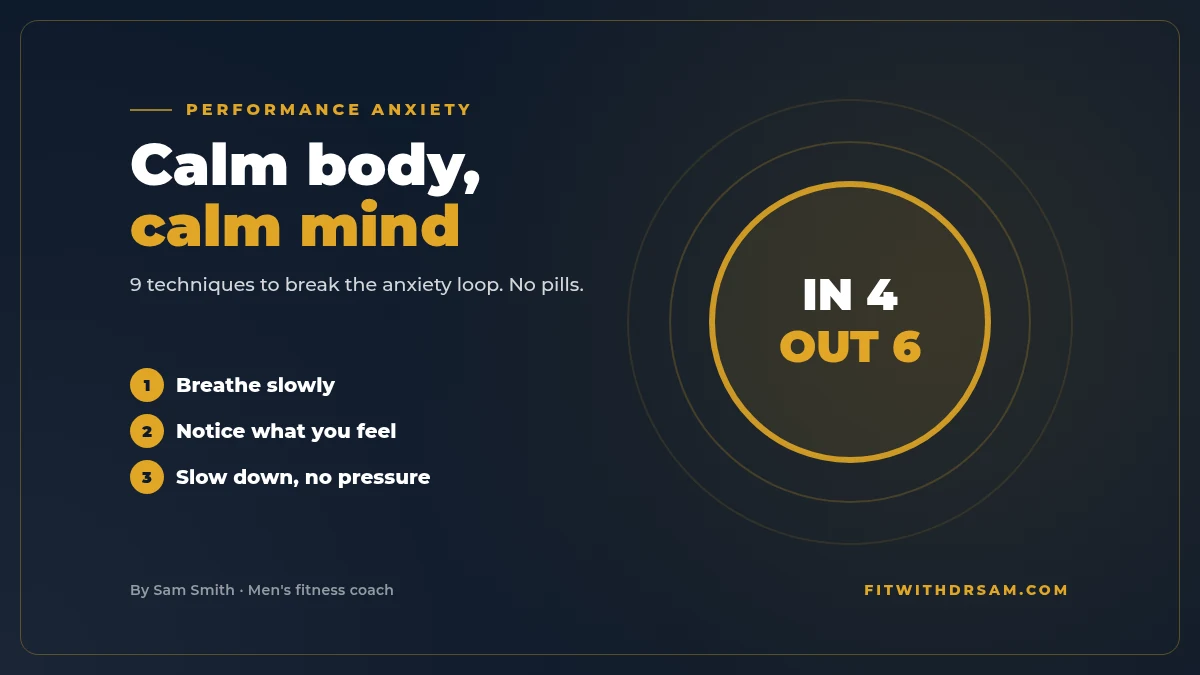
Educational content, not medical advice. This article is general information from a fitness coach. It’s not a diagnosis or treatment. If you have a health concern, see a doctor. See “When to see a doctor” below.
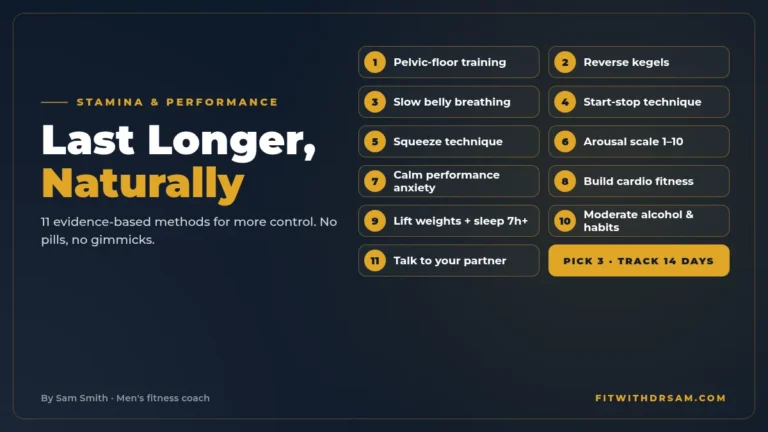
Performance anxiety in men is the worry that you won’t “perform” well enough during intimacy: that you’ll lose your erection, finish too soon, or disappoint your partner. It’s common, it’s not a sign that something is wrong with you, and it usually responds well to practice. Below are 9 techniques I use with clients, from slow breathing to changing how you think about sex, plus a 2-week reset plan and clear signs that it’s time to see a professional. If lasting longer is your main goal, our guide to lasting longer in bed naturally covers that side in depth.
Key takeaways
- Sexual performance anxiety is common. Estimates range from about 9% to 25% of men.
- Worry turns on the stress response, which works against arousal and can speed up or stall things. That creates a loop.
- The fastest tools are slow breathing, moving your attention to what you feel, and taking pressure off the goal.
- Regular exercise lowers anxiety, and aerobic training is linked to better erectile function.
- If erection problems keep happening, see a doctor first. A sex therapist or CBT can help when anxiety is the main driver.
What is performance anxiety in men?
Sexual performance anxiety happens when fear, embarrassment or worry affect your interest, performance or enjoyment during sex. It isn’t a formal diagnosis, but it’s one of the most common sexual complaints. Cleveland Clinic estimates it affects up to 25% of men (Cleveland Clinic), and a 2020 review put the figure at 9% to 25% of men (Pyke, 2020).
For most men it shows up in one of three ways:
- Erection worries: you’re fine on your own or in the morning, but with a partner your mind starts racing and your body doesn’t follow.
- Finishing too soon: nerves and tension speed things up, and fear of it happening again makes it more likely.
- Overthinking: you’re watching yourself instead of being present, a habit sex therapists call “spectatoring”.
The same review found that performance anxiety contributes to both early ejaculation and erection problems that have a psychological cause (Pyke, 2020). The encouraging part is that the things that feed it, such as stress, tension, pressure and silence, are all things you can work on.
Why it happens: the anxiety loop
Arousal works best when your body feels safe. Your nervous system has two main modes: a “fight or flight” mode that raises your heart rate and muscle tension, and a “rest and digest” mode that slows things down. Anxiety pushes you into fight-or-flight, and that works against relaxed arousal.
Then the loop starts. One night goes badly. Next time, you go in expecting it to happen again, so you monitor yourself. Monitoring creates more tension, which makes a repeat more likely, which “proves” the fear. Cleveland Clinic describes the same vicious cycle: the next time, you’re thinking about the last time, so you’re not relaxed and you’re not in the moment (Cleveland Clinic).
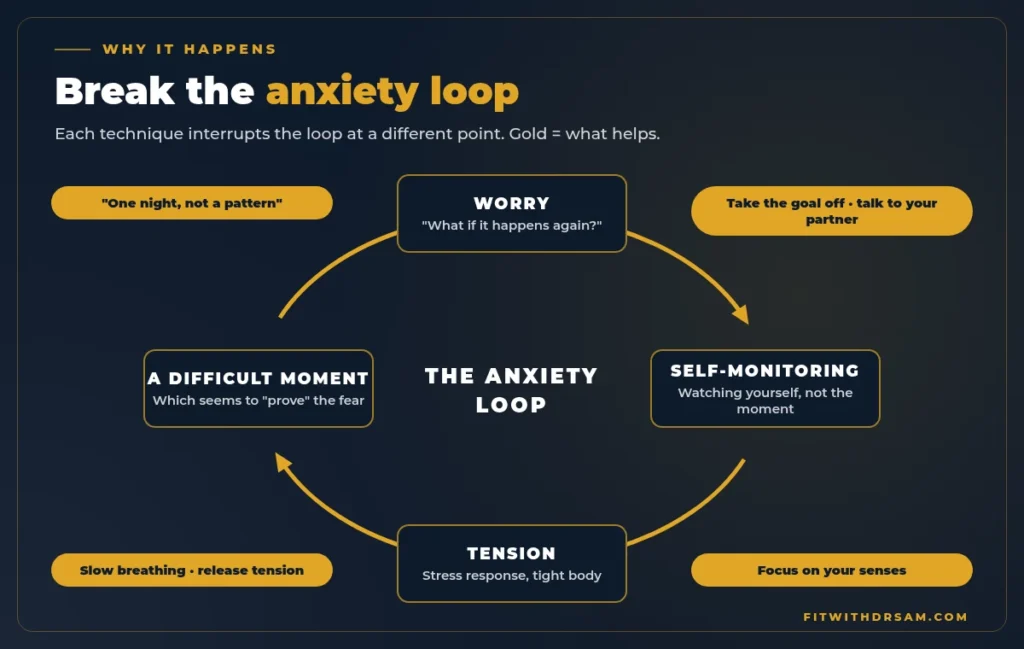
Every technique below breaks the loop at a different point: calming the body, changing what you pay attention to, or taking away the pressure.
9 techniques to calm performance anxiety
1. Know what’s normal
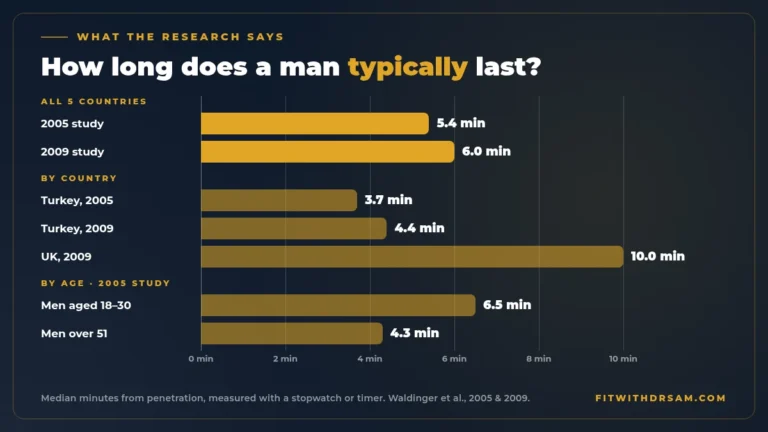
A lot of performance anxiety comes from unrealistic standards. The NHS says most men occasionally fail to get or keep an erection, usually because of stress, tiredness or too much alcohol, and that it’s nothing to worry about (NHS). Time is often misjudged too. Read how long a man should last in bed for what the research actually shows. Many men find they’re already in the normal range.
Try this: next time a night doesn’t go to plan, say to yourself, “That was one night, not a pattern.” Don’t analyze it at 2 a.m.
2. Slow your breathing
Slow breathing is the quickest way to shift your body out of fight-or-flight. A systematic review found that breathing at fewer than 10 breaths a minute was linked to more relaxation and less anxiety (Zaccaro et al., 2018), and the NHS recommends breathing exercises for stress (NHS).
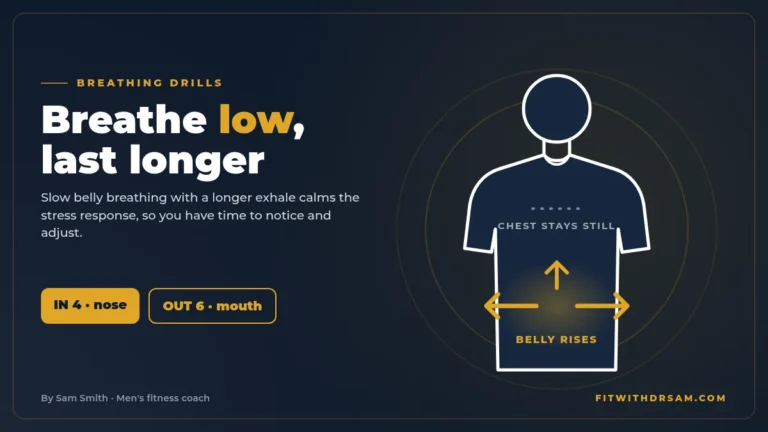
Try this: breathe in through your nose for 4 counts and out through your mouth for 6, for 2 minutes before intimacy. The full drills, including a 10-second reset you can use in the moment, are in breathing techniques to last longer in bed.
3. Move your attention from your head to your senses
Anxiety lives in your thoughts about the future: “What if it happens again?” Arousal lives in the present: touch, warmth, breathing, closeness. Mindfulness is the skill of bringing your attention back to the present without judging yourself. In a small pilot study, men with situational erection problems who did 4 weeks of mindfulness-based group therapy reported better erectile function and sexual satisfaction 6 months later (Bossio et al., 2018). It had no control group, so treat it as promising rather than proven.
Try this: practice outside the bedroom first. For 5 minutes a day, focus on your breath and notice 3 things you can feel, like your feet on the floor or the air on your skin. When your mind drifts, gently bring it back. The NHS has a simple guide to getting started (NHS mindfulness). During intimacy, use the same skill: when you catch yourself “watching”, come back to what you can feel.
4. Take the goal off the table
When sex becomes a test you can pass or fail, anxiety follows. Sex therapists often use structured, pressure-free touch exercises (called sensate focus) for exactly this reason: removing the goal removes the fear of failing it.
Try this: agree with your partner on a few evenings where the only aim is closeness: massage, cuddling, slow touch, with no expectation of anything more. Many men find their body responds better once nothing is required of it. A sex therapist can guide you through the full program step by step.
5. Talk to your partner
Silence makes anxiety worse, and your partner may wrongly assume they’re the problem. Cleveland Clinic’s sex therapist puts communication first, because feeling connected and knowing your partner wants the same thing makes it easier to relax (Cleveland Clinic).
Try this: choose a calm moment, not the bedroom. Keep it simple: “I’ve been feeling some pressure lately, and it gets in my head. Slowing down helps me. Can we take things slower?” Most partners respond with relief, not judgment.
Free plan
Get the 7-Day Stamina Starter
A simple plan to build calm, confidence and stamina: slow-breathing drills, pelvic-floor basics, mobility and three short bodyweight sessions, with a tick-box tracker. 10 to 15 minutes a day.
Send me the free planFree. No spam. Unsubscribe anytime.
6. Check your thoughts
Cognitive behavioral therapy (CBT) teaches you to notice unhelpful thoughts and test them against the facts. It’s widely used for anxiety (NHS), and it’s one of the approaches recommended for sexual performance anxiety, though specific trials are still limited (Pyke, 2020).
Try this: use a quick three-step check. Catch the thought (“I’m going to lose it again”). Check it (“Is that a fact or a fear? What happened most times before?”). Change it to something true and calmer (“I don’t need to be perfect. I can slow down.”). Write it down a few times a week. It gets faster with practice.
7. Release tension in your body
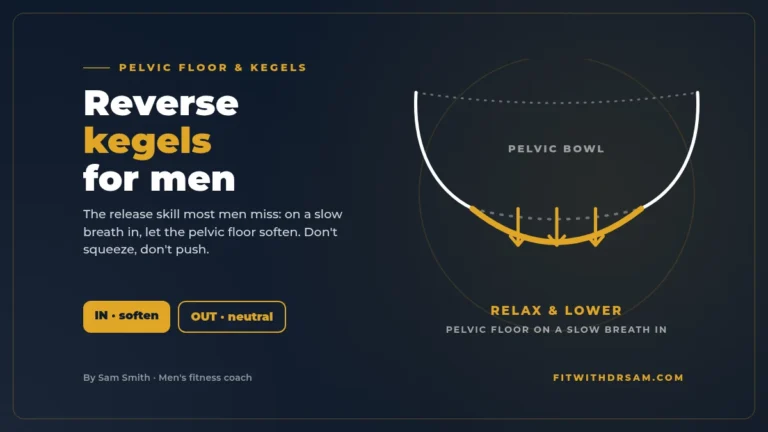
When you’re anxious, you brace: shoulders up, jaw tight, belly held, and often a clenched pelvic floor. That tension feeds the stress response and can speed things up. Learning to let go physically sends your brain the opposite message. Reverse kegels teach you to relax the pelvic floor on a slow breath, and they balance out the strength work in our pelvic-floor guide.
Try this: do a 60-second body scan before bed. Breathe out slowly and relax, in order, your jaw, your shoulders, your hands, your belly and your pelvic floor.
8. Train regularly
Exercise is one of the best-supported tools for anxiety. A review of 15 trials found that aerobic exercise reduced anxiety compared with no exercise, with stronger effects from higher-intensity programs (Aylett et al., 2018), and a large overview of 97 reviews found physical activity had a medium effect on anxiety symptoms (Singh et al., 2023). Fitness helps your body directly too: a meta-analysis of 11 randomized trials found that regular aerobic exercise improved erectile function, especially in men who started with more difficulty (Khera et al., 2023).
Try this: aim for about 150 minutes of brisk walking, cycling, running or similar each week, plus 2 strength sessions. Feeling strong and fit in your own body is a quiet confidence boost of its own.
9. Get the basics right
Tiredness, alcohol and stress are the NHS’s three most common reasons for an occasional erection problem (NHS). Fixing them is unglamorous, but it works:
- Sleep: aim for 7 to 9 hours. Being tired makes anxiety louder.
- Alcohol: a drink to “take the edge off” can backfire. The NHS advises no more than 14 units a week.
- Smoking: stopping is one of the lifestyle changes the NHS recommends for erection health.
- Online pills: don’t self-medicate with products bought online. The NHS warns that many websites sell fake medicines. If you think medication could help, speak to a doctor.
A 2-week reset plan
Pick a regular time each day. The whole plan takes 10 to 15 minutes, and none of it needs a partner except the weekend sessions.
| Days | Daily practice (10 to 15 min) | Focus |
|---|---|---|
| 1 to 3 | 4-6 breathing (2 min) + 5-minute senses practice + thought check once | Notice when and where you tense up |
| 4 to 7 | Breathing + 60-second body scan + 8 reverse kegels | Use a long exhale whenever you feel stressed during the day |
| Weekend 1 | One pressure-free evening with your partner (no goal) | Stay with what you can feel, not how you’re doing |
| 8 to 11 | Breathing + senses practice + 2 workouts this week | Catch, check and change one anxious thought a day |
| 12 to 14 | Repeat, plus a calm 5-minute talk with your partner about what helps | Slow down and pause whenever you need to |
Track how calm you feel, not how you “performed”. If you’d like a structured daily routine that builds the physical side too, the free 7-Day Stamina Starter above fits alongside this plan.
When it might be more than nerves
Anxiety and physical causes often overlap. Erection problems can be linked to conditions such as high blood pressure, diabetes, hormone problems or depression, and some medicines can play a part too (NHS, MedlinePlus). That’s why a check-up is worth it if problems keep happening, even if you’re sure it’s “just in your head”. A doctor can also help if you’ve always finished very quickly (NHS).
Therapy is a strength move, not a last resort. In the UK, the NHS points men to the College of Sexual and Relationship Therapists (COSRT). In the US and Canada, you can search the AASECT directory of certified sex therapists (AASECT). In Germany, your Hausarzt or a urologist can refer you.
For a structured program that combines breathing, pelvic-floor practice, training and confidence work, see my book Increase Stamina in Bed.
When to see a doctor
Self-help is a good first step, but book an appointment with your doctor (GP in the UK, Hausarzt in Germany) or a urologist if:
- erection problems keep happening, or started suddenly
- you have pain, blood in your semen, or urinary symptoms
- you have diabetes, high blood pressure, heart problems or another long-term condition
- you started a new medicine and noticed changes
- you’ve almost always finished within about a minute and it distresses you or your partner
- anxiety or low mood affects you most days, or it’s straining your relationship
- nothing has improved after about 3 months of regular practice
If you ever feel hopeless or have thoughts of harming yourself, get help now: call 988 in the US or Canada, Samaritans on 116 123 in the UK, or TelefonSeelsorge on 0800 111 0 111 in Germany, or your local emergency number.
Frequently asked questions
Is performance anxiety common in men?
Yes. Estimates suggest that somewhere between 9% and 25% of men deal with sexual performance anxiety. Most men have the occasional off night because of stress, tiredness or alcohol, and that alone isn’t a sign that anything is wrong.
Can performance anxiety cause erection problems?
It can. Worry triggers the body’s stress response, which works against arousal, and one difficult experience can start a cycle of anxiety the next time. If erection problems keep happening, see a doctor, because they can also be a sign of a treatable health condition.
Can anxiety make you finish too fast?
Anxiety and tension can speed things up for many men, and performance anxiety is linked to early ejaculation. Slow breathing, relaxing the pelvic floor and start-stop practice can help. If it has always happened very quickly and distresses you, talk to a doctor.
How do I calm performance anxiety in the moment?
Slow down or pause, take one long exhale, drop your shoulders, unclench your jaw and soften your belly. Then bring your attention back to what you can feel instead of how you’re doing. Practicing this when you’re calm first makes it far easier to use when you’re nervous.
Should I see a doctor or a therapist for performance anxiety?
Start with a doctor if you have erection problems that keep happening, pain, or other symptoms, so physical causes can be checked. A sex therapist or a CBT therapist is a good next step if anxiety is the main issue, if it’s affecting your relationship, or if self-help hasn’t worked after a few months.
The bottom line
Performance anxiety in men is common, and it isn’t a life sentence. Calm your body with slow breathing and physical release, move your attention to what you feel, take the pressure off, and talk to your partner. Train regularly and get the basics right. Give it a few weeks of steady practice, and see a doctor or therapist if problems keep happening.
Next step: get the free 7-Day Stamina Starter, or read the full guide to lasting longer in bed naturally.
Bestseller · ★ 5.0 from 94 reviews on Gumroad
Increase Stamina in Bed
My complete 30-day stamina and confidence program: a 111-page guide (PDF + EPUB) with 9 bonus files and 3 videos. It covers breathing and pelvic-floor practice, training routines, energy habits and how to stay present instead of anxious. Practical, drug-free and non-explicit.
Get the book on GumroadResults vary. Educational content, not a medical treatment.
References
- Cleveland Clinic. How to overcome sexual performance anxiety. Read online
- Pyke RE. Sexual performance anxiety. Sex Med Rev. 2020;8(2):183-190. PubMed
- NHS. Erectile dysfunction (impotence). Read online
- Zaccaro A, Piarulli A, Laurino M, et al. How breath-control can change your life: a systematic review on psycho-physiological correlates of slow breathing. Front Hum Neurosci. 2018;12:353. PubMed Central
- NHS. Breathing exercises for stress. Read online
- Bossio JA, Basson R, Driscoll M, Correia S, Brotto LA. Mindfulness-based group therapy for men with situational erectile dysfunction: a mixed-methods feasibility analysis and pilot study. J Sex Med. 2018;15(10):1478-1490. PubMed
- NHS. Mindfulness. Read online
- NHS. Cognitive behavioural therapy (CBT). Read online
- Aylett E, Small N, Bower P. Exercise in the treatment of clinical anxiety in general practice: a systematic review and meta-analysis. BMC Health Serv Res. 2018;18(1):559. PubMed Central
- Singh B, Olds T, Curtis R, et al. Effectiveness of physical activity interventions for improving depression, anxiety and distress: an overview of systematic reviews. Br J Sports Med. 2023;57(18):1203-1209. PubMed Central
- Khera M, Bhattacharyya S, Miller LE. Effect of aerobic exercise on erectile function: systematic review and meta-analysis of randomized controlled trials. J Sex Med. 2023;20(12):1369-1375. PubMed
- NHS. Ejaculation problems. Read online
- MedlinePlus (U.S. National Library of Medicine). Erectile dysfunction. Read online
- College of Sexual and Relationship Therapists (COSRT), UK. Find a therapist
- AASECT (American Association of Sexuality Educators, Counselors and Therapists). Referral directory
All links checked October 10, 2026.