High-Protein Meal Plan for Men: A 150 g Day and Shopping List
Educational content, not medical advice. This article is general information from a fitness coach. It’s not a diagnosis or treatment. If you have a health concern, see a doctor. See “When to see a doctor” below.
A good high-protein meal plan for men isn’t about eating chicken and rice six times a day. It’s about hitting a sensible protein target with food you actually like, that fits your budget and keeps you full. I’ve helped men build muscle and lose fat for more than 10 years, and protein is usually the first thing I fix. Below you’ll find how much you need, a full 150 g day, a 7-day rotation, a shopping list and cheap swaps for the US, Canada, the UK and Germany. If money is tight, read my guide to building muscle on a budget too.
Key takeaways
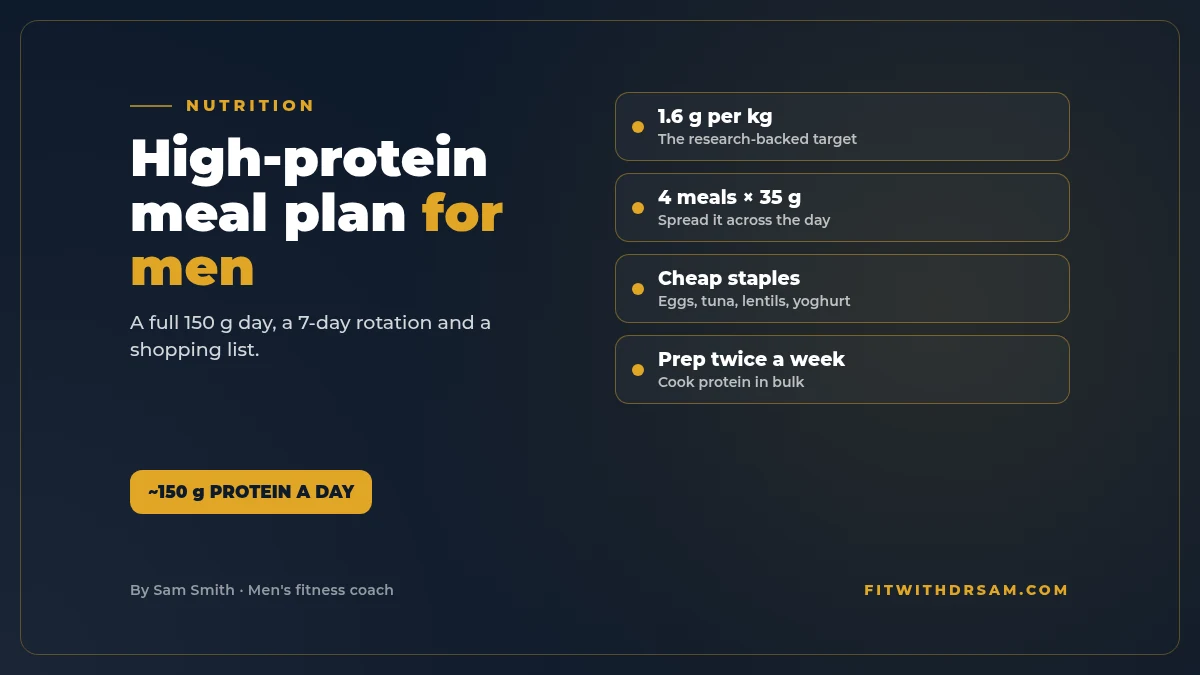
- Men who lift need about 1.6 g of protein per kg (0.7 g per lb) of body weight a day; up to 2.2 g/kg when dieting.
- Spread it over 3 to 5 meals of about 30 to 40 g each.
- Cheap staples like eggs, canned fish, lentils, Greek yoghurt and chicken thighs cover most needs.
- Protein supports muscle, keeps you full and helps protect muscle during fat loss.
- If you have kidney disease, talk to your doctor before eating more protein.
How much protein do men actually need?
The basic RDA of 0.8 g per kg of body weight is the minimum to avoid deficiency, not the best amount for building muscle. A large meta-analysis of 49 trials found that protein intake above about 1.6 g per kg a day gave little extra muscle gain in people doing resistance training (Morton et al., 2018). The International Society of Sports Nutrition suggests 1.4 to 2.0 g per kg for most exercising people (Jäger et al., 2017).
| Body weight | 1.6 g/kg (building) | 2.0 g/kg (cutting) |
|---|---|---|
| 70 kg / 154 lb | 112 g | 140 g |
| 80 kg / 176 lb | 128 g | 160 g |
| 90 kg / 198 lb | 144 g | 180 g |
| 100 kg / 220 lb | 160 g | 200 g |
If you carry a lot of excess fat, base it on your goal weight instead. For most men, 130 to 170 g a day is a realistic target. The sample plan below lands at about 150 g.
Why protein matters for men
- Muscle. Protein provides the building blocks your muscles use to repair and grow after training.
- Fullness. Protein tends to keep you fuller than the same calories from refined carbs or fat, which helps with fat loss.
- Protecting muscle while dieting. A higher protein intake helps you keep muscle when you’re eating less.
- Ageing well. After 40, getting enough protein alongside strength training helps slow muscle loss. See my home workout for men over 40.
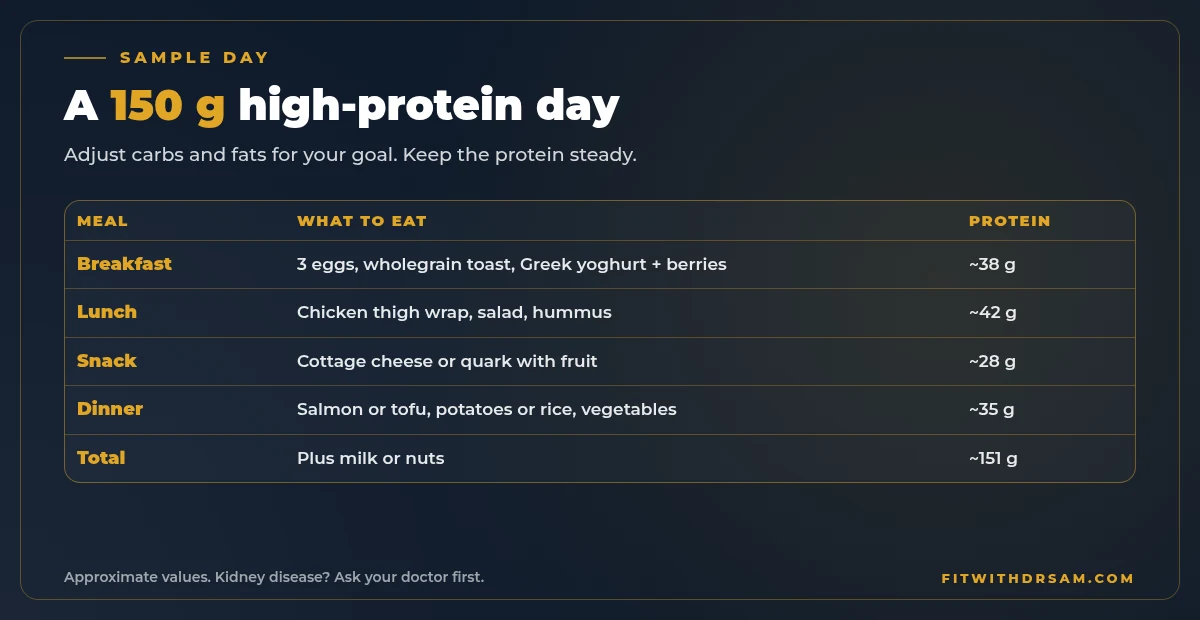
A full 150 g high-protein day
| Meal | What to eat | Protein |
|---|---|---|
| Breakfast | 3 eggs scrambled + 2 slices wholegrain toast + 150 g Greek yoghurt with berries | ~38 g |
| Lunch | Chicken thigh wrap (150 g cooked chicken), salad, hummus | ~42 g |
| Snack | 250 g cottage cheese or quark with fruit | ~28 g |
| Dinner | Salmon fillet (150 g) or tofu, potatoes or rice, vegetables | ~35 g |
| Extras | Glass of milk or a handful of nuts | ~8 g |
| Total | Roughly 2,300 to 2,600 kcal | ~151 g |
Adjust portions of carbs and fats (rice, bread, oil, nuts) up for muscle gain or down for fat loss. Keep the protein roughly the same.
7-day high-protein meal rotation
| Day | Breakfast | Lunch | Dinner |
|---|---|---|---|
| Mon | Eggs + toast + yoghurt | Chicken wrap | Salmon, potatoes, greens |
| Tue | Overnight oats with whey or skyr | Tuna and bean salad | Turkey chilli with rice |
| Wed | Omelette with cheese and spinach | Leftover chilli | Stir-fry beef or tofu with noodles |
| Thu | Greek yoghurt bowl + nuts | Lentil soup + chicken | Baked cod, rice, peas |
| Fri | Eggs + smoked salmon bagel | Chicken and quinoa bowl | Homemade burgers (lean beef) + salad |
| Sat | Protein pancakes | Sardines on toast | Roast chicken, vegetables |
| Sun | Full breakfast (eggs, beans, lean bacon) | Roast leftovers | Lentil and chickpea curry with paneer |
Vegetarian or vegan? Swap meat and fish for tofu, tempeh, seitan, lentils, beans, edamame and soy milk, and you’ll still hit your target. My guide to muscle building for vegetarians and vegans has details.
Shopping list (with country swaps)
| Food | Protein per serving | Cheap swap (UK / DE / US-CA) |
|---|---|---|
| Eggs (2 large) | ~12 g | Same everywhere |
| Greek yoghurt (170 g) | ~17 g | Skyr (UK), Magerquark (DE, ~12 g per 100 g) |
| Chicken thighs (150 g cooked) | ~38 g | Frozen chicken breast |
| Canned tuna (1 can drained) | ~25 g | Sardines or mackerel |
| Cottage cheese (200 g) | ~24 g | Hüttenkäse (DE) |
| Lentils (200 g cooked) | ~18 g | Dried lentils are cheapest |
| Tofu (150 g firm) | ~20 g | Tempeh |
| Milk (300 ml) | ~10 g | Soy milk |
Values are approximate and vary by brand; check labels. Harvard’s Nutrition Source has a good overview of healthy protein choices (Harvard T.H. Chan), and MyPlate lists common protein foods (USDA MyPlate).
Free plan
Get the 7-Day Stamina Starter
The free 7-Day Stamina Starter adds simple training and energy habits to your nutrition, 10 to 15 minutes a day, with a tick-box tracker.
Send me the free planFree. No spam. Unsubscribe anytime.
Meal prep tips that save time
- Cook protein in bulk twice a week: a tray of chicken thighs, a pot of chilli, a dozen boiled eggs.
- Use a formula: protein + carb + vegetable + sauce. Change the sauce, not the system.
- Keep emergency protein: canned fish, yoghurt, cottage cheese, a tub of whey.
- Go easy on alcohol. It adds calories and can slow recovery; see alcohol and muscle growth.
Common mistakes
- Back-loading protein at dinner after a low-protein breakfast and lunch.
- Counting “protein bars” as health food. Many are sweets with added protein.
- Forgetting fibre. Eat vegetables, fruit, beans and whole grains too. The NHS Eatwell Guide is a good template (NHS).
- Overdoing processed meat. Keep bacon, sausages and salami as occasional foods.
When to see a doctor
When to see a doctor
Talk to your doctor or a registered dietitian before a big change if:
- you have kidney disease or reduced kidney function
- you have diabetes, gout or liver disease
- you take medicines that are affected by diet
- you have a history of disordered eating
People with chronic kidney disease often need tailored protein targets (National Kidney Foundation).
Frequently asked questions
How much protein does a man need a day to build muscle?
For men who lift weights, research suggests about 1.6 g of protein per kg of body weight a day (about 0.7 g per lb) captures most of the muscle-building benefit. Some men go up to 2.2 g per kg, especially when dieting. For an 85 kg (187 lb) man that’s roughly 135 to 185 g a day.
Is 150 grams of protein a day too much?
For most healthy, active men, 150 g a day is a normal, safe target, roughly 1.6 to 2 g per kg for men weighing 75 to 95 kg. If you have kidney disease or another medical condition, check with your doctor before increasing protein.
What are the best cheap high-protein foods?
Eggs, canned tuna or sardines, chicken thighs, lentils, beans, cottage cheese, Greek yoghurt, milk, tofu and frozen fish give a lot of protein per pound, dollar or euro.
How should I spread protein across the day?
Aim for 3 to 5 meals or snacks with roughly 30 to 40 g of protein each. Spreading intake helps you hit your total and keeps you fuller than one huge protein meal.
Do I need protein shakes?
No. Shakes are a convenient way to top up, but whole foods can cover your needs. If you use powder, choose a brand that’s third-party tested.
The bottom line
Aim for about 1.6 g of protein per kg of body weight a day, spread over 3 to 5 meals, using affordable whole foods. Use the 150 g day as your template, rotate meals across the week and prep in bulk. My book Nutrition, Metabolism & Muscle ($19) has the full system: how to find your calories and macros, 3 meal plans and a tracker.
Diet, BMR & bodyweight guide · by Sam Smith
Nutrition, Metabolism & Muscle
My practical guide to eating for fat loss or muscle: how to find your BMR and macros, build meals that keep you full and train anywhere. Includes a calculator, tracker and 3 meal plans.
See the bookResults vary. Educational content, not medical or dietary treatment.
References
- Morton RW, Murphy KT, McKellar SR, et al. A systematic review, meta-analysis and meta-regression of the effect of protein supplementation on resistance training-induced gains in muscle mass and strength in healthy adults. Br J Sports Med. 2018;52(6):376-384. PubMed
- Jäger R, Kerksick CM, Campbell BI, et al. International Society of Sports Nutrition position stand: protein and exercise. J Int Soc Sports Nutr. 2017;14:20. PubMed Central
- Harvard T.H. Chan School of Public Health. The Nutrition Source: Protein. Read online
- USDA MyPlate. Protein foods. Read online
- NHS. The Eatwell Guide. Read online
- National Kidney Foundation. Nutrition and kidney disease. Read online
All links checked October 17, 2026.