How to Reconnect With Your Partner: 12 Small Habits That Rebuild Closeness
General guidance, not therapy or medical advice. This article shares coaching experience and research. If you’re struggling with your mental health or your safety, please talk to a qualified professional. See “When to get extra help” below.
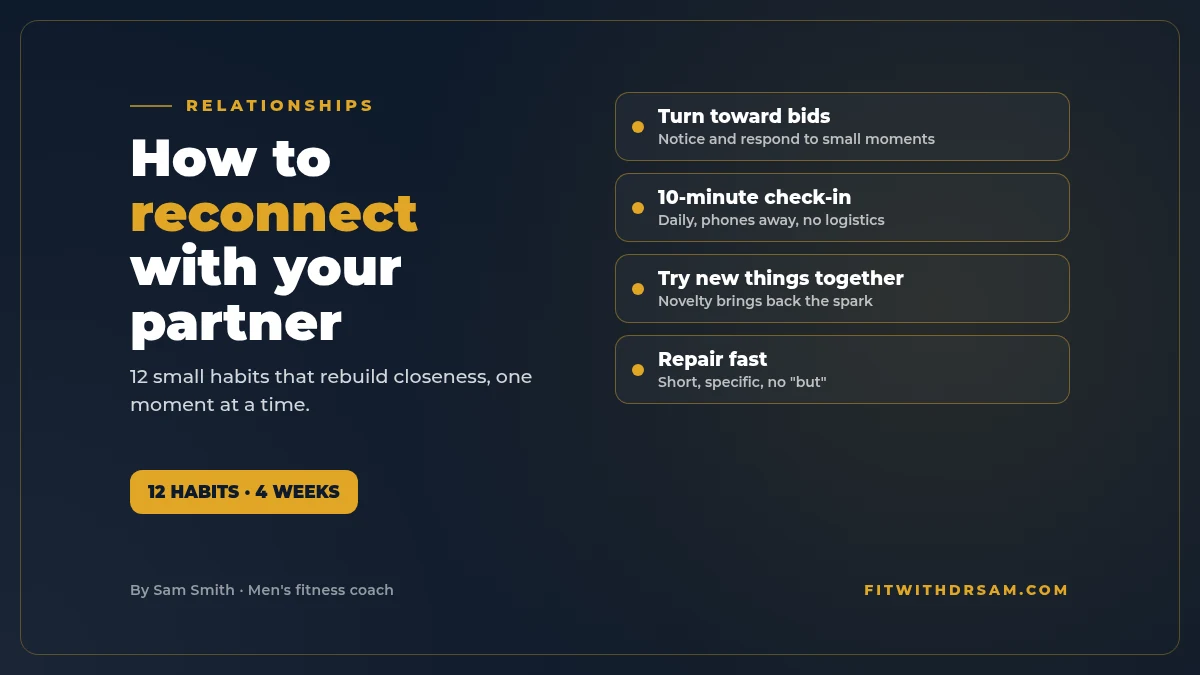
If you’re wondering how to reconnect with your partner, you’re probably feeling the distance already: conversations about logistics only, evenings on separate screens, less touch, more irritation. It’s common, especially when work, kids and stress pile up, and it’s usually fixable. Connection isn’t rebuilt by one big romantic gesture. It’s rebuilt by small, repeated moments of attention. Here are 12 habits, grouped into daily, weekly and repair habits, with the research behind them and a simple 4-week plan.
Key takeaways
- Couples who stayed together turned toward each other’s small “bids” for attention 86% of the time, versus 33% for couples who divorced.
- Aim for at least 5 positive interactions for every negative one, especially during conflict.
- How you react to your partner’s good news matters as much as how you handle problems.
- Doing new and exciting things together raised relationship quality in experiments.
- Repair after fights fast and simply. Get professional help if patterns keep repeating.
Why couples drift apart
Most couples don’t drift apart because of one big event. They drift because of thousands of tiny missed moments. Relationship researcher John Gottman calls these moments bids: small attempts to connect, like “Look at this”, a sigh, a hand on your shoulder or a story about their day. In his research, couples who were still married 6 years later had turned toward each other’s bids 86% of the time; couples who divorced had done so only 33% of the time (Gottman Institute).
Stress makes it worse. When you’re tired and overloaded, you miss more bids, react more sharply and spend less time doing anything fun together. The good news: the same small moments that caused the drift can reverse it.
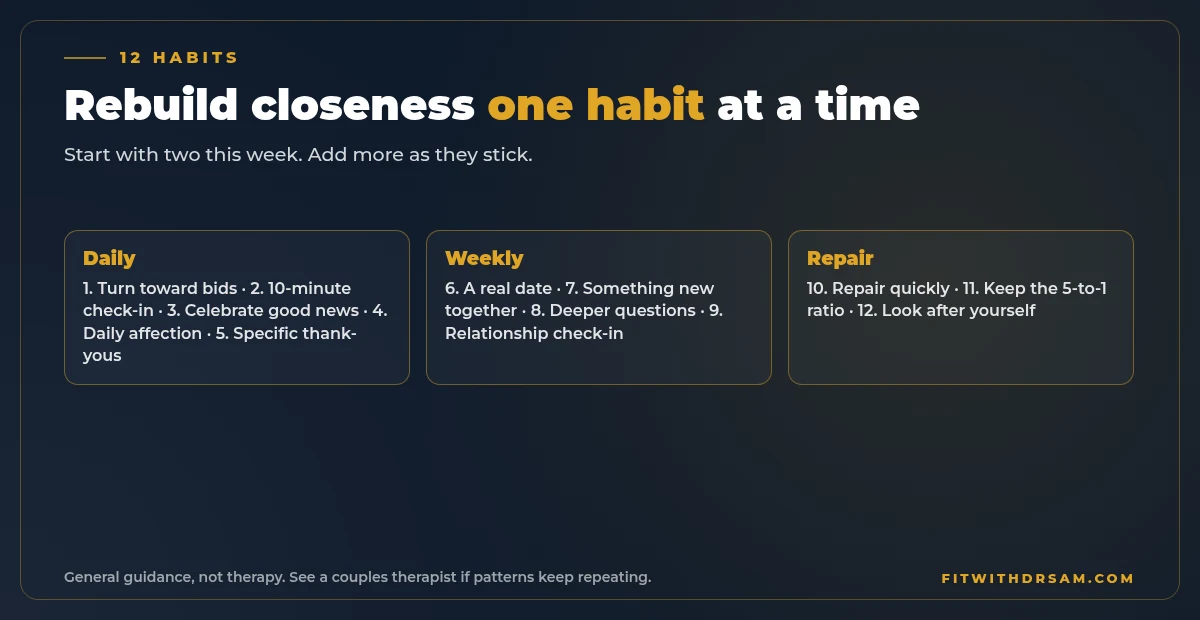
Daily habits to reconnect
1. Turn toward bids
When your partner reaches out, even in a small way, respond. Look up, answer, ask a follow-up question. You don’t have to agree or drop everything; you just have to show you noticed. This is the single most powerful habit on this list.
2. A 10-minute daily check-in
Ten minutes a day, phones away, with one rule: no logistics. Not “who’s picking up the kids”, but “What was the best and hardest part of your day?” and “Is anything on your mind?” Then listen more than you talk.
3. Celebrate their good news
How you respond to your partner’s good news matters. Researchers found that couples where partners responded to good news actively and enthusiastically, by asking questions and sharing the excitement, reported more intimacy and satisfaction (Gable et al., 2004). “That’s amazing, tell me how it happened” beats “Nice” while you look at your phone.
4. Daily physical affection
Non-sexual touch rebuilds closeness: a long hug, holding hands on a walk, a hand on their back as you pass. Six-second kisses and 20-second hugs are a simple target many couples find helpful. Keep it pressure-free, with no expectation that it has to lead anywhere.
5. Say thank you, specifically
Appreciation fades fastest in long relationships. Once a day, thank your partner for something specific: “Thanks for handling that call with the school, I know you were busy.” Specific gratitude lands far better than a general “You’re great.”
Weekly habits to rebuild closeness
6. A real date, once a week
Put it in the calendar like a meeting. It doesn’t have to be expensive: a walk with coffee, cooking a new recipe together, a picnic. The rule: you talk about each other, not the kids or bills.
7. Try something new together
In a series of studies, couples who did a short novel and exciting activity together reported higher relationship quality afterwards than couples who did something routine (Aron et al., 2000). Novelty brings back some of the spark of the early months. Try a class, a hike somewhere new, a new sport or a weekend trip. Training together counts too: a shared goal, like both following a 3-day workout plan, gives you something to build together.
8. Ask deeper questions
Questions build closeness when they go a bit beyond the surface. Psychologist Arthur Aron’s famous study created feelings of closeness between strangers with a structured set of increasingly personal questions (Aron et al., 1997). Try a few on your date night: “What’s something you’ve always wanted to do but haven’t?” “When do you feel most loved by me?” “What’s one thing you’d like more of from us?”
9. A weekly relationship check-in
Once a week, 20 minutes: what went well between us this week, what was hard, and what does each of us need next week? It turns small frustrations into conversations before they become resentment.
Free plan
Get the 7-Day Stamina Starter
Feeling better in your own body helps you show up in your relationship. The free 7-Day Starter gives you 10 to 15 minutes a day of breathing, mobility and short workouts, with a tick-box tracker.
Send me the free planFree. No spam. Unsubscribe anytime.
Repair habits: reconnecting after a fight
10. Repair quickly and simply
Every couple fights. What separates happy couples is how fast they repair. A good repair is short and specific: “I was sharp with you earlier, and that wasn’t fair. I’m sorry.” No “but”, no lecture. If you’re both still flooded, take a 20-minute break to calm down first, and say when you’ll come back to it.
11. Keep the 5-to-1 ratio
Gottman’s research found that stable, happy couples have about five positive interactions for every negative one during conflict (Gottman Institute). Even during a disagreement, a bit of humor, a touch or an “I see your point” keeps things from spiraling. Criticism of character (“You always…”, “You never…”) and contempt are the patterns to avoid most.
12. Look after yourself too
It’s hard to connect when you’re running on empty. Sleep, exercise and managing stress make you more patient and present. If confidence is part of the problem, our 30-day confidence plan helps. If physical intimacy has become a source of worry or avoidance, that’s common too, and our guide to performance anxiety in men explains how to take the pressure off. When nerves rise before a hard conversation, a few minutes of the slow breathing in our breathing techniques guide helps you stay calm.
A 4-week plan to reconnect with your partner
| Week | Focus | Habits to add |
|---|---|---|
| 1 | Notice | Turn toward bids (1) + daily thank-you (5). Track how many bids you notice. |
| 2 | Talk | Add the 10-minute check-in (2) and celebrating good news (3). |
| 3 | Have fun | Add a weekly date (6) with something new (7) and 3 deeper questions (8). |
| 4 | Maintain | Add the weekly relationship check-in (9). Keep affection (4) and repair (10, 11) going. |
Don’t announce a big project or expect your partner to change at the same pace. Just start. Most partners notice and respond within a couple of weeks when the effort is genuine and consistent.
When to get extra help
When to get extra help
Small habits work for everyday distance. Consider a couples therapist if:
- the same arguments repeat for months with no progress
- there’s contempt, constant criticism or one of you has emotionally checked out
- trust has been broken, for example by an affair
- you’ve tried for a few months and nothing has changed
Find a couples therapist through Relate in the UK or AAMFT in the US and Canada; in Germany, many cities have free Paar- und Lebensberatung centers. If you ever feel unsafe in your relationship, or you’re worried about your own behavior, contact your local emergency number or a domestic abuse helpline: The Hotline in the US (1-800-799-7233), the Men’s Advice Line in the UK (0808 801 0327) or the Hilfetelefon in Germany (116 016).
Frequently asked questions
How do you reconnect with your partner emotionally?
Start small and daily: put your phone away when you talk, respond warmly when your partner shares something, and spend 10 minutes a day asking real questions and listening. Emotional connection is rebuilt through many small moments of attention more than through big gestures.
How do you reconnect with your partner after a fight?
Wait until you’re both calm, then take responsibility for your part with a simple, specific apology, without “but”. Describe how you felt rather than attacking their character, listen to their side and agree on one thing you’ll each do differently. A short, calm repair conversation matters more than winning the argument.
How long does it take to reconnect in a relationship?
Many couples feel a difference within 2 to 4 weeks of consistent small habits. Rebuilding trust after a serious breach, or after years of distance, usually takes longer and often goes faster with a couples therapist.
Can a relationship go back to how it was at the start?
It usually becomes something different rather than identical: less novelty, more depth. Research suggests that doing new and exciting activities together can bring back some of that early spark, and many couples report feeling closer than before once they rebuild connection on purpose.
When should we see a couples therapist?
Consider it if the same fights keep repeating, if one of you feels contempt or has checked out, after an affair or major breach of trust, or if a few months of effort haven’t helped. Couples therapy works best before things reach a breaking point, not after.
The bottom line
To reconnect with your partner, focus on small things done often: turn toward their bids, check in for 10 minutes a day, celebrate their wins, touch more, say thank you, date weekly, try new things together and repair quickly after fights. Start with two habits this week. Closeness is built the same way it was lost: one small moment at a time.
For couples · by Sam Smith
Mastering Modern Relationships
My practical guide for couples: how to communicate without blaming, argue as a team, rebuild trust and keep attraction alive, with worksheets you can do together.
See the bookEducational content, not therapy or medical advice.
References
- The Gottman Institute. Turn toward instead of away. Read online
- The Gottman Institute. The magic relationship ratio, according to science. Read online
- Gable SL, Reis HT, Impett EA, Asher ER. What do you do when things go right? The intrapersonal and interpersonal benefits of sharing positive events. J Pers Soc Psychol. 2004;87(2):228-245. PubMed
- Aron A, Norman CC, Aron EN, McKenna C, Heyman RE. Couples’ shared participation in novel and arousing activities and experienced relationship quality. J Pers Soc Psychol. 2000;78(2):273-284. PubMed
- Aron A, Melinat E, Aron EN, Vallone RD, Bator RJ. The experimental generation of interpersonal closeness: a procedure and some preliminary findings. Pers Soc Psychol Bull. 1997;23(4):363-377. DOI
- Relate (UK). Relationship counselling. Read online
- American Association for Marriage and Family Therapy (AAMFT). Find a therapist
All links checked October 11, 2026.