How to Be More Confident as a Man: A 30-Day Plan
General guidance, not therapy or medical advice. This article shares coaching experience and research. If you’re struggling with your mental health or your safety, please talk to a qualified professional. See “When to get extra help” below.
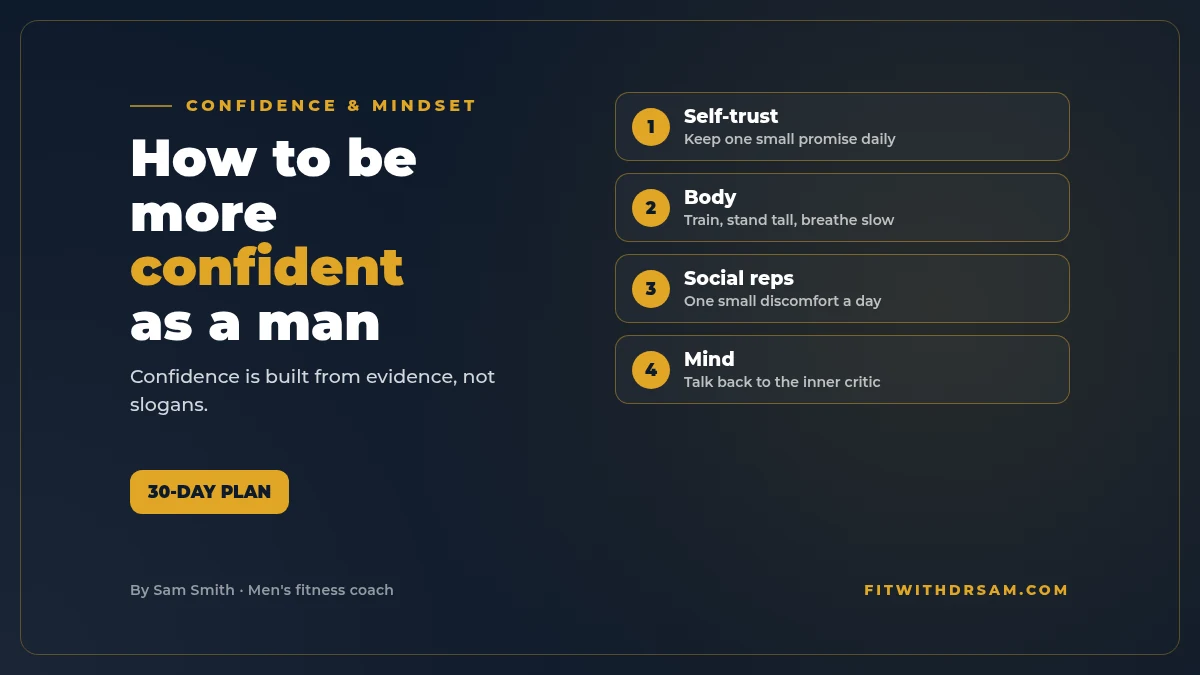
If you want to know how to be more confident as a man, start with this: confidence isn’t a personality type, it’s a result. It’s the trust you build in yourself when you keep your word, take care of your body and do hard things often enough that they stop feeling hard. You can’t think your way into it, but you can train it, like a muscle. Below is the 30-day plan I give coaching clients, with the research behind each step and the myths that waste your time.
Key takeaways
- Confidence comes mainly from evidence: small wins you repeat until you trust yourself.
- Keep one small daily promise to yourself. It’s the fastest way to rebuild self-trust.
- Training your body is one of the most reliable confidence habits, and it lowers anxiety too.
- Practice social reps: small, slightly uncomfortable actions, every day.
- “Power poses” and fake-it slogans don’t do much. Calm posture, eye contact and a steady voice do.
What confidence really is
Psychologist Albert Bandura called it self-efficacy: your belief that you can handle a specific situation. His research found that the strongest source of that belief is mastery experiences, actually doing the thing successfully, ideally starting with easier versions and building up (Bandura, 1977). Watching others, encouragement and your physical state help too, but nothing beats personal evidence.
That’s why affirmations in the mirror rarely work on their own. If your daily life is full of broken promises, skipped workouts and avoided conversations, your brain has evidence that you can’t rely on yourself. Change the evidence and the feeling follows.
Confidence also isn’t the same as being loud. The most confident men I’ve coached are often calm. They listen, they don’t need to win every argument, and they can say “I don’t know” or “I was wrong” without feeling smaller. Arrogance is usually insecurity in disguise.
The 4 pillars of confidence for men
1. Self-trust: keep your promises to yourself
Pick one small daily commitment you’ll keep no matter what: a 10-minute walk, 20 push-ups, making your bed, reading 10 pages. Small is the point. Make it a specific plan, such as “after my morning coffee, I’ll do 20 push-ups”. Research on these “if-then” plans, called implementation intentions, found they substantially improve the odds of following through on goals (Gollwitzer & Sheeran, 2006). Every day you keep it is a vote for “I’m someone who does what he says.” Our post on consistency in your workouts has more on making habits stick.
2. Your body: train, stand and move like you mean it
Training is a confidence machine. Every week you lift a bit more or run a bit further, you collect proof that effort works. It helps your mood too: a 2023 overview of 97 reviews found physical activity clearly reduced symptoms of depression, anxiety and distress (Singh et al., 2023). If you don’t train yet, start with a simple program like our 3-day full-body plan, which works at any age.
What about “power posing”? A famous 2010 study claimed that two minutes of expansive poses raised testosterone and confidence. A much larger replication found no effect on hormones or risk-taking (Ranehill et al., 2015). Skip the poses and focus on basics people actually notice: stand tall with relaxed shoulders, keep your phone in your pocket, hold eye contact for a few seconds, and speak a little slower than feels natural.
3. Social reps: practice small discomfort daily
Most men don’t lack social skills; they lack practice. Avoidance feels safe but keeps the fear alive, while gradual exposure shrinks it. Start with tiny reps and build up:
- Ask a stranger for a recommendation in a shop or café.
- Give a genuine, specific compliment (about a choice someone made, not their body).
- Speak first in one meeting or group conversation.
- Call instead of texting someone you’ve been meaning to contact.
- Introduce yourself to someone new at the gym, at work or at a class.
The goal isn’t a perfect outcome. The rep counts when you do it, however it goes. After a few weeks, things that felt scary feel normal, and that’s confidence growing.
4. Your mind: handle the inner critic
Low confidence often comes with a harsh inner voice: “You’ll mess this up”, “They think you’re boring”. You don’t have to believe every thought. Cognitive behavioral therapy (CBT), one of the best-researched approaches for anxiety (Hofmann et al., 2012), teaches a simple routine you can use yourself: notice the thought, ask what the evidence is for and against it, and replace it with something more balanced, such as “I might feel awkward at first, and that’s fine.” The NHS suggests similar steps for building self-esteem, including challenging negative beliefs and being kind to yourself (NHS).
When nerves hit in the moment, use your breath. A long, slow exhale calms your body within a minute. The 4-6 breath in our breathing techniques guide works just as well before a date, a presentation or a tough conversation.
Free plan
Get the 7-Day Stamina Starter
Confidence starts with your body. The free 7-Day Starter gives you 10 to 15 minutes a day of breathing, mobility and three short bodyweight sessions, with a tick-box tracker so you can keep your promise to yourself.
Send me the free planFree. No spam. Unsubscribe anytime.
Your 30-day confidence plan
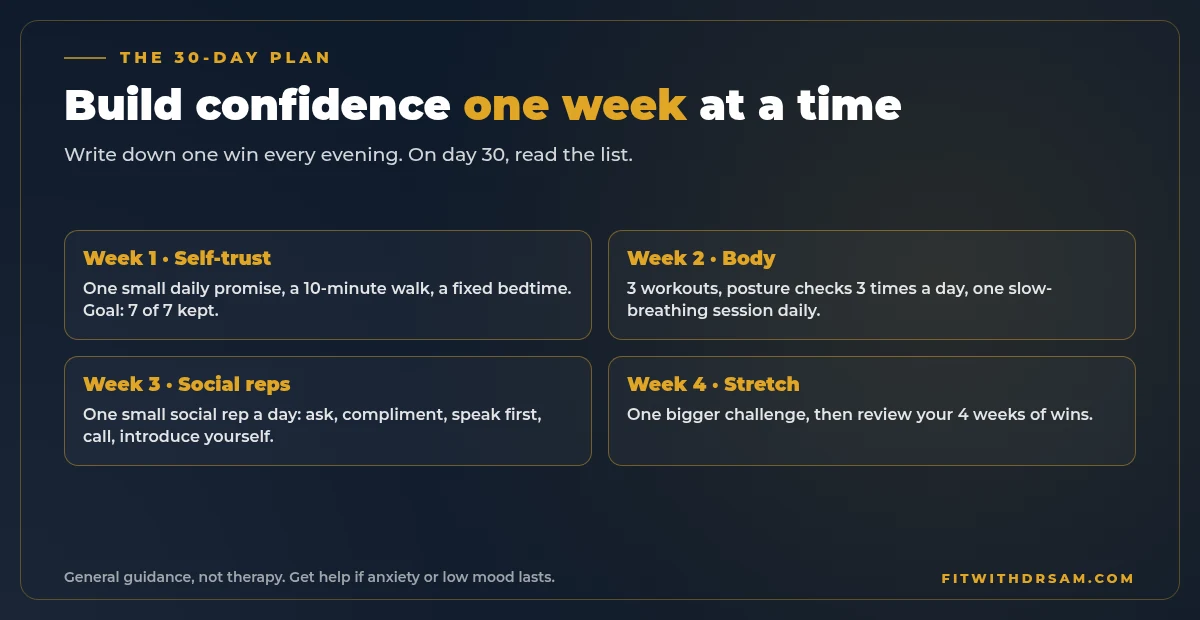
| Week | Daily actions | Goal |
|---|---|---|
| 1: Self-trust | One small daily promise + 10-minute walk + bed by a set time | 7 out of 7 promises kept |
| 2: Body | Start 3 workouts a week + posture check 3 times a day + one slow-breathing session | Feel stronger and calmer |
| 3: Social reps | One small social rep a day (list above) + daily promise | 7 reps, whatever the result |
| 4: Stretch | One bigger challenge (ask someone out, speak up in a meeting, join a class) + review your 4 weeks | Prove to yourself you can do hard things |
Write down one win every evening, however small. On day 30, read the list. That list is your confidence: evidence that you show up, follow through and handle discomfort.
How to look and sound more confident
People judge confidence in seconds, mostly from body language and voice. You can practice these today, and they feed back into how you feel:
- Slow down. Nervous men talk fast and fill silences. Speak a little slower, and let a pause sit for a second before you answer.
- Lower the volume of your doubts. Drop the habit of starting sentences with “Sorry, but” or “This is probably stupid”. Just say the thing.
- Hold eye contact for about 3 to 5 seconds at a time while talking, a bit longer while listening.
- Take up normal space. Feet planted, shoulders relaxed, hands visible and still. No need to puff your chest out.
- Dress for the man you’re building. Clothes that fit well, clean shoes and simple grooming make a bigger difference than any brand.
Record yourself on your phone telling a 1-minute story. Watch it back once, choose one thing to improve, and repeat it a week later. It feels awkward, and it works.
Confidence with women and in relationships
Confidence in dating works the same way. It isn’t about lines or tricks; it’s about being comfortable with yourself, showing genuine interest in the other person and being okay with any outcome. If you’re nervous in intimate moments, that’s common too, and our guide to performance anxiety in men explains how to calm it. In a relationship, confidence looks like honest communication, keeping your word and not needing constant reassurance.
Myths that keep men stuck
- “Fake it till you make it.” Acting confident can help you take the first step, but real confidence comes from what you do after that step.
- “Confident men aren’t nervous.” They are. They just act anyway, and the nerves shrink with practice.
- “I need to fix everything first.” Waiting until you feel ready means waiting forever. Start small today.
- “Alpha” behavior. Dominating conversations or putting others down signals insecurity, not confidence.
When to get extra help
When to get extra help
Self-help works for everyday low confidence. Talk to your doctor or a therapist if:
- fear of social situations is intense and lasts for months
- you avoid work, friends or dating because of anxiety
- you feel low, hopeless or numb most days
- you’re using alcohol or other substances to cope
Social anxiety is common and treatable, often with CBT (NHS, NIMH). If you ever feel hopeless or have thoughts of harming yourself, get help now: call or text 988 in the US or Canada, call Samaritans on 116 123 in the UK, or TelefonSeelsorge on 0800 111 0 111 in Germany, or your local emergency number.
Frequently asked questions
How can a man become more confident fast?
The fastest real gains come from action, not mindset tricks: keep one small promise to yourself every day, start training, improve your posture and voice, and do one slightly uncomfortable social action daily. Most men feel a difference within 2 to 4 weeks, because confidence grows from evidence that you can handle things.
Is confidence something you’re born with?
Partly, temperament plays a role, but confidence is largely learned. Psychologists describe self-efficacy, your belief that you can handle a task, as built mostly through “mastery experiences”: doing hard things successfully, starting small. That’s something any man can practice.
Does working out make you more confident?
For many men, yes. Training gives you clear, measurable wins every week, improves posture and energy, and a large overview of studies found physical activity reduces symptoms of anxiety and depression. Getting stronger is one of the most reliable confidence habits there is.
What’s the difference between confidence and arrogance?
Confidence is calm trust in yourself; it doesn’t need to prove anything. Arrogance is usually a cover for insecurity: needing to win, dominate or put others down. Confident men can listen, admit mistakes and be happy for other people’s success.
When is low confidence a sign of something more serious?
If fear of social situations is intense, lasts for months, makes you avoid work, dating or friends, or comes with low mood most days, it may be social anxiety or depression. Both are common and treatable. A doctor or a therapist offering CBT is a good place to start.
The bottom line
You become more confident as a man by building evidence: keep small promises, train your body, practice social reps and talk back to your inner critic. Follow the 30-day plan, write down one win a day, and by the end of the month you’ll have proof that you can rely on yourself. That’s what confidence is.
30-day challenge · by Sam Smith
The Warrior’s Stamina
My 30-day challenge for men who want more discipline, self-control and stamina: daily bodyweight workouts, breathwork and simple rituals that build the habit of keeping your word.
See the bookResults vary. Educational content, not therapy or medical advice.
References
- Bandura A. Self-efficacy: toward a unifying theory of behavioral change. Psychol Rev. 1977;84(2):191-215. PubMed
- Gollwitzer PM, Sheeran P. Implementation intentions and goal achievement: a meta-analysis of effects and processes. Adv Exp Soc Psychol. 2006;38:69-119. DOI
- Singh B, Olds T, Curtis R, et al. Effectiveness of physical activity interventions for improving depression, anxiety and distress: an overview of systematic reviews. Br J Sports Med. 2023;57(18):1203-1209. PubMed Central
- Ranehill E, Dreber A, Johannesson M, et al. Assessing the robustness of power posing: no effect on hormones and risk tolerance in a large sample of men and women. Psychol Sci. 2015;26(5):653-656. PubMed
- Hofmann SG, Asnaani A, Vonk IJ, Sawyer AT, Fang A. The efficacy of cognitive behavioral therapy: a review of meta-analyses. Cognit Ther Res. 2012;36(5):427-440. PubMed Central
- NHS. Raising low self-esteem. Read online
- NHS. Social anxiety (social phobia). Read online
- National Institute of Mental Health. Social anxiety disorder: more than just shyness. Read online
All links checked October 11, 2026.