Workout Plan for Men Over 40: 3 Days a Week
Educational content, not medical advice. This article is general information from a fitness coach. It’s not a diagnosis or treatment. If you have a health concern, see a doctor. See “When to see a doctor” below.
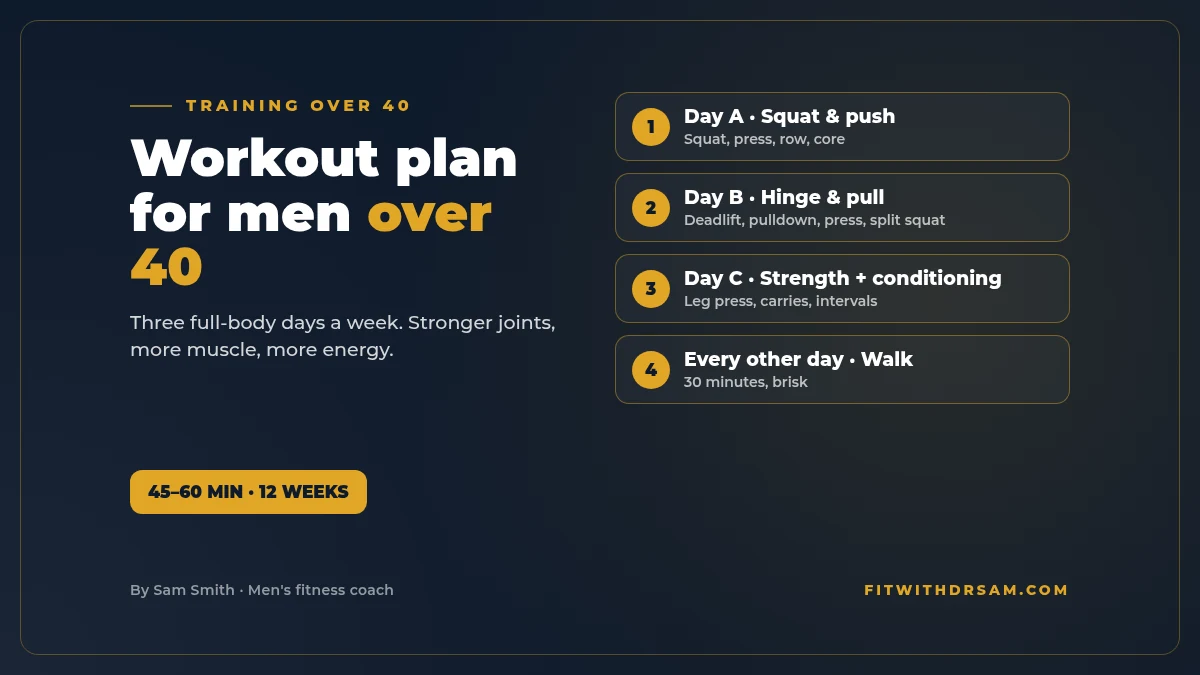
The best workout plan for men over 40 is simple: three full-body strength sessions a week, built on a few big movements, with a proper warm-up, steady progression and some walking or cardio around it. You don’t need punishing two-hour sessions or a bodybuilding split. Below is the exact 3-day plan I use with clients in their 40s and 50s, how to progress it over 12 weeks, how to work around stiff joints, and how to eat for it. If you want the “why”, our post on muscle mass and lifespan explains how much strength matters as you age.
Key takeaways
- Muscle mass starts to decline from your 30s, but strength training reverses much of it. Older adults gained about 25% to 30% in strength in a 47-study meta-analysis.
- Train 3 full-body days a week, around 45 to 60 minutes each, with 1 to 3 reps left in the tank on most sets.
- Even 30 to 60 minutes a week of strength training was linked to a 10% to 20% lower risk of early death.
- Warm up for 10 minutes, progress slowly, and choose joint-friendly versions of each movement.
- Eat about 1.6 g of protein per kg (0.7 g per lb) a day and sleep 7 to 9 hours to recover.
Why training changes after 40
Your body still responds to training after 40, but a few things shift. Harvard Health notes that after 30 you can lose as much as 3% to 5% of your muscle mass per decade if you do nothing about it (Harvard Health). Recovery tends to take a little longer, joints and tendons are less forgiving of sudden jumps in load, and work, family and stress leave less time and energy.
The good news is that the fix is well proven. A meta-analysis of 47 studies with 1,079 older adults found that resistance training increased strength by about 25% to 33% depending on the exercise, and higher-intensity training produced bigger gains (Peterson et al., 2010). The benefits go beyond the mirror. A 2022 meta-analysis found that muscle-strengthening activity was associated with a 10% to 17% lower risk of death from any cause, heart disease, cancer and diabetes, with the biggest benefit at about 30 to 60 minutes a week (Momma et al., 2022). That’s a very achievable dose.
Health guidelines agree. The NHS, WHO and the Canadian guidelines all recommend strength training on at least 2 days a week, plus 150 minutes of moderate activity (NHS, WHO, CSEP).
The 5 rules of training over 40
- Full body, 3 times a week. Training each muscle 2 to 3 times a week spreads the work out, so each session is shorter and less draining. A meta-analysis found strength gains were similar or better with higher weekly frequency when volume was matched (Ralston et al., 2018).
- Leave 1 to 3 reps in reserve. End most sets when you could still do 1 to 3 more good reps. You get nearly all the benefit with far less joint stress and fatigue.
- Progress slowly. Add 1 or 2 reps, or about 2.5 kg (5 lb) on lower-body lifts and 1 to 2 kg (2.5 to 5 lb) on upper-body lifts, only when every set feels solid.
- Never skip the warm-up. Ten minutes of easy cardio and mobility, then 1 or 2 lighter sets of your first exercise.
- Protect your back. Brace gently, keep a neutral spine and don’t round under load. Our guide to bodybuilding mistakes that injure your back covers the most common errors.
The 3-day workout plan for men over 40
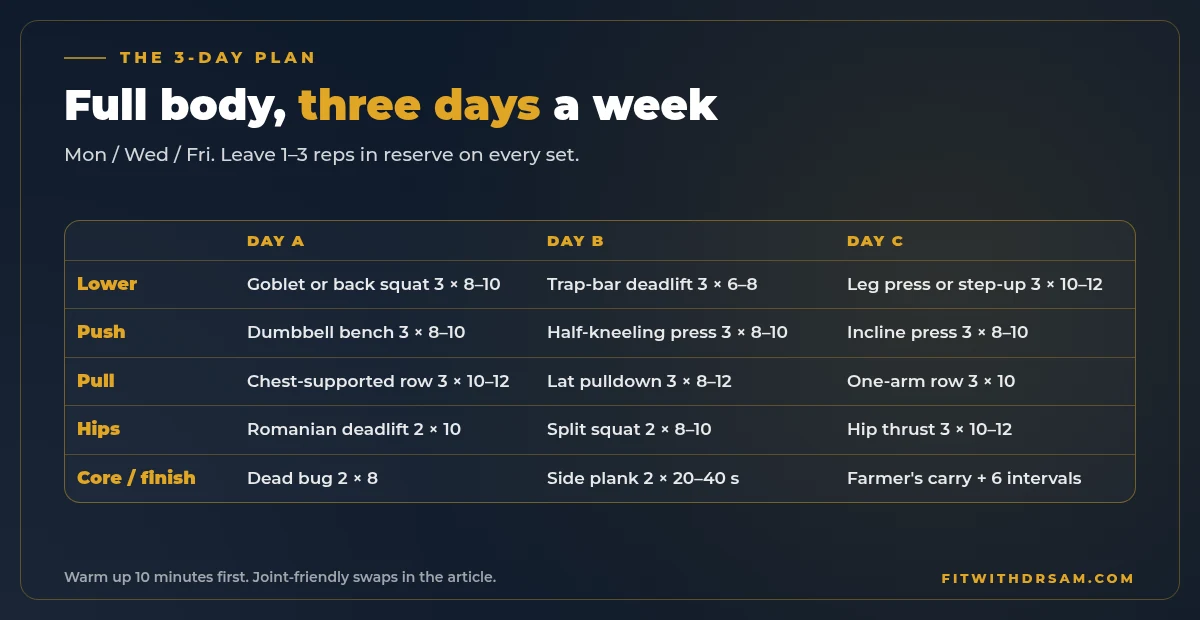
Do the three sessions on non-consecutive days, for example Monday, Wednesday and Friday. Rest 90 seconds to 2 minutes between sets of the big lifts and 60 seconds on the smaller ones. Each session takes about 45 to 60 minutes including the warm-up.
Day A: Squat and push
| Exercise | Sets × reps | Joint-friendly option |
|---|---|---|
| Goblet squat or back squat | 3 × 8–10 | Box squat to a bench |
| Dumbbell bench press | 3 × 8–10 | Push-up, hands raised on a bench |
| Chest-supported dumbbell row | 3 × 10–12 | Seated cable row |
| Romanian deadlift (dumbbells) | 2 × 10 | Glute bridge |
| Dead bug | 2 × 8 per side | — |
Day B: Hinge and pull
| Exercise | Sets × reps | Joint-friendly option |
|---|---|---|
| Trap-bar deadlift | 3 × 6–8 | Kettlebell deadlift from a raised block |
| Lat pulldown or assisted pull-up | 3 × 8–12 | Band pulldown |
| Half-kneeling one-arm dumbbell press | 3 × 8–10 per side | Landmine press |
| Split squat | 2 × 8–10 per side | Hold a support for balance |
| Side plank | 2 × 20–40 seconds per side | Knees bent |
Day C: Strength and conditioning
| Exercise | Sets × reps | Joint-friendly option |
|---|---|---|
| Leg press or step-up | 3 × 10–12 | Lower step |
| Incline dumbbell press | 3 × 8–10 | Machine press |
| One-arm dumbbell row | 3 × 10 per side | — |
| Hip thrust | 3 × 10–12 | Glute bridge on the floor |
| Farmer’s carry | 3 × 30–40 m (35–45 yards) | Lighter dumbbells, shorter walks |
| Finisher: bike or rower intervals | 6 × 30 s hard / 60 s easy | Brisk incline walk |
On the other days, walk. A daily 30-minute brisk walk gets you most of the way to 150 minutes of cardio and helps recovery. Add the mobility routine from our stretching exercises guide on 2 or 3 evenings to keep your hips, shoulders and back moving well.
Free plan
Get the 7-Day Stamina Starter
Short on time this week? The free 7-Day Starter gives you three 15-minute bodyweight sessions, daily mobility and breathing, with a tick-box tracker. Ideal before you start the full plan.
Send me the free planFree. No spam. Unsubscribe anytime.
How to progress over 12 weeks
| Weeks | Focus | What to do |
|---|---|---|
| 1–2 | Technique | Use about 60% of the effort you think you could manage. 2 sets per exercise. Learn every movement. |
| 3–6 | Build | 3 sets. Use the top of the rep range with 2 reps in reserve, then add weight. |
| 7–10 | Strength | Main lifts move to the lower end of the rep range with heavier loads; keep 1 to 2 reps in reserve. |
| 11 | Deload | Same exercises, half the sets, lighter weights. Let your joints and energy recover. |
| 12 | Test and reset | Note your best sets, then start a new block with slightly heavier starting weights. |
Keep a simple log: exercise, weight, reps and how it felt. If you’re not getting stronger over 3 to 4 weeks, check your sleep, stress and food before you add more training. More isn’t better after 40; better recovery usually is.
Nutrition and recovery for men over 40
- Protein: a meta-analysis found that the muscle-building benefit of extra protein levelled off at about 1.6 g per kg of body weight a day (about 0.7 g per lb) (Morton et al., 2018). For a 85 kg (187 lb) man, that’s around 135 g a day, or 30 to 40 g at each of 3 to 4 meals.
- Food quality: build meals around protein, vegetables, whole grains and healthy fats. Our list of testosterone foods for men doubles as a good shopping list for training.
- Sleep: 7 to 9 hours. It’s when most of your recovery happens.
- Alcohol: keep it moderate, especially on training days. It slows recovery and adds easy calories.
- Stress: on very stressful weeks, keep the sessions but drop one set from each exercise.
Common mistakes men over 40 make in the gym
- Training like they did at 20. Ego lifting and long, high-volume splits often end in sore joints and missed weeks.
- Skipping legs and back. The hips and back are what keep you strong, mobile and pain-free for decades.
- No plan. Random workouts make it impossible to progress. Repeat the same plan for 12 weeks.
- Ignoring cardio. Heart health matters as much as muscle. Walk daily and add one interval finisher a week.
- Pushing through joint pain. Muscle soreness is normal; sharp or worsening joint pain isn’t. Switch to the joint-friendly option and get it checked if it persists.
When to see a doctor
When to see a doctor
Exercise is safe for most men, but check with your doctor (GP in the UK, Hausarzt in Germany) before starting if:
- you have heart disease, high blood pressure, diabetes or another long-term condition
- you get chest pain, unusual breathlessness, dizziness or palpitations when you exert yourself
- you have a joint or back injury that hasn’t been assessed
- you’ve been inactive for a long time and are unsure where to start
Stop any exercise immediately if you feel chest pain or faintness, and get medical help. A physiotherapist can help you adapt the plan around an injury.
Frequently asked questions
How many days a week should a man over 40 work out?
Three strength sessions a week is a strong, sustainable target for most men over 40, with 2 or 3 days of walking or other cardio around them. Two full-body sessions also work well if you’re busy. Health guidelines in the UK, US and Canada recommend strength training on at least 2 days a week plus 150 minutes of moderate activity.
Can you still build muscle after 40?
Yes. A meta-analysis of 47 studies in older adults found that resistance training improved strength by roughly 25% to 30%, and muscle can be built well into your 60s and beyond. Progress may be a little slower than at 25, and recovery matters more, but the response to training is still strong.
Should men over 40 lift heavy?
Most men over 40 can lift moderately heavy weights safely once their technique is solid. Higher-intensity training was linked to bigger strength gains in older adults. Build up over several weeks, stop each set with 1 to 3 reps in reserve, and avoid grinding out maximal lifts if you have joint or back problems.
How long should a workout be for men over 40?
About 45 to 60 minutes, including a 10-minute warm-up. That’s enough for 4 to 6 exercises of 2 to 4 sets each. Longer sessions aren’t more effective if you’re training 3 times a week.
How much protein do men over 40 need to build muscle?
A meta-analysis found that the benefit for muscle levelled off at about 1.6 g of protein per kg of body weight a day (about 0.7 g per pound). For a 85 kg (187 lb) man, that’s about 135 g a day, spread over 3 to 4 meals.
The bottom line
After 40, consistency beats intensity. Train three full-body days a week, keep 1 to 3 reps in reserve, add weight slowly, walk on the days in between, eat enough protein and sleep well. Run this plan for 12 weeks and you’ll be stronger, move better and feel more energetic. It also supports the stamina side of fitness, which we cover in exercises to last longer.
30-day challenge · by Sam Smith
The Warrior’s Stamina
My 30-day challenge for men who want more stamina, discipline and self-control: bodyweight workouts you can do anywhere, breathwork and simple daily rituals. A good companion on the days between your gym sessions.
See the bookResults vary. Educational content, not medical advice.
References
- Peterson MD, Rhea MR, Sen A, Gordon PM. Resistance exercise for muscular strength in older adults: a meta-analysis. Ageing Res Rev. 2010;9(3):226-237. PubMed Central
- Momma H, Kawakami R, Honda T, Sawada SS. Muscle-strengthening activities are associated with lower risk and mortality in major non-communicable diseases: a systematic review and meta-analysis of cohort studies. Br J Sports Med. 2022;56(13):755-763. PubMed Central
- Morton RW, Murphy KT, McKellar SR, et al. A systematic review, meta-analysis and meta-regression of the effect of protein supplementation on resistance training-induced gains in muscle mass and strength in healthy adults. Br J Sports Med. 2018;52(6):376-384. PubMed Central
- Ralston GW, Kilgore L, Wyatt FB, Buchan D, Baker JS. Weekly training frequency effects on strength gain: a meta-analysis. Sports Med Open. 2018;4(1):36. PubMed Central
- Harvard Health Publishing. Preserve your muscle mass. Read online
- NHS. Physical activity guidelines for adults aged 19 to 64. Read online
- World Health Organization. Physical activity (fact sheet). Read online
- Canadian Society for Exercise Physiology. Canadian 24-Hour Movement Guidelines for Adults aged 18–64. Read online
All links checked October 11, 2026.