Testosterone Foods for Men: 15 to Eat and 6 to Limit
Educational content, not medical advice. This article is general information from a fitness coach. It’s not a diagnosis or treatment. If you have a health concern, see a doctor. See “When to see a doctor” below.
The best testosterone foods for men aren’t magic “boosters”. They’re foods rich in the nutrients your body needs to make testosterone, mainly zinc, vitamin D, healthy fats and protein, inside a diet that keeps your body fat in a healthy range. Below are 15 foods worth eating regularly, 6 to limit, the myths you can ignore, and a simple day of eating. This guide is about food; for sleep, training and the rest of the picture, read our pillar guide on how to increase testosterone naturally.
Key takeaways
- No single food raises testosterone. Food helps mainly by fixing deficiencies (zinc, vitamin D) and helping you keep a healthy weight.
- Don’t cut fat too low: in a meta-analysis, low-fat diets lowered testosterone compared with higher-fat diets.
- Losing excess body fat is one of the most reliable ways to raise low testosterone linked to obesity.
- Limit heavy drinking, large amounts of real licorice, crash diets and ultra-processed food.
- Soy is fine. A 41-study meta-analysis found no effect on men’s hormones.
How food affects testosterone
Your body makes testosterone from cholesterol, in a process that needs enough energy and several nutrients. Food affects it in three main ways:
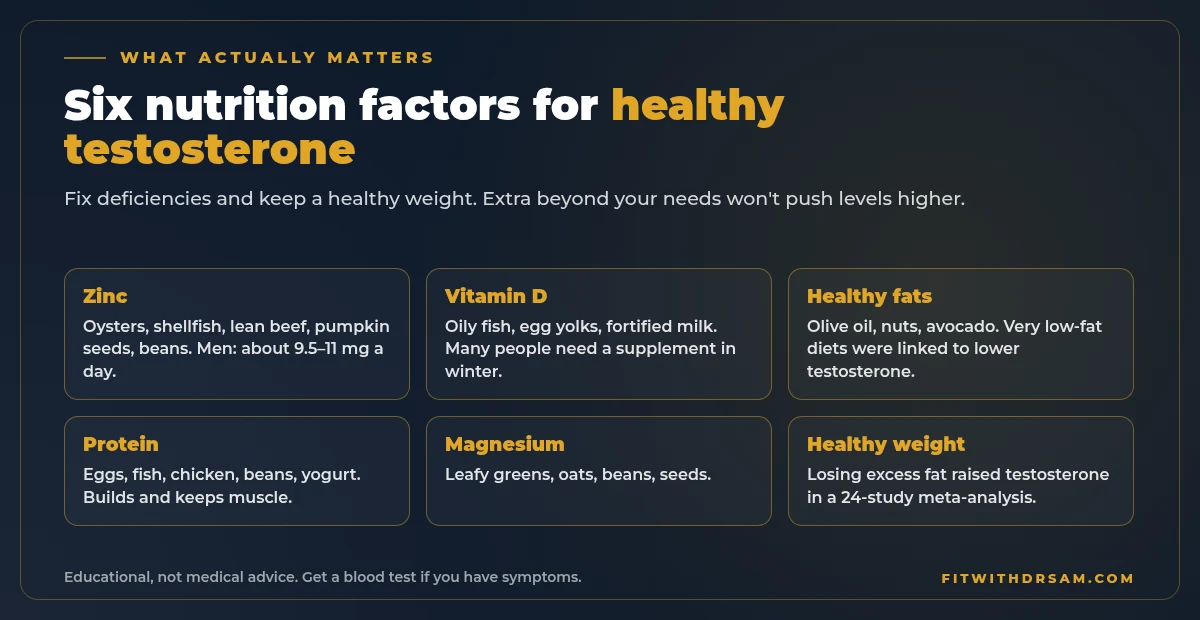
- Deficiencies. Zinc and vitamin D are the two best studied. In one study, restricting zinc in healthy young men lowered testosterone sharply over 20 weeks, and zinc supplements in older men who were marginally deficient raised it (Prasad et al., 1996). Fix a deficiency and levels can recover; take more than you need and there’s no extra benefit.
- Dietary fat. A 2021 meta-analysis of 6 intervention studies found that men on low-fat diets had lower total and free testosterone than men on higher-fat diets (Whittaker & Wu, 2021). The studies were small, but the message is clear: don’t fear healthy fats.
- Body weight. Excess body fat is strongly linked to low testosterone. A meta-analysis of 24 studies found that weight loss, through diet or surgery, raised testosterone, and the more weight men lost, the bigger the rise (Corona et al., 2013). So the “best testosterone food” is often simply a diet you can stay lean on.
For context: testosterone is reported in ng/dL in the US and nmol/L in the UK, Canada and Germany (1 nmol/L is about 28.8 ng/dL). Levels peak in early adulthood and fall gradually after that. The NHS points out this decline is steady, not the sudden drop that “male menopause” headlines suggest (NHS).
15 testosterone foods to eat
Zinc-rich foods
- 1. Oysters and shellfish. Oysters are the richest food source of zinc by far; crab, lobster and mussels are good too. Men need about 11 mg of zinc a day in the US and Canada and 9.5 mg in the UK (NIH Office of Dietary Supplements).
- 2. Lean beef and lamb. A 100 g (3.5 oz) serving of beef gives a large share of your daily zinc plus high-quality protein. Choose lean cuts and keep processed meats like salami and hot dogs occasional.
- 3. Pumpkin seeds. A 30 g (1 oz) handful provides zinc and magnesium. Easy to add to oats, yogurt or salads.
- 4. Beans, lentils and chickpeas. A good plant source of zinc, magnesium and fiber, and they keep you full, which helps with weight control.
- 5. Chicken and turkey. Lean protein with some zinc, especially in darker meat. A practical base for most meals.
Vitamin D foods
- 6. Oily fish. Salmon, sardines, mackerel and trout are among the few natural food sources of vitamin D, plus omega-3 fats. Aim for 2 portions of fish a week, one of them oily.
- 7. Whole eggs. The yolk contains vitamin D, fat and cholesterol. Egg whites alone miss most of that.
- 8. Fortified milk, yogurt and cereals. In the US and Canada, milk is fortified with vitamin D. In the UK and Germany, fortification is less common, so check the label.
- 9. UV-exposed mushrooms. Some supermarket mushrooms are grown under UV light and labeled as a vitamin D source.
Food alone rarely covers vitamin D in winter. In a 1-year trial of overweight men with low vitamin D, a daily supplement of 3,332 IU raised total testosterone from 10.7 to 13.4 nmol/L (about 309 to 386 ng/dL), while placebo didn’t (Pilz et al., 2011). It was a small study in men who were deficient, so don’t expect the same if your levels are normal. The NHS advises everyone in the UK to consider a 10 microgram (400 IU) supplement in autumn and winter (NHS). Ask your doctor about a blood test before taking higher doses.
Healthy fats
- 10. Extra-virgin olive oil. Use it as your main cooking and salad oil.
- 11. Nuts. Walnuts, almonds and Brazil nuts; a 30 g (1 oz) handful a day is a sensible portion.
- 12. Avocado. Monounsaturated fat, fiber and potassium. Half an avocado is a good serving.
Foods for overall hormone health
- 13. Leafy greens. Spinach, kale and chard provide magnesium, which your body needs for hundreds of processes, including hormone production.
- 14. Oats and whole grains. Fiber, magnesium and steady energy for training. Very low-carb diets aren’t necessary for staying lean.
- 15. Colorful vegetables and fruit. Not a direct testosterone food, but they’re the base of a diet that keeps you lean, and body fat is one of the biggest factors you can control. For budget versions of all of this, see building muscle on a budget.
Free plan
Get the 7-Day Stamina Starter
A simple 7-day plan: daily 10 to 15 minutes of breathing, pelvic-floor basics, mobility and three short bodyweight sessions, plus easy energy habits, with a tick-box tracker.
Send me the free planFree. No spam. Unsubscribe anytime.
6 foods and habits to limit
| Limit | Why | What to do instead |
|---|---|---|
| Heavy drinking | Alcohol can interfere with testosterone production; heavy, long-term drinking is clearly linked to lower levels | Stay within 14 units a week (UK guidance), spread over 3+ days, with alcohol-free days |
| Large amounts of real licorice | Glycyrrhizin in real licorice lowered testosterone in a small study of healthy men | Occasional sweets are fine; avoid eating it daily or in large amounts |
| Ultra-processed fast food | Easy to overeat, which drives weight gain, and weight gain is linked to lower testosterone | Base most meals on protein, vegetables and whole foods |
| Sugary drinks | Lots of calories without fullness | Water, sparkling water, coffee or tea without sugar |
| Very low-fat diets | Linked to lower testosterone in a meta-analysis | Get about 25–35% of calories from fat, mostly unsaturated |
| Crash diets | Eating far too little for your activity can suppress testosterone, as seen in underfed endurance athletes | Lose weight slowly, about 0.5–1% of body weight a week |
On alcohol, a research review explains that it can act on the testes and on the brain signals that control them, and heavy drinkers often have low testosterone (Emanuele & Emanuele, 1998). The UK low-risk limit is 14 units a week; one unit is 10 ml (8 g) of pure alcohol, roughly half a pint of regular beer (NHS). Our post on alcohol and muscle growth covers how it affects your training too. On licorice, the study was small but striking: healthy men eating 7 g a day of real licorice saw testosterone fall within a week (Armanini et al., 1999). On crash diets, a review of male endurance athletes found that low energy availability is linked to reduced testosterone (Cupka et al., 2023).
Testosterone food myths
- “Soy lowers testosterone.” A 2021 meta-analysis of 41 clinical studies found neither soy protein nor isoflavones affected men’s testosterone or other reproductive hormones (Reed et al., 2021). Tofu and soy milk are fine, and useful if you eat plant-based (see muscle building for vegetarians and vegans).
- “Raw eggs or bull testicles boost testosterone.” There’s no good evidence, and raw eggs carry a food-poisoning risk.
- “Booster” supplements from social media. Many make big claims with little evidence. If you’re not deficient in a nutrient, extra is unlikely to help, and some products contain hidden or unlisted ingredients.
- “More protein means more testosterone.” Protein builds muscle, but very high protein at the expense of fat and carbs isn’t a testosterone strategy.
A sample day of testosterone-friendly eating
| Meal | Example | Key nutrients |
|---|---|---|
| Breakfast | 3 whole eggs, spinach, whole-grain toast, a piece of fruit | Protein, vitamin D, fat, magnesium |
| Lunch | Lentil and chicken salad with olive oil, avocado and pumpkin seeds | Zinc, fiber, healthy fats |
| Snack | Greek yogurt (fortified, if available) with a handful of walnuts and berries | Protein, fat |
| Dinner | Salmon or lean beef (150 g / 5 oz), potatoes or rice, two vegetables | Vitamin D or zinc, carbs for training |
| Weekly extras | Oysters, mussels or sardines once a week | Zinc, vitamin D, omega-3 |
Adjust the portions to your goal: smaller if you need to lose fat, larger if you’re trying to gain muscle. Combine this with strength training, 7 to 9 hours of sleep and regular activity for the biggest effect.
When to see a doctor
When to see a doctor
Food is a foundation, not a treatment. See your doctor (GP in the UK, Hausarzt in Germany) for a blood test if you notice:
- low sex drive, erection problems or fewer morning erections that last for weeks
- ongoing tiredness, low mood or poor concentration without an obvious reason
- loss of muscle, increasing body fat or breast tenderness or swelling
- you’re thinking about testosterone “boosters”, high-dose zinc or vitamin D, or testosterone therapy
Testosterone is usually measured with a morning blood test, when levels are highest (Cleveland Clinic). Many symptoms of low testosterone have other causes, such as stress, poor sleep, thyroid problems or depression, so it’s worth getting checked properly.
Frequently asked questions
What food increases testosterone the most?
No single food raises testosterone on its own. The foods that help most are rich in zinc (oysters, shellfish, beef, pumpkin seeds) and vitamin D (oily fish, egg yolks, fortified milk), because low levels of either are linked to lower testosterone. If you aren’t low, extra won’t push you higher. Your overall diet and body weight matter more.
What foods kill testosterone?
No food “kills” testosterone, but some habits can lower it: heavy drinking, large daily amounts of real licorice, very low-fat diets, crash dieting, and a diet of ultra-processed food and sugary drinks that leads to weight gain. Soy, despite the myth, doesn’t lower testosterone in men according to a large meta-analysis.
Do eggs increase testosterone?
Eggs don’t directly raise testosterone, but they’re a cheap source of protein, vitamin D (in the yolk) and the dietary fat and cholesterol your body uses to make hormones. For most healthy men, whole eggs can be part of a balanced diet.
Is soy bad for men’s testosterone?
The evidence says no. A 2021 meta-analysis of 41 clinical studies found that neither soy protein nor soy isoflavones affected testosterone or other male reproductive hormones. Tofu, soy milk and edamame are fine protein sources for men.
How quickly can diet change testosterone?
It depends on the cause. Correcting a real deficiency, or losing excess body fat, can raise testosterone over a few months. If your levels are already normal, diet changes have a small effect. If you have symptoms of low testosterone, get a blood test before trying to fix it with food or supplements.
The bottom line
The best testosterone foods are ordinary: shellfish, lean meat, eggs, oily fish, seeds, beans, nuts, olive oil and plenty of plants. Eat enough zinc and vitamin D, don’t cut fat too low, limit alcohol and ultra-processed food, and keep your body fat in a healthy range. That’s what the evidence supports, without the hype.
Diet, BMR & bodyweight guide · by Sam Smith
Nutrition, Metabolism & Muscle
My practical guide to eating for fat loss or muscle: how to find your BMR and macros, build meals that keep you full, and train with bodyweight anywhere. Includes a calculator, tracker and 3 meal plans.
See the bookResults vary. Educational content, not medical or dietary treatment.
References
- Whittaker J, Wu K. Low-fat diets and testosterone in men: systematic review and meta-analysis of intervention studies. J Steroid Biochem Mol Biol. 2021;210:105878 (corrigendum 2026). PubMed
- Corona G, Rastrelli G, Monami M, et al. Body weight loss reverts obesity-associated hypogonadotropic hypogonadism: a systematic review and meta-analysis. Eur J Endocrinol. 2013;168(6):829-843. PubMed
- Prasad AS, Mantzoros CS, Beck FW, et al. Zinc status and serum testosterone levels of healthy adults. Nutrition. 1996;12(5):344-348. PubMed
- Pilz S, Frisch S, Koertke H, et al. Effect of vitamin D supplementation on testosterone levels in men. Horm Metab Res. 2011;43(3):223-225. PubMed
- Reed KE, Camargo J, Hamilton-Reeves J, et al. Neither soy nor isoflavone intake affects male reproductive hormones: an expanded and updated meta-analysis of clinical studies. Reprod Toxicol. 2021;100:60-67. PubMed
- Armanini D, Bonanni G, Palermo M. Reduction of serum testosterone in men by licorice. N Engl J Med. 1999;341(15):1158. PubMed
- Emanuele MA, Emanuele NV. Alcohol’s effects on male reproduction. Alcohol Health Res World. 1998;22(3):195-201. PubMed Central
- Cupka M, et al. Hungry runners: low energy availability in male endurance athletes and its impact on performance and testosterone: mini-review. Eur J Transl Myol. 2023;33(2):11104. PubMed Central
- NIH Office of Dietary Supplements. Zinc: fact sheet for health professionals. Read online
- NHS. Vitamin D. Read online
- NHS. Alcohol units. Read online
- NHS. The “male menopause”. Read online
- Cleveland Clinic. Testosterone. Read online
All links checked October 11, 2026.