Exercises to Last Longer in Bed: An 8-Week Training Plan for Men
Educational content, not medical advice. This article is general information from a fitness coach. It’s not a diagnosis or treatment. If you have a health concern, see a doctor. See “When to see a doctor” below.
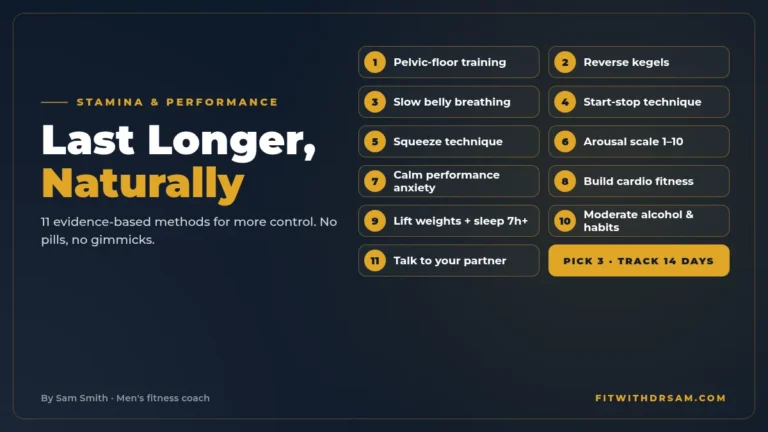
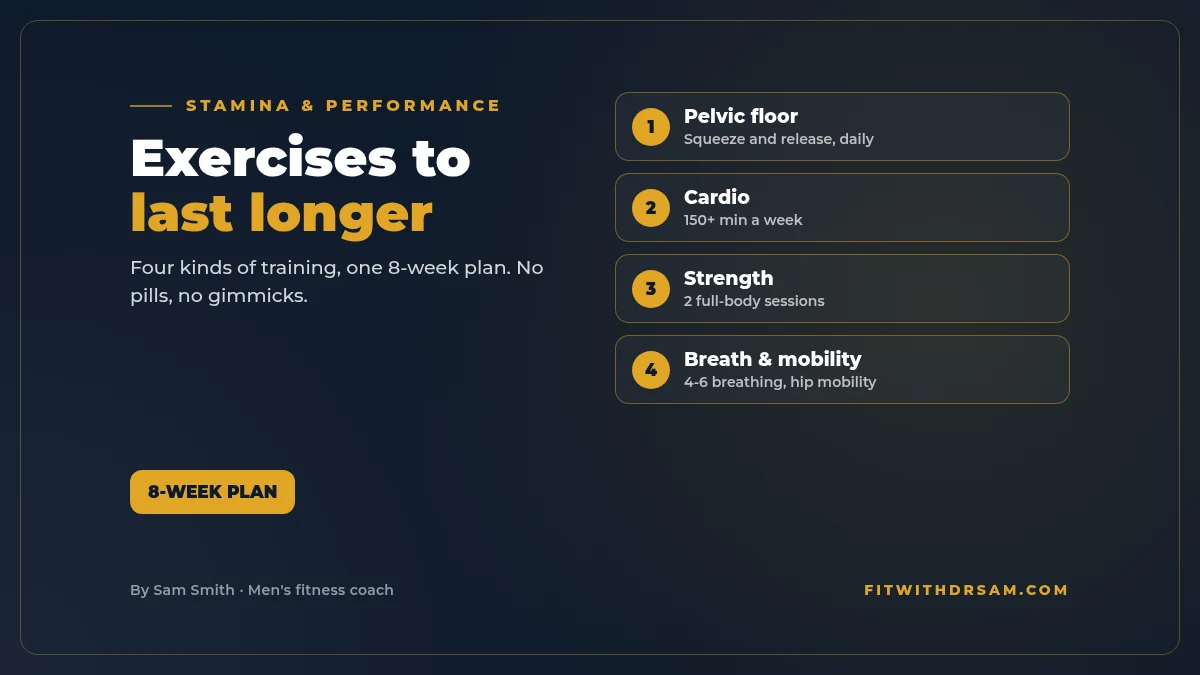
The best exercises to last longer in bed train four things: your pelvic floor, your cardio fitness, your overall strength, and your breathing and ability to relax. Most men try only one of these, usually kegels, and give up after a week. Below is the 8-week plan I use with coaching clients, with the exact exercises, sets and weekly targets, plus what the research says about each part. For every drug-free method, including pacing techniques, see our guide to lasting longer in bed naturally.
Key takeaways
- Pelvic-floor training has the best evidence of any exercise for ejaculatory control. In clinical programs, men trained for about 12 weeks.
- Learn to relax the pelvic floor, not just squeeze it. A tense pelvic floor can work against control.
- In one trial, 30+ minutes of moderate activity, 5 times a week, improved results in men with lifelong early ejaculation.
- Two full-body strength sessions a week support fitness, posture and confidence, in line with NHS and WHO guidelines.
- Expect gradual change over 4 to 12 weeks. Results vary, and some causes need a doctor.
Why exercise can help you last longer
Lasting longer is partly a skill and partly a fitness issue. The skill is noticing your arousal early and staying calm enough to steer it. The fitness side is about the muscles and systems that support that skill:
- The pelvic-floor muscles sit at the base of your pelvis and are directly involved in ejaculation. Training them gives you more awareness and control.
- Your heart and circulation support blood flow, energy and a calmer stress response. Fitter men are less likely to tire, tense up or rush.
- Your breathing sets your nervous system’s pace. Fast, shallow breathing pushes arousal up quickly; slow breathing helps you stay steady.
- Your strength and mobility affect posture, hip and core control, and how comfortable and confident you feel in your body.
It’s worth being honest about the evidence. Early ejaculation is common: Cleveland Clinic says 30% to 40% of men experience it at some point (Cleveland Clinic). The research on exercise is promising, but it’s mostly small studies. Exercise is a smart, low-risk first step, not a guarantee, and it works best alongside the techniques in our other guides.
Pillar 1: Pelvic-floor training (strength and release)
This is the part with the most evidence. A 2019 systematic review of 10 trials concluded that pelvic-floor muscle training “appears effective” for early ejaculation, while noting that the studies were of low to moderate quality and used very different protocols (Myers & Smith, 2019). In an Italian clinic, men with lifelong early ejaculation followed a 12-week supervised pelvic-floor program, three sessions a week. 111 of the 122 who finished it gained control of the reflex, and just over half still had good control 3 years later (Pastore et al., 2018). That program used physiotherapy, electrostimulation and biofeedback, so a home routine is a simpler version. The principle is the same, though: train the muscles consistently for months, not days.
How to do a kegel correctly
- Find the muscles: imagine stopping the flow of urine or holding in gas. That gentle lift and squeeze is your pelvic floor. Use it only to find the muscles; don’t make a habit of stopping your urine stream (Cleveland Clinic).
- Lie on your back with your knees bent. Squeeze and lift for 3 to 5 seconds while breathing normally.
- Relax fully for the same time or longer. The release is half the exercise.
- Keep your glutes, thighs and belly loose. If you’re holding your breath, you’re squeezing too hard.
Add quick flicks too: 10 fast, firm squeezes with a full release between each. These train the fast-reacting fibers you use to “brake” in the moment. For the full technique and common mistakes, see our pelvic floor guide.
Add the release: reverse kegels
Many men who finish fast are already tense: they clench their glutes, brace their belly and hold their breath. More squeezing doesn’t fix that. A reverse kegel is a gentle, controlled release of the same muscles on a slow breath in. Practice 8 to 10 slow releases after each kegel set. The step-by-step method is in reverse kegels for men.
Pillar 2: Cardio for stamina and blood flow
Cardio is the most underrated exercise for lasting longer. In a randomized, sham-controlled trial of 105 men with lifelong early ejaculation, the group that did moderate physical activity for more than 30 minutes, at least 5 times a week, improved ejaculation time and symptom scores compared with a minimal-activity group. Their results were comparable to a group given a prescription medicine (Kilinc et al., 2018). It’s one small study, so we can’t call it proven. Aerobic exercise also has good evidence for erection health: a 2023 meta-analysis of randomized trials found it improved erectile function (Khera et al., 2023).
The target overlaps with standard health advice. The NHS and WHO recommend at least 150 minutes of moderate activity a week (NHS, WHO). “Moderate” means you can talk but not sing. Good options:
- Brisk walking: about 6 to 6.5 km/h (3.7 to 4 mph). The easiest place to start.
- Cycling: outdoors or on a stationary bike, at a steady pace.
- Jogging or incline walking: once 30 minutes of walking feels easy.
- Rowing or swimming: good choices if your knees or back don’t like running.
Once a week, swap one steady session for intervals: 6 to 8 rounds of 1 minute hard and 2 minutes easy. Intervals raise fitness quickly and teach you to bring your heart rate back down, which is a useful skill in itself.
Free plan
Get the 7-Day Stamina Starter
10 to 15 minutes a day for one week: breathing, pelvic-floor basics, mobility and three short bodyweight sessions, with a tick-box tracker. The easiest way to start this plan.
Send me the free planFree. No spam. Unsubscribe anytime.
Pillar 3: Strength training for the hips and core
Strength training won’t make you last longer on its own, but it supports everything else: better posture, stronger hips and core, a fitter body and more confidence. The NHS recommends strengthening activities that work all the major muscle groups on at least 2 days a week (NHS). These five movements cover the muscles that matter most here:
| Exercise | Sets × reps | Why it helps |
|---|---|---|
| Glute bridge or hip thrust | 3 × 12 | Strong glutes and hips; you learn to work the glutes without clenching the pelvic floor |
| Goblet squat or bodyweight squat | 3 × 10 | Hip and leg strength; breathe out on the way up |
| Dead bug | 3 × 8 per side | Deep core control with relaxed breathing |
| Bird dog | 3 × 8 per side | Hip and trunk stability, posture |
| Side plank | 3 × 20 to 40 seconds per side | Side core and hip strength |
One rule matters more than any single exercise: don’t hold your breath. Holding your breath and bracing hard on every rep keeps the pelvic floor tense. Breathe out through the effort, and let your belly and pelvic floor relax between reps.
Pillar 4: Breathing and mobility
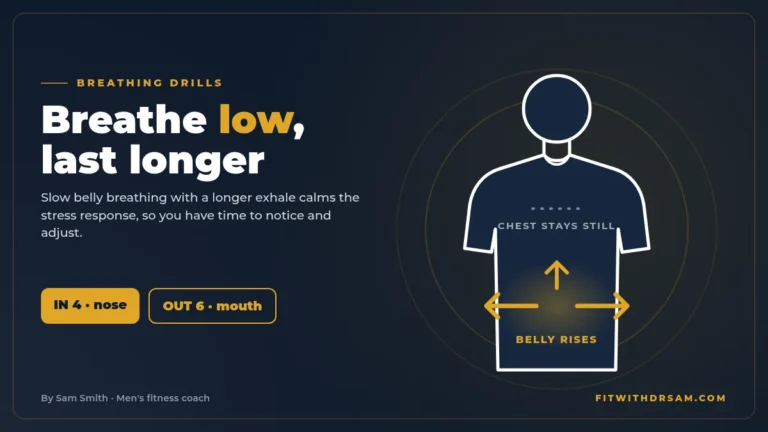
Arousal and breathing are linked. As arousal climbs, breathing speeds up and gets shallow, and that pushes things along faster. Slow, low breathing does the opposite. Practice the 4-6 breath every day: in through your nose for 4 counts, out for 6, belly soft, for 3 to 5 minutes. The drills, and how to use them in the moment, are in breathing techniques to last longer.
Finish each session with 5 minutes of hip mobility, because hours of sitting make the hips tight: a hip-flexor stretch (30 seconds per side), a deep squat hold (30 to 60 seconds, holding onto something if needed) and child’s pose with slow breaths into your lower back. These help you relax the area you’ve just trained.
The 8-week plan to last longer
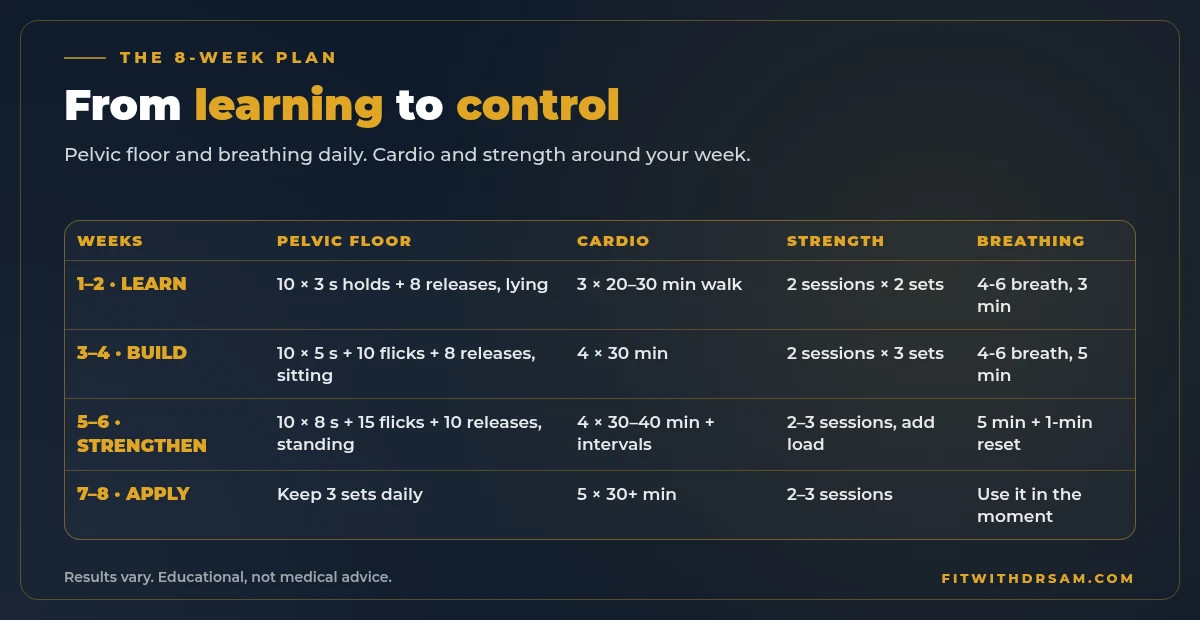
Do the pelvic-floor and breathing work daily (about 10 minutes). Cardio and strength fit around your week. Here’s how it progresses:
| Weeks | Pelvic floor (daily) | Cardio | Strength | Breathing |
|---|---|---|---|---|
| 1–2: Learn | 2 sets: 10 × 3-second holds + 8 reverse kegels, lying down | 3 × 20–30 min brisk walk | 2 full-body sessions, 2 sets each | 4-6 breath, 3 min |
| 3–4: Build | 3 sets: 10 × 5-second holds + 10 quick flicks + 8 releases, sitting | 4 × 30 min (one can be cycling) | 2 sessions, 3 sets | 4-6 breath, 5 min |
| 5–6: Strengthen | 3 sets: 10 × 8-second holds + 15 flicks + 10 releases, standing | 4 × 30–40 min + 1 interval session | 2–3 sessions, 3 sets, add load | 5 min + a 1-minute reset when stressed |
| 7–8: Apply | Keep 3 sets daily; add gentle control holds while walking | 5 × 30+ min (the trial’s target) | 2–3 sessions | Use slow breathing during intimacy too |
Track it. A simple tick-box for each day makes a big difference, and consistency is what made the clinical programs work. In weeks 7 and 8, start using what you’ve trained: notice your arousal early, slow your breath, and soften your belly and pelvic floor. That’s where training turns into control. If nerves get in the way, our guide to performance anxiety in men covers staying calm and present.
Common mistakes that slow progress
- Only squeezing. Hundreds of kegels a day with no release can make a tense pelvic floor tighter. Balance every strength set with a release set.
- Using the wrong muscles. If your glutes, thighs or belly tense, ease off. The movement should be small and internal.
- Stopping after a week. The clinical programs ran for around 12 weeks. Give it at least 8 before you judge it.
- Skipping cardio. It’s the part most men leave out, and it may be one of the most useful.
- Ignoring sleep and alcohol. Poor sleep and heavy drinking undo a lot of good training. Aim for 7 to 9 hours of sleep.
When to see a doctor
When to see a doctor
Exercise is a good first step, but book an appointment with your doctor (GP in the UK, Hausarzt in Germany) or a urologist if:
- you’ve almost always finished within about a minute and it distresses you or your partner
- the problem started suddenly after a long time without it
- you also have erection problems, pain or urinary symptoms
- you have diabetes, high blood pressure or a heart condition, or you’re not sure it’s safe to start exercising
- nothing has improved after about 3 months of regular practice
The NHS notes that early ejaculation is common and treatable, with options that include techniques, counseling and medicine (NHS). If you get chest pain, dizziness or unusual breathlessness when you exercise, stop and get checked.
Frequently asked questions
What exercises help you last longer in bed?
The best-supported options are pelvic-floor training (kegels plus the release skill, reverse kegels), regular moderate cardio such as brisk walking, cycling or jogging, and breathing drills that keep you calm. Strength training and mobility work support those by improving fitness, posture and body awareness.
How long does it take for exercises to help you last longer?
Most men need 4 to 12 weeks of regular practice. In clinical pelvic-floor programs, men trained for about 12 weeks. You may notice better awareness in the first 2 to 3 weeks, but steady change takes longer, and results vary.
Does running help you last longer?
It may. In one randomized trial, men with lifelong early ejaculation who did more than 30 minutes of moderate activity at least 5 times a week improved compared with a low-activity group. It’s one small study, so treat cardio as a helpful part of the plan, not a cure.
Can kegels make you last longer?
They help many men. Reviews of pelvic-floor muscle training report better ejaculatory control, although the studies are small and the protocols vary. Kegels work best combined with learning to relax the same muscles, breathing practice and good overall fitness.
Can I do these exercises at home?
Yes. The pelvic-floor drills, breathing and the bodyweight strength routine need no equipment, and brisk walking, stair climbing or cycling all count as cardio. A gym helps you progress the strength work, but it isn’t required.
The bottom line
The exercises that help you last longer aren’t secret. Train your pelvic floor to squeeze and to let go, build up to at least 150 minutes of cardio a week, lift twice a week without holding your breath, and practice slow breathing daily. Do it for 8 weeks and track it. Most men notice more awareness and calm first, then more control.
Bestseller · ★ 5.0 from 94 reviews on Gumroad
Increase Stamina in Bed
My complete stamina program in one book: a 30-day plan with kegel and reverse-kegel routines, breathing and arousal-control drills, training sessions and energy habits, plus bonus guides and videos. Practical, drug-free and non-explicit.
See the bookResults vary. Educational content, not a medical treatment.
References
- Myers C, Smith M. Pelvic floor muscle training improves erectile dysfunction and premature ejaculation: a systematic review. Physiotherapy. 2019;105(2):235-243. PubMed
- Pastore AL, Palleschi G, Fuschi A, et al. Pelvic muscle floor rehabilitation as a therapeutic option in lifelong premature ejaculation: long-term outcomes. Asian J Androl. 2018;20(6):572-575. PubMed Central
- Pastore AL, Palleschi G, Fuschi A, et al. Pelvic floor muscle rehabilitation for patients with lifelong premature ejaculation: a novel therapeutic approach. Ther Adv Urol. 2014;6(3):83-88. PubMed Central
- Kilinc MF, Aydogmus Y, Yildiz Y, Doluoglu OG. Impact of physical activity on patient self-reported outcomes of lifelong premature ejaculation patients: results of a prospective, randomised, sham-controlled trial. Andrologia. 2018;50(1):e12799. PubMed
- Khera M, Bhattacharyya S, Miller LE. Effect of aerobic exercise on erectile function: systematic review and meta-analysis of randomized controlled trials. J Sex Med. 2023;20(12):1369-1375. PubMed
- NHS. Physical activity guidelines for adults aged 19 to 64. Read online
- World Health Organization. Physical activity (fact sheet). Read online
- Cleveland Clinic. Kegel exercises for men. Read online
- Cleveland Clinic. Premature ejaculation. Read online
- NHS. Ejaculation problems. Read online
All links checked October 11, 2026.