Strength Training and Testosterone: What Actually Raises It
Educational content, not medical advice. This article is general information from a fitness coach. It’s not a diagnosis or treatment. If you have a health concern, see a doctor. See “When to see a doctor” below.
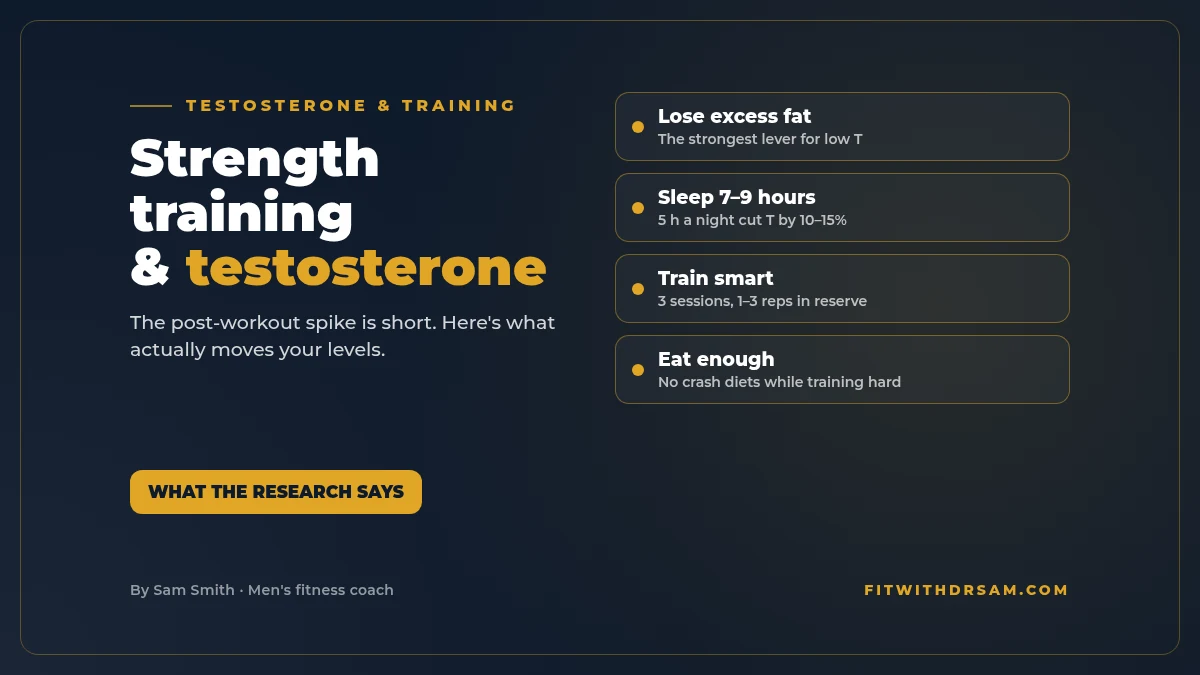
Strength training and testosterone are linked, but not in the way most gym advice suggests. Lifting weights gives you a short spike in testosterone after a hard session, yet it barely changes your resting levels over months. The bigger effects come from what training does to your body: less fat, more muscle, better sleep and energy. Below I’ll break down what the research says, the training mistakes that can lower testosterone, and a weekly plan that supports healthy levels. For the full lifestyle picture, see our pillar guide on how to increase testosterone naturally.
Key takeaways
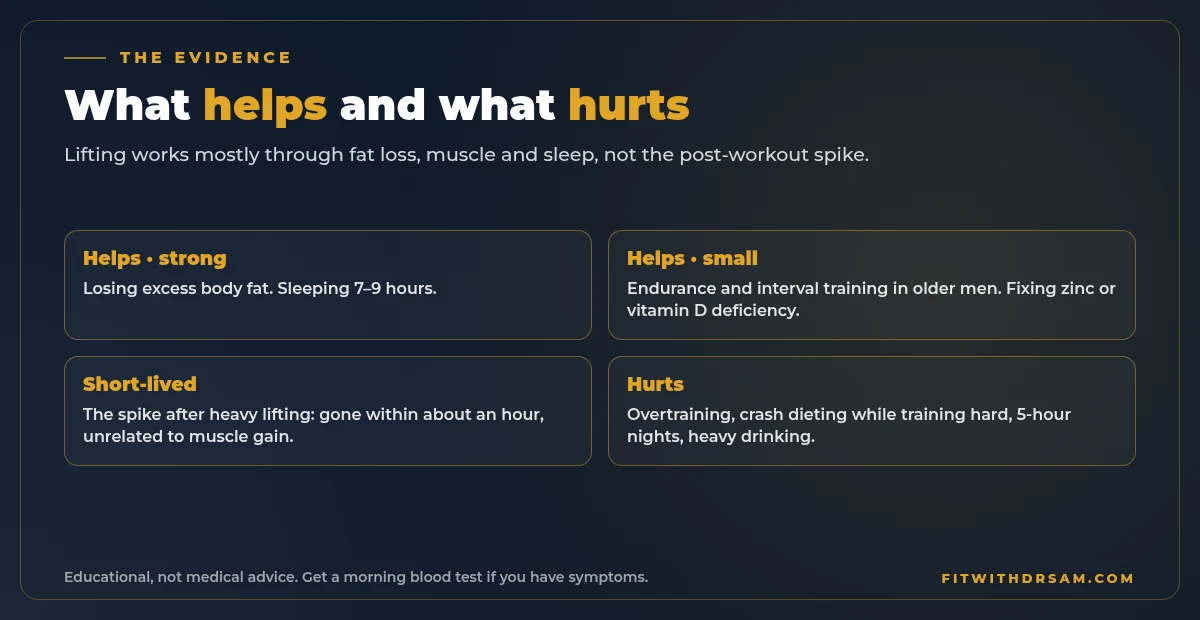
- The post-workout testosterone spike is real but short-lived (minutes, not days) and doesn’t predict muscle growth.
- In older men, resistance training didn’t significantly change resting testosterone in a meta-analysis; endurance and interval training showed small increases.
- Losing excess body fat is one of the most reliable ways to raise low testosterone.
- Sleeping 5 hours a night for a week lowered daytime testosterone by 10% to 15% in young men.
- Too much training with too little food or rest can lower testosterone. Train hard, but recover harder.
The short-term spike: what the gym myths get wrong
After a hard session of big lifts, testosterone rises for a short period, typically returning to baseline within about an hour (Kraemer et al., 2020). Social media calls this the “weightlifting testosterone boost” and builds whole programs around it.
The problem is that this spike doesn’t seem to matter much for results. Researchers at McMaster University in Canada measured the hormone response of 56 young men during a 12-week training program. The size of their post-workout testosterone rise wasn’t related to how much muscle or strength they gained (West & Phillips, 2012). So don’t choose exercises, rest times or supplements just to chase a bigger spike. Choose them to get stronger.
Does lifting raise your resting testosterone?
This is the question that matters, and the honest answer is: not much, for most men. A 2019 meta-analysis of 22 training studies in men aged 60 and over found that resistance training didn’t significantly change resting total testosterone, while endurance training and interval training produced small increases (Hayes & Elliott, 2019). The studies were short and small, and fewer data exist for younger men, but the pattern is consistent: training isn’t a testosterone injection.
That doesn’t make lifting pointless for hormone health. It works through indirect routes:
- Less body fat. Fat tissue is linked to lower testosterone. A meta-analysis of 24 studies found that weight loss raised testosterone, with bigger rises in men who lost more weight (Corona et al., 2013). Training plus a sensible diet is the most sustainable way to get there.
- More muscle and better insulin sensitivity. Muscle is your body’s biggest store for blood sugar, and better metabolic health supports healthier hormones.
- Better sleep and mood. Regular training tends to improve sleep quality, and sleep is when most testosterone is produced.
- Longer, healthier life. Muscle-strengthening activity was linked to a 10% to 17% lower risk of death from any cause in a 2022 meta-analysis (Momma et al., 2022), whatever it does to hormones.
Training mistakes that can lower testosterone
1. Overtraining and under-recovering
Men who train very high volumes for years, mostly endurance athletes, can develop persistently low testosterone, a pattern researchers call the “exercise-hypogonadal male condition” (Lane et al., 2019). Warning signs: constant fatigue, falling performance, low sex drive, poor sleep and frequent illness. For most gym-goers, this comes from too many hard sessions with too little rest, not from lifting itself.
2. Training hard while eating too little
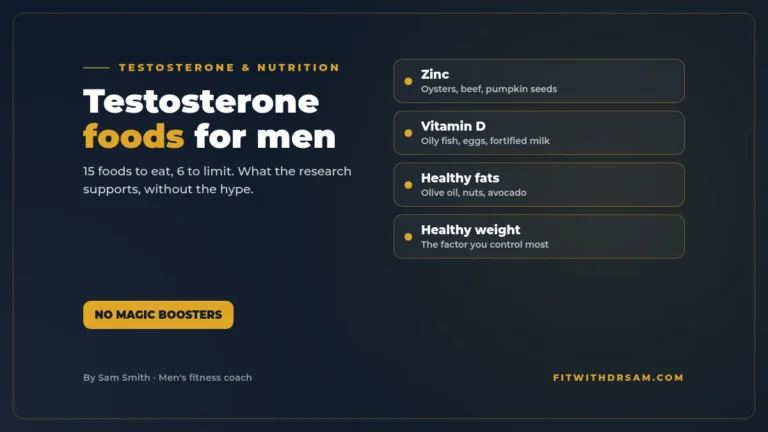
A review of male endurance athletes found that low energy availability, burning far more than you eat, is linked to reduced testosterone (Cupka et al., 2023). If you’re cutting, aim to lose about 0.5% to 1% of your body weight a week, not more, and keep protein high. Our list of testosterone foods for men helps you eat well during a diet.
3. Short sleep
In a small but well-known study, young healthy men who slept 5 hours a night for one week had daytime testosterone levels 10% to 15% lower than after normal sleep (Leproult & Van Cauter, 2011). Early-morning gym sessions that cut your sleep to 5 or 6 hours may cost more than they give. Aim for 7 to 9 hours.
4. Drinking to recover
Post-workout beers are a habit for many men. Heavy drinking is linked to lower testosterone and slows recovery and muscle growth; our post on alcohol and muscle growth explains how.
Free plan
Get the 7-Day Stamina Starter
Start with the basics: the free 7-Day Starter gives you 10 to 15 minutes a day of breathing, mobility and three short bodyweight sessions, plus simple sleep and energy habits, with a tick-box tracker.
Send me the free planFree. No spam. Unsubscribe anytime.
How to train for healthy testosterone
There’s no special “testosterone workout”. The best plan is one that builds muscle, helps you lose fat and lets you recover. Here’s what that looks like for most men:
| Element | Weekly target | Why |
|---|---|---|
| Strength training | 3 full-body sessions, 45–60 min | Builds muscle, helps fat loss |
| Main lifts | Squat, hinge (deadlift), push, pull, carry | Compound lifts give the most return per minute |
| Effort | Stop most sets 1–3 reps short of failure | Strong stimulus without excess fatigue |
| Cardio | 150 min moderate (e.g. brisk walking) + 1 short interval session | Heart health; interval and endurance work showed small testosterone increases |
| Rest days | At least 2 per week with no hard training | Recovery |
| Sleep | 7–9 hours a night | Short sleep lowered testosterone by 10–15% |
| Deload | One easier week every 6–10 weeks | Prevents accumulated fatigue |
If you want a ready-made plan, our 3-day workout plan follows exactly these rules and works for men of any age. Pair it with enough protein (about 1.6 g per kg, or 0.7 g per lb, of body weight a day) and a diet that lets you stay lean.
Testosterone and training myths
- “Train legs to boost testosterone for your arms.” The idea is that the big hormone spike after leg day helps your upper body grow. Because the spike doesn’t predict muscle growth, it’s not a reason to change your program. Train legs because strong legs matter.
- “Short rests make more testosterone, so more muscle.” Shorter rests can raise the acute hormone response, but longer rests of 2 to 3 minutes on big lifts let you lift more weight and often produce better results.
- “Training to failure every set raises testosterone.” It mostly raises fatigue. Stopping 1 to 3 reps short gives nearly the same stimulus with better recovery.
- “Big muscles mean high testosterone.” Muscle size depends on training, food, sleep and genetics. Men with normal testosterone can build impressive physiques, and some very muscular men use drugs that shut down their natural production.
- “Supplements with T in the name will fix it.” Most “testosterone boosters” have little evidence behind them, and some contain undeclared ingredients. Fix sleep, body fat and training first.
Signs your testosterone might really be low
Testosterone falls gradually with age, but the NHS notes that this decline is steady rather than a sudden “male menopause” (NHS). Many symptoms people blame on testosterone, such as tiredness, low mood or weight gain, often have other causes like poor sleep, stress, depression or thyroid problems. That’s why a blood test matters more than any online quiz.
When to see a doctor
When to see a doctor
Talk to your doctor (GP in the UK, Hausarzt in Germany) about a blood test if you notice for several weeks:
- low sex drive, erection problems or fewer morning erections
- constant fatigue, low mood or poor concentration
- loss of muscle or strength despite training, or increasing body fat
- breast tenderness or swelling, or reduced body hair
- you’re considering testosterone “boosters” or testosterone therapy
Testosterone is usually tested in the morning, when levels are highest (Cleveland Clinic). Never use anabolic steroids or testosterone bought online: they can shut down your own production, affect fertility and carry serious health risks.
Frequently asked questions
Does lifting weights increase testosterone?
Lifting causes a short rise in testosterone for roughly 15 to 60 minutes after a hard session, but long-term resting levels usually change little. In a meta-analysis of older men, resistance training didn’t significantly change resting testosterone. Lifting still helps indirectly, by building muscle and helping you lose fat, and fat loss is linked to higher testosterone.
What type of workout increases testosterone the most?
Big compound lifts like squats, deadlifts and presses with short to moderate rest produce the largest short-term rise. But that spike doesn’t predict how much muscle you build. For resting testosterone, what matters most is a training plan you can recover from, combined with fat loss if you need it, good sleep and enough food.
Can too much exercise lower testosterone?
Yes. Very high training loads, especially lots of endurance training without enough food or rest, are linked to persistently lower testosterone, sometimes called the exercise-hypogonadal male condition. Signs include constant fatigue, falling performance, low sex drive and poor sleep.
Does cardio lower testosterone?
Normal amounts of cardio don’t. In older men, endurance and interval training were linked to small increases in resting testosterone. Problems are linked to very high volumes, such as marathon-level training, combined with eating too little.
How long does it take to raise testosterone naturally?
If low testosterone is linked to excess weight or poor sleep, changes can show over 2 to 6 months as you lose fat and recover. If your levels are already normal, lifestyle changes won’t push them much higher. If you have symptoms, get a morning blood test before trying to fix it yourself.
The bottom line
Strength training won’t send your testosterone soaring, and the post-workout spike is mostly irrelevant. What lifting does is help you build muscle, lose fat and sleep better, and those changes support healthy testosterone. Train 3 times a week with good effort, walk on the other days, eat enough, sleep 7 to 9 hours, and don’t overdo it. If you have symptoms, get tested rather than guessing.
Diet, BMR & bodyweight guide · by Sam Smith
Nutrition, Metabolism & Muscle
My practical guide to eating for fat loss or muscle: how to find your BMR and macros, build meals that keep you full, and train with bodyweight anywhere. Includes a calculator, tracker and 3 meal plans.
See the bookResults vary. Educational content, not medical or dietary treatment.
References
- Hayes LD, Elliott BT. Short-term exercise training inconsistently influences basal testosterone in older men: a systematic review and meta-analysis. Front Physiol. 2019;9:1878. PubMed Central
- West DW, Phillips SM. Associations of exercise-induced hormone profiles and gains in strength and hypertrophy in a large cohort after weight training. Eur J Appl Physiol. 2012;112(7):2693-2702. PubMed Central
- Kraemer WJ, Ratamess NA, Hymer WC, Nindl BC, Fragala MS. Growth hormone(s), testosterone, insulin-like growth factors, and cortisol: roles and integration for cellular development and growth with exercise. Front Endocrinol. 2020;11:33. PubMed Central
- Corona G, Rastrelli G, Monami M, et al. Body weight loss reverts obesity-associated hypogonadotropic hypogonadism: a systematic review and meta-analysis. Eur J Endocrinol. 2013;168(6):829-843. PubMed
- Leproult R, Van Cauter E. Effect of 1 week of sleep restriction on testosterone levels in young healthy men. JAMA. 2011;305(21):2173-2174. PubMed Central
- Lane AR, Magallanes CA, Hackney AC. Reproductive dysfunction from exercise training: the “exercise-hypogonadal male condition”. Arch Med Deporte. 2019;36(5):319-322. PubMed Central
- Cupka M, et al. Hungry runners: low energy availability in male endurance athletes and its impact on performance and testosterone: mini-review. Eur J Transl Myol. 2023;33(2):11104. PubMed Central
- Momma H, Kawakami R, Honda T, Sawada SS. Muscle-strengthening activities are associated with lower risk and mortality in major non-communicable diseases: a systematic review and meta-analysis of cohort studies. Br J Sports Med. 2022;56(13):755-763. PubMed Central
- NHS. The “male menopause”. Read online
- Cleveland Clinic. Testosterone. Read online
All links checked October 11, 2026.