Start-Stop and Squeeze Techniques: A Step-by-Step Practice Plan
Educational content, not medical advice. This article is general information from a fitness coach. It’s not a diagnosis or treatment. If you have a health concern, see a doctor. See “When to see a doctor” below.
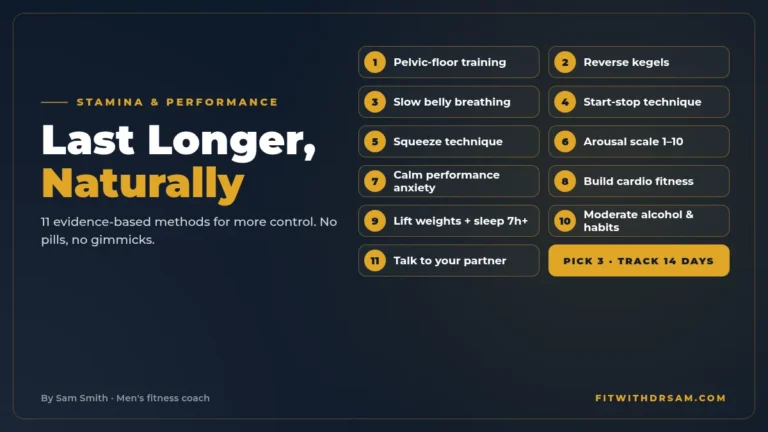
The start-stop technique and the squeeze technique are two simple exercises that teach you to recognize your arousal early and bring it back down before the point of no return. They’ve been used by sex therapists since the 1950s and 1970s, they’re free, and they need no pills. This guide explains exactly how to do each one, a 6-week practice plan, the most common mistakes, and how to combine them with breathing and pelvic-floor training. It’s part of our complete guide to lasting longer in bed naturally.
Key takeaways
- Start-stop: pause when you reach about 7 out of 10 on your arousal scale, wait until it drops to 4 or 5, then continue. Repeat 3 to 4 times.
- Squeeze: the same pause, plus gentle pressure for 10 to 20 seconds to reduce the urge faster.
- Practice alone first, then with a partner. Plan on 4 to 12 weeks, 2 to 3 sessions a week.
- Combine it with slow breathing and relaxing your pelvic floor during the pause.
- If it has always happened within about a minute, or it’s causing distress, talk to a doctor too.
How the techniques work
Ejaculation is a reflex with a build-up phase. Many men who finish quickly don’t notice the build-up until it’s too late. They go from “fine” to “past the point of no return” with no warning. Both techniques train the same skill: noticing arousal earlier and steering it.
The start-stop method was described by urologist James Semans in 1956 (Semans, 1956), and Masters and Johnson later added the squeeze technique. A Canadian trial compared couples using these behavioral methods with couples on a waiting list. Both treatment groups improved in duration of intercourse and sexual satisfaction, while the waiting-list group didn’t (de Carufel & Trudel, 2006). A Cochrane review found that evidence on psychological and behavioral treatments is limited, with few, small trials, but that behavioral therapy showed benefit in those trials (Melnik et al., 2011). The NHS lists both techniques among the options a specialist may teach you (NHS).
In short: they’re low-risk, well established and worth doing properly, but they’re a skill, not an instant fix.
Before you start: the arousal scale
Both techniques use a simple 1 to 10 scale. 1 is no arousal at all; 10 is the point of no return. The goal is to learn what 6, 7 and 8 feel like for you:
- 1 to 4: relaxed, building slowly.
- 5 to 6: clearly aroused, comfortable, in control. This is where you want to spend most of your time.
- 7: strong arousal, still in control. This is your pause point.
- 8 to 9: close. Hard to come back from.
- 10: the point of no return.
At first, you’ll probably misjudge it and go too far. That’s normal and part of learning. Just note what 8 felt like and pause earlier next time.
How to do the start-stop technique
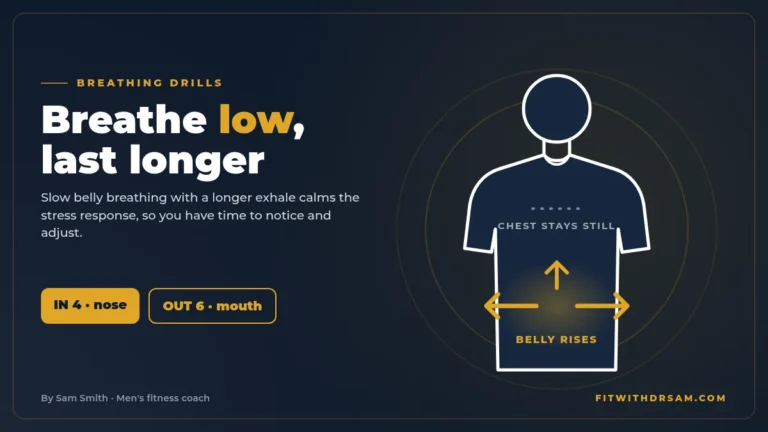
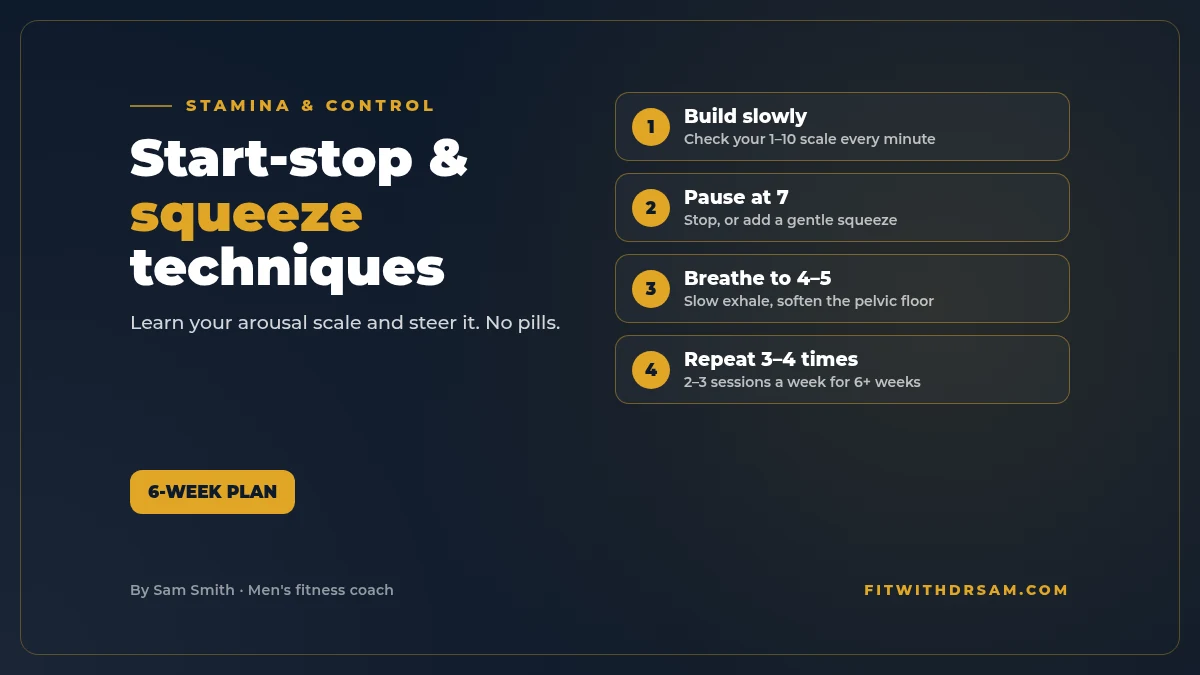
- Set up. Choose a private, unhurried time. Take 2 minutes of slow breathing first: in for 4, out for 6.
- Build slowly. Begin solo practice and focus on the physical sensations, not on images or fantasies. Check in with your scale every minute or so.
- Stop at about 7. Stop all stimulation completely.
- Breathe and relax. Take slow belly breaths. Soften your belly, glutes and pelvic floor. Unclench your jaw. Wait until you’re down to about 4 or 5. This usually takes 30 to 60 seconds.
- Start again. Build back up to 7 and pause again.
- Repeat 3 to 4 times, then finish if you want to, without guilt. A session takes about 15 to 20 minutes.
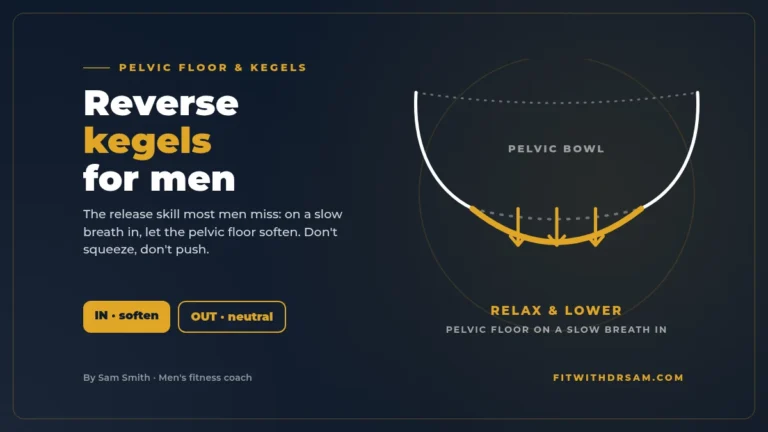
The pause is where the learning happens, so make it calm. Many men tense up and hold their breath while waiting, which keeps arousal high. A long, slow exhale and a gentle release of the pelvic floor (a reverse kegel) bring it down faster. Our breathing techniques to last longer walks you through the exact drills.
How to do the squeeze technique
The squeeze technique adds one step to the pause. When you reach about 7, stop and apply firm but gentle pressure with your thumb and fingers just below the tip, where the head meets the shaft, for 10 to 20 seconds, until the urge fades. Then let go, wait about 30 seconds, and continue. That’s the method the NHS describes (NHS); Cleveland Clinic gives similar instructions (Cleveland Clinic).
- Use firm pressure, never painful pressure.
- It’s normal for the erection to soften slightly. It returns when you continue.
- Some men find squeezing at the base works better for them. Experiment gently.
- Repeat 3 to 4 times per session, like start-stop.
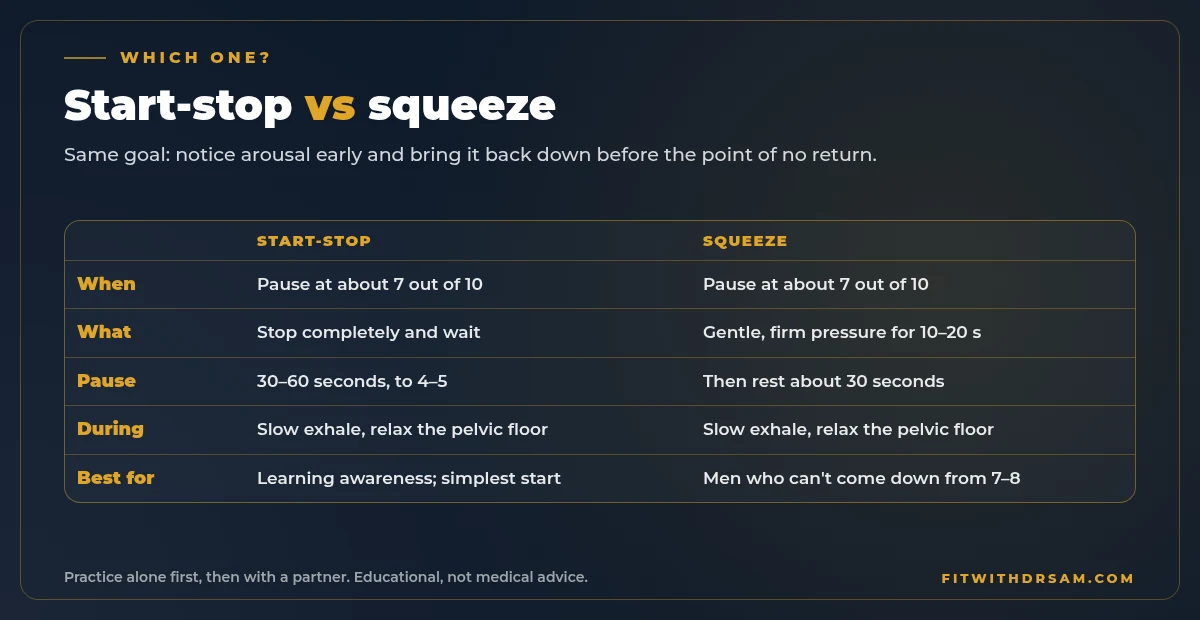
Start-stop vs squeeze: which should you use?
| Start-stop | Squeeze | |
|---|---|---|
| What you do | Stop and wait | Stop and apply gentle pressure for 10–20 s |
| Pause length | Usually 30–60 seconds | Usually 10–20 seconds, then 30 seconds rest |
| Best for | Learning awareness; simplest to start | Men who struggle to come down from 7–8 |
| With a partner | Easy to do without much interruption | Needs more coordination |
| Downside | Pauses can feel long at first | Some couples find it awkward |
My usual advice: start with start-stop for 2 weeks. If your arousal keeps climbing even when you stop, add the squeeze. Many men end up using a mix, plus a lighter version where they simply slow down and change rhythm instead of stopping completely.
Free plan
Get the 7-Day Stamina Starter
Build the foundation for these techniques in 10 to 15 minutes a day: breathing, pelvic-floor basics, mobility and three short bodyweight sessions, with a tick-box tracker.
Send me the free planFree. No spam. Unsubscribe anytime.
A 6-week practice plan
| Weeks | Practice | Goal |
|---|---|---|
| 1–2 | Solo start-stop, 3 sessions a week, 3–4 pauses each. Daily 4-6 breathing. | Recognize 6, 7 and 8 reliably |
| 3–4 | Solo practice with lighter pauses (slow down instead of stopping). Add the squeeze if needed. Daily pelvic-floor routine. | Stay at 5–7 for 15 minutes |
| 5 | Talk with your partner. Practice together with full pauses; agree on a simple signal. | Same control with a partner |
| 6+ | Gradually shorter, less noticeable pauses. Keep breathing and pelvic-floor practice. | Control without long breaks |
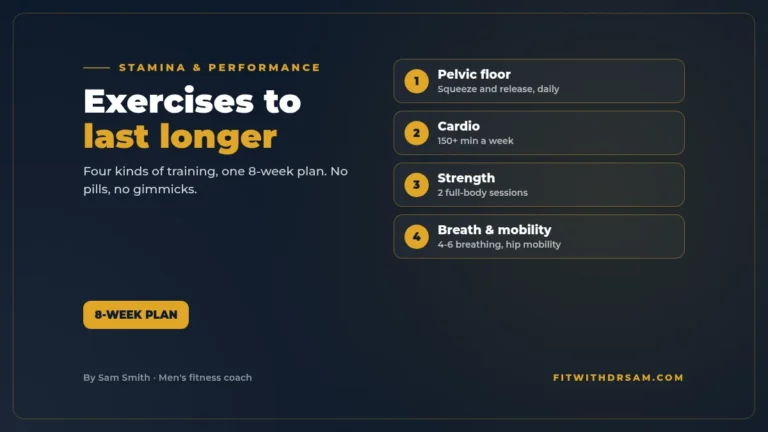
Pair the plan with the physical side. Pelvic-floor muscle training has its own evidence for ejaculatory control (Myers & Smith, 2019), and our 8-week plan of exercises to last longer combines it with cardio and strength.
Common mistakes
- Pausing too late. If you pause at 9, it’s often too late. Pause earlier than you think you need to.
- Tensing during the pause. Clenching your pelvic floor and holding your breath keeps arousal high. Breathe out slowly and let go.
- Distracting yourself. Thinking about something boring may delay things, but it stops you learning your signals. Stay with the sensations.
- Practicing rarely. Two or three sessions a week for several weeks beats one long session.
- Measuring with a stopwatch. Focus on control and enjoyment, not minutes. Read how long a man should last: the normal range is wider than most men think.
Talking to your partner
Bringing a partner into practice is easier than it sounds if you frame it as teamwork: “I’m working on something that will make things better for both of us, and I’d like your help.” Agree on a signal for a pause, keep the mood light, and remember that pauses can be spent kissing, talking or simply breathing together. If anxiety is part of the picture, our guide on performance anxiety in men can help you both.
When to see a doctor
When to see a doctor
Self-help is a good first step, but talk to your doctor (GP in the UK, Hausarzt in Germany) or a urologist if:
- you’ve almost always finished within about a minute, since your first experiences
- it started suddenly after years without a problem
- you also have erection problems, pain, or urinary symptoms
- it’s causing distress or strain in your relationship
- nothing has improved after about 3 months of regular practice
Treatments include counseling and medicines, sometimes combined with these techniques (NHS). A sex therapist can guide you through them: find one through COSRT in the UK or AASECT in the US and Canada.
Frequently asked questions
What is the start-stop technique?
The start-stop technique is a behavioral exercise for early ejaculation, first described in 1956. You stop stimulation when you feel you’re getting close, wait until the urge fades, then start again, usually 3 or 4 times per session. Over weeks of practice it teaches you to recognize the point of no return earlier and to stay in control.
Does the start-stop technique really work?
Behavioral techniques such as start-stop and squeeze have been used for decades and helped many men in studies, including one trial where couples improved duration and satisfaction compared with a waiting list. The evidence base is small and older, so results vary. They tend to work best combined with breathing, pelvic-floor training and patience.
What’s the difference between start-stop and the squeeze technique?
Both use a pause before the point of no return. With start-stop you simply stop and wait. With the squeeze technique, you also apply gentle pressure for 10 to 20 seconds where the head meets the shaft, which reduces the urge faster. Many men start with start-stop because it’s simpler.
How long does it take for start-stop to work?
Most programs run for 4 to 12 weeks with practice 2 to 3 times a week. Many men notice better awareness of their arousal within 2 or 3 weeks; steady control usually takes longer.
Should I do these techniques alone or with a partner?
Most sex therapists suggest starting alone, so you can focus on your own sensations without pressure, then moving to practice with a partner once you feel more in control. Talking it through with your partner first makes the partner stage much easier.
The bottom line
The start-stop and squeeze techniques teach you to notice your arousal early and bring it back down. Learn your 1 to 10 scale, pause at 7, breathe and relax until you’re at 4 or 5, and repeat. Practice alone first, then with your partner, 2 to 3 times a week for at least 6 weeks. Combined with breathing and pelvic-floor training, it’s one of the most practical drug-free ways to build control.
Bestseller · ★ 5.0 from 94 reviews on Gumroad
Increase Stamina in Bed
My complete stamina program: a 30-day plan with step-by-step pacing practice, breathing and arousal-control drills, kegel and reverse-kegel routines and energy habits, plus bonus guides and videos. Practical, drug-free and non-explicit.
See the bookResults vary. Educational content, not a medical treatment.
References
- Semans JH. Premature ejaculation: a new approach. South Med J. 1956;49(4):353-358. PubMed
- de Carufel F, Trudel G. Effects of a new functional-sexological treatment for premature ejaculation. J Sex Marital Ther. 2006;32(2):97-114. PubMed
- Melnik T, Althof S, Atallah AN, et al. Psychosocial interventions for premature ejaculation. Cochrane Database Syst Rev. 2011;(8):CD008195. PubMed
- Myers C, Smith M. Pelvic floor muscle training improves erectile dysfunction and premature ejaculation: a systematic review. Physiotherapy. 2019;105(2):235-243. PubMed
- NHS. Ejaculation problems. Read online
- Cleveland Clinic. Premature ejaculation. Read online
- College of Sexual and Relationship Therapists (COSRT), UK. Find a therapist
- AASECT (American Association of Sexuality Educators, Counselors and Therapists). Referral directory
All links checked October 11, 2026.