Alcohol and Testosterone: How Drinking Affects Men
Educational content, not medical advice. This article is general information from a fitness coach. It’s not a diagnosis or treatment. If you have a health concern, see a doctor. See “When to see a doctor” below.
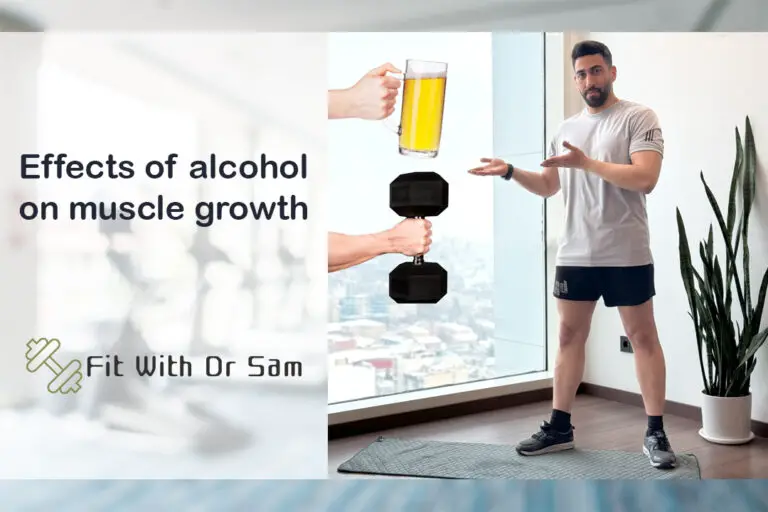
Alcohol and testosterone is one of the most common questions I get from men who train. Many of my clients are doing everything right in the gym, then undo a lot of it with a heavy weekend. I’m not here to tell you never to drink. But you should know what alcohol does to your hormones, sleep, body fat and recovery, so you can make your own call. This guide covers the research, how much is too much, and practical ways to cut back without losing your social life. For more on the gym side, see my post on alcohol and muscle growth.
Key takeaways
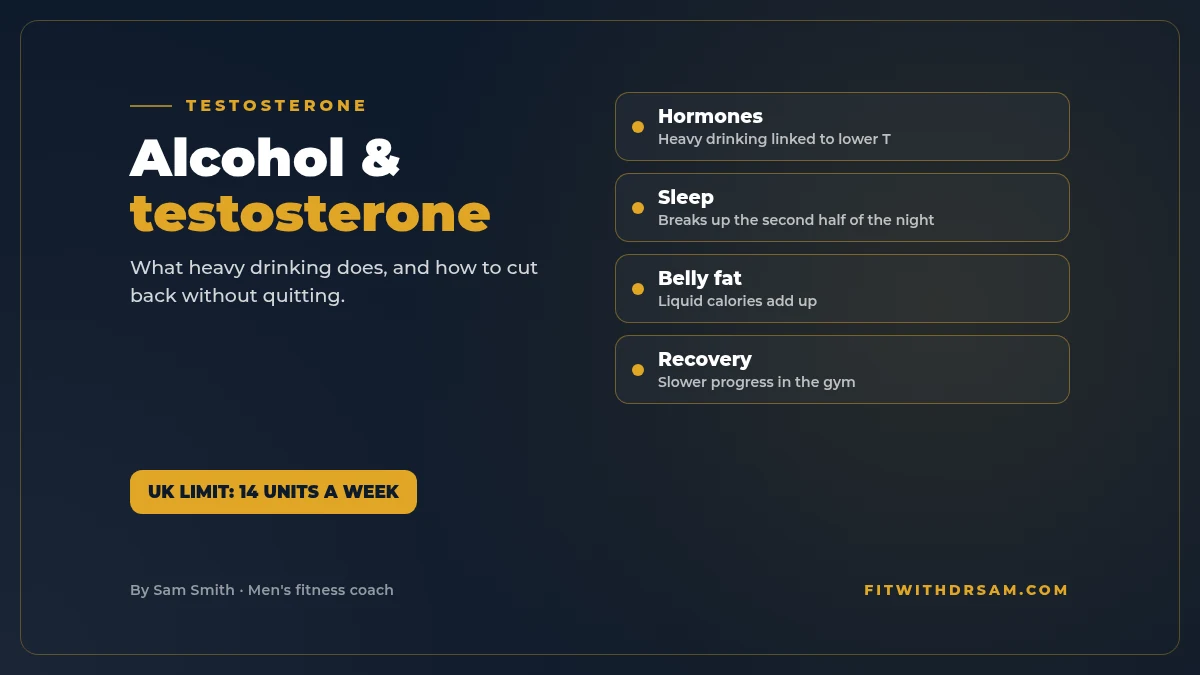
- Heavy and long-term drinking is linked to lower testosterone in men.
- Alcohol affects testosterone directly and indirectly, through worse sleep and more belly fat.
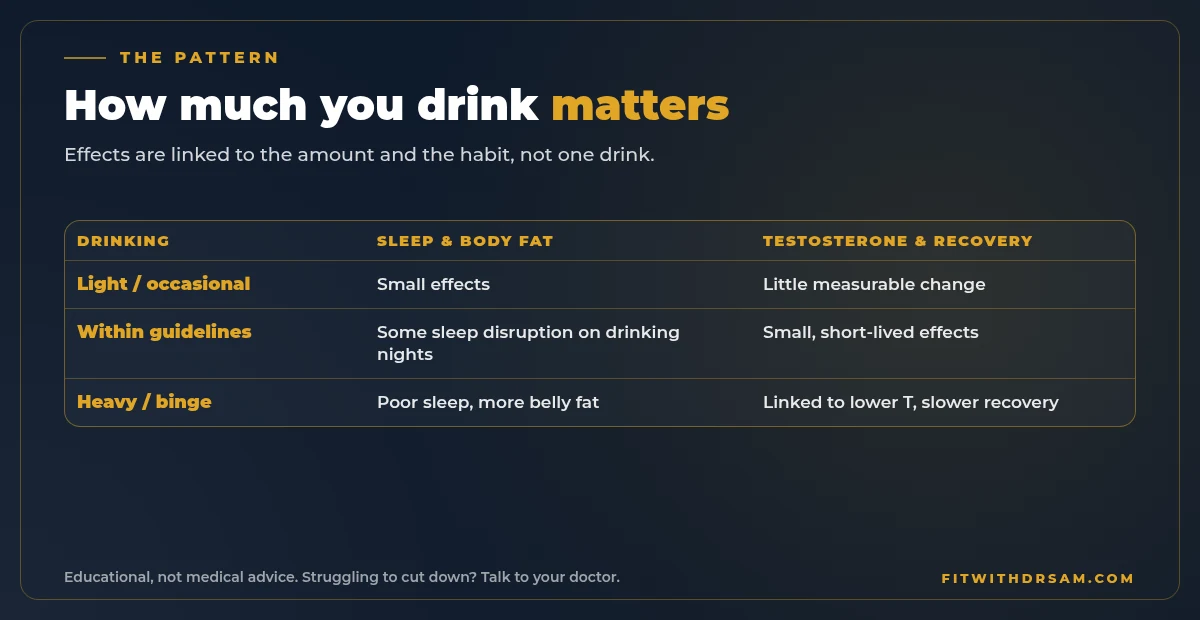
- Light, occasional drinking has much smaller effects than heavy drinking.
- The UK limit is 14 units a week; health bodies agree less is better.
- Cutting back often improves sleep, energy and training within weeks.
How alcohol affects testosterone
Testosterone production depends on a chain: the brain (hypothalamus and pituitary) sends signals to the testes, which make testosterone. Research reviews show alcohol can interfere with every link in that chain. It can reduce the signals from the brain and affect the cells in the testes that produce testosterone (Emanuele & Emanuele, 2001). The US National Institute on Alcohol Abuse and Alcoholism lists hormone disruption among alcohol’s effects on the body (NIAAA).
The pattern matters. The clearest link with low testosterone is seen in men who drink heavily over months and years. A single drink with dinner isn’t in the same league as regular binge drinking.
The indirect effects: sleep, belly fat and recovery
Sleep
Alcohol helps some people fall asleep, but it tends to break up the second half of the night and reduce restful sleep. Since much of your testosterone is released during sleep, regular drinking before bed works against you. More in my guide to sleep and testosterone.
Belly fat
Alcohol has 7 calories per gram, and drinks often come with snacks and late-night food. Four pints of beer can add 800 calories or more. Excess body fat, especially around the belly, is one of the strongest factors linked to lower testosterone.
Recovery and training
Drinking after training can slow recovery and leave you dehydrated and under-slept for your next session. Over time, that means slower progress in strength and muscle.
How much is too much?
| Country | Official guidance (men) |
|---|---|
| UK | No more than 14 units a week, spread over 3+ days, with drink-free days |
| US | 2 drinks or fewer on days you drink, or don’t drink |
| Canada | Fewer drinks is better; 2 or fewer a week keeps risk low (2023 guidance) |
| Germany | DGE advises that not drinking is best for health |
In the UK, 14 units is about 6 pints of average-strength beer or 6 medium glasses of wine a week (NHS). The CDC defines heavy drinking for men as 15 or more drinks a week, and binge drinking as 5 or more on one occasion (CDC). The German Nutrition Society (DGE) now says no amount of alcohol is risk-free (DGE).
Does the type of drink matter?
Mostly, no. Total alcohol is what counts. Beer gets blamed for “man boobs” and low testosterone, partly because of hops and partly because it’s easy to drink a lot of liquid calories. Spirits with sugary mixers carry the same calorie problem. Red wine has some antioxidants, but not enough to make heavy drinking healthy.
Free plan
Get the 7-Day Stamina Starter
Cutting back? The free 7-Day Stamina Starter gives you daily training, breathing and sleep habits to fill the gap, 10 to 15 minutes a day, with a tick-box tracker.
Send me the free planFree. No spam. Unsubscribe anytime.
7 ways to cut back without losing your social life
- Set your number before you go out. Decide on 2 drinks, not “we’ll see”.
- Alternate every alcoholic drink with water or a zero-alcohol beer.
- Choose lower-strength drinks. A 4% beer instead of a 6% craft IPA cuts alcohol by a third.
- Have 3 or more drink-free days a week.
- Eat a proper meal first. Protein and fibre slow absorption. My high-protein meal plan has ideas.
- Plan the morning after. A training session or a walk booked for the next morning makes the last round easier to skip.
- Track it for 2 weeks. Most men drink more than they think.
Alcohol myths men believe
- “A few beers help me recover after training.” Fluids and carbs help recovery; the alcohol works against it. A zero-alcohol beer gives you the ritual without the downside.
- “I only drink at weekends, so it doesn’t count.” Eight drinks on a Saturday is binge drinking, even with five dry days. Spreading and reducing is better than saving up.
- “Red wine is good for testosterone.” There’s no good evidence for that. Any benefit from antioxidants is outweighed by the alcohol at higher amounts.
- “Hangovers are the only problem.” The bigger costs are invisible: broken sleep, extra calories and slower recovery that add up week after week.
- “Testosterone boosters will undo it.” Most so-called boosters have little evidence. Drinking less does far more than any pill sold online.
A simple 4-week cut-back plan
| Week | Goal |
|---|---|
| 1 | Track every drink. No changes yet, just awareness. |
| 2 | Add 3 drink-free days. Swap one round for a zero-alcohol option. |
| 3 | Set a 2-drink cap on nights out. Eat a proper meal first. |
| 4 | Book a morning training session after your usual night out. |
What happens when you cut back
Men I coach who cut down from heavy weekends usually report better sleep within a week or two, more energy, less bloating, better training sessions and easier fat loss over the following months. Everyone is different, and if you’ve been drinking heavily for a long time, recovery takes longer. Combine cutting back with strength training; see strength training and testosterone for the training side.
When to see a doctor
When to see a doctor
See your doctor (GP in the UK, Hausarzt in Germany) if:
- you regularly drink more than the guidelines and find it hard to cut down
- you get shaky, sweaty or anxious when you stop drinking (don’t stop suddenly without medical advice)
- you have symptoms of low testosterone such as low sex drive, erection problems or constant fatigue
- you have stomach pain, yellowing skin or other signs of liver problems
Testosterone is best tested in the morning (Cleveland Clinic). If you’re worried about your drinking, the NHS lists support options (NHS); in the US, the SAMHSA helpline is 1-800-662-4357.
Frequently asked questions
Does alcohol lower testosterone?
Heavy and long-term drinking is linked to lower testosterone in men. Alcohol can affect the testes directly and disrupt the hormone signals from the brain. Light, occasional drinking seems to have much smaller effects, but drinking less is generally better for health.
How long does alcohol affect testosterone?
Studies suggest a heavy drinking session can lower testosterone for roughly a day afterwards. Regular heavy drinking can keep levels lower over the long term, and some effects improve after cutting back.
Is beer worse for testosterone than other drinks?
The main factor is the total amount of alcohol, not the type of drink. Beer is often blamed because of hops and because it’s easy to drink a lot of calories, which can add belly fat.
Will quitting alcohol raise my testosterone?
If you drink heavily, cutting back is likely to help your sleep, weight and energy, which support healthier levels. If you drink lightly and your levels are normal, stopping won’t push them much higher. Results vary from person to person.
How much alcohol is safe for men?
The UK advises no more than 14 units a week spread over 3 or more days. US guidelines suggest men limit themselves to 2 drinks or fewer on days they drink. Health bodies agree that less is better.
The bottom line
Heavy drinking is linked to lower testosterone, worse sleep, more belly fat and slower recovery. Light, occasional drinking matters much less. If you want to look, feel and perform better, keep within the guidelines, build in drink-free days and swap some nights out for training. My book Nutrition, Metabolism & Muscle ($19) helps you set up a diet that supports your goals, with or without the odd beer.
Diet, BMR & bodyweight guide · by Sam Smith
Nutrition, Metabolism & Muscle
My practical guide to eating for fat loss or muscle: how to find your BMR and macros, build meals that keep you full and train anywhere. Includes a calculator, tracker and 3 meal plans.
See the bookResults vary. Educational content, not medical or dietary treatment.
References
- Emanuele MA, Emanuele NV. Alcohol and the male reproductive system. Alcohol Res Health. 2001;25(4):282-287. PubMed Central
- NIAAA. Alcohol’s effects on the body. Read online
- NHS. Calculating alcohol units. Read online
- NHS. The risks of drinking too much. Read online
- CDC. About moderate alcohol use. Read online
- Deutsche Gesellschaft für Ernährung (DGE). Position on alcohol, 2024. Read online
- Cleveland Clinic. Testosterone. Read online
All links checked October 17, 2026.