Sleep and Testosterone: How Sleep Affects Your Levels
Educational content, not medical advice. This article is general information from a fitness coach. It’s not a diagnosis or treatment. If you have a health concern, see a doctor. See “When to see a doctor” below.
Sleep and testosterone are tightly connected, and it’s the link most men ignore. They’ll buy supplements, change their diet and add gym sessions, then sleep 5 or 6 hours a night. As a coach, I see the same thing again and again: when men fix their sleep, their energy, training and mood improve faster than with anything else. This guide explains what the research says about sleep and testosterone, the habits that hurt both, and a simple routine to sleep better from tonight. For the full lifestyle picture, see my guide to increasing testosterone naturally.
Key takeaways
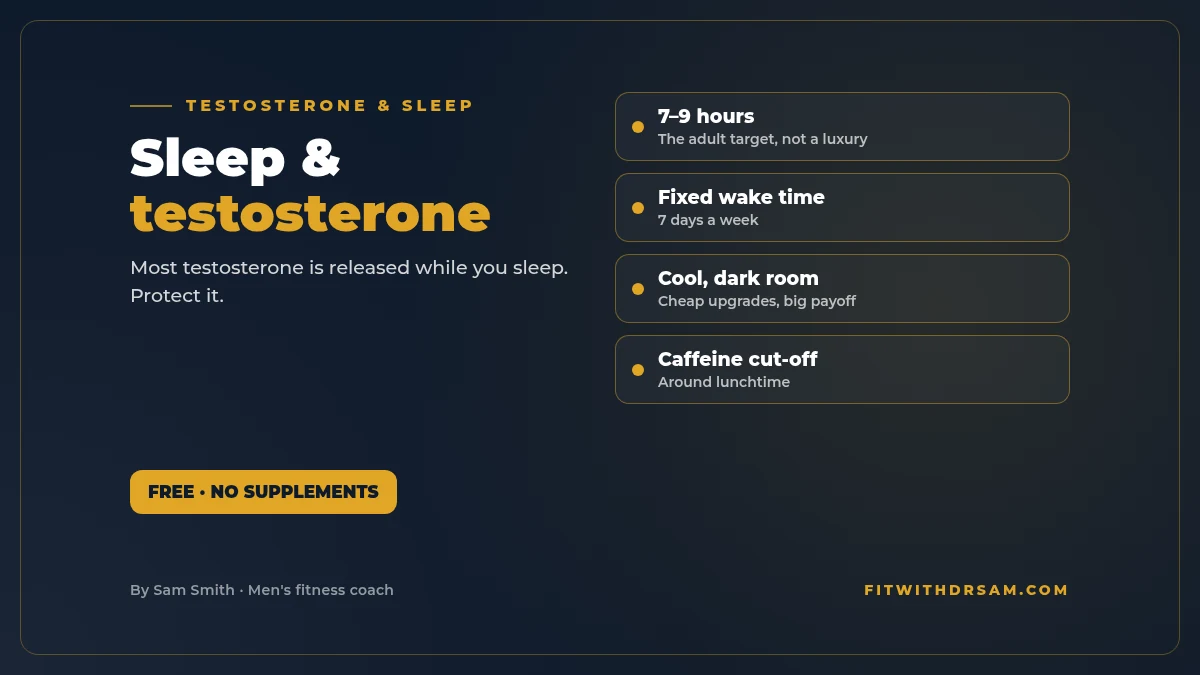
- Most testosterone is released during sleep, and levels peak in the morning.
- One week of 5-hour nights lowered daytime testosterone by 10% to 15% in young men in a small study.
- Adults should aim for at least 7 hours a night.
- Loud snoring and daytime sleepiness can be signs of sleep apnoea, which is linked to low testosterone.
- Fix the basics first: a fixed wake time, a dark cool room, no late caffeine and less alcohol.
How sleep and testosterone are linked
Your body releases testosterone in a daily rhythm. Levels rise during sleep and are usually highest in the morning, which is why doctors test testosterone early in the day (Cleveland Clinic). When sleep gets cut short, that overnight rise has less time to happen.
The best-known study on this was small but clear. Ten healthy young men spent a week sleeping 5 hours a night in a lab. Their daytime testosterone dropped by 10% to 15% compared with when they slept normally, and they reported lower energy and vigour (Leproult & Van Cauter, 2011). The researchers noted that around 15% of working adults in the US sleep 5 hours or less a night. Ten men is a small sample, so don’t treat the exact number as a promise. The direction, though, matches what I see in coaching: short sleep, flat energy.
It works both ways. Low testosterone is linked to poorer sleep quality in some men, so poor sleep and low energy can feed each other. That’s one reason to fix the habits you control first.
How much sleep do you need?
The CDC recommends at least 7 hours of sleep a night for adults aged 18 to 60, and 7 to 9 hours for those over 60 (CDC). A joint statement from US sleep experts reached the same 7-hour minimum (Watson et al., 2015). Hours in bed isn’t the same as hours asleep. If you’re in bed for 7 hours but wake up four times, you’re not getting 7 hours of sleep.
| Signs you’re not sleeping enough | Signs you probably are |
|---|---|
| You need an alarm and hit snooze | You often wake up just before the alarm |
| You crash in the afternoon | Energy is steady through the day |
| Weights feel heavy for no reason | Training performance is consistent |
| You need caffeine to function | Coffee is a choice, not a lifeline |
| You fall asleep within minutes on the sofa | You fall asleep in 10 to 20 minutes in bed |
7 habits that wreck sleep (and your energy)
1. Caffeine too late
Caffeine stays in your system for hours. In one study, 400 mg of caffeine taken even 6 hours before bed reduced total sleep by more than an hour (Drake et al., 2013). That’s about 2 strong coffees or a big pre-workout. Set a caffeine cut-off around lunchtime if you sleep badly.
2. Drinking to fall asleep
Alcohol can help you fall asleep but tends to break up the second half of the night. Heavy drinking is also linked to lower testosterone. My post on alcohol and muscle growth explains how it slows recovery too.
3. Irregular wake times
Waking at 6 on weekdays and 11 on weekends gives your body clock jet lag every Monday. A fixed wake time, 7 days a week, is the single most useful sleep habit I give clients.
4. Screens and bright light late at night
Bright light in the evening tells your brain it’s still daytime. Dim the lights an hour before bed and keep the phone out of reach, or at least on night mode.
5. A hot, noisy or bright bedroom
Most people sleep better in a cool, dark, quiet room. Blackout curtains, an eye mask and earplugs are cheap upgrades.
6. Training hard late at night
Exercise generally improves sleep, but a very intense session right before bed keeps some men wired. If that’s you, move hard training earlier and keep evenings for walking or stretching. My stretching routine is a good wind-down.
7. Big meals right before bed
A heavy meal late at night can cause reflux and restless sleep. Try to finish your last big meal 2 to 3 hours before bed.
Free plan
Get the 7-Day Stamina Starter
The free 7-Day Stamina Starter includes simple sleep and energy habits, plus 10 to 15 minutes a day of breathing, mobility and bodyweight training, with a tick-box tracker.
Send me the free planFree. No spam. Unsubscribe anytime.
A simple sleep routine for healthy testosterone
| When | What to do |
|---|---|
| Morning | Same wake time every day. Get outside light for 10 minutes. |
| Daytime | Train or walk. Aim for 150 minutes of moderate activity a week. |
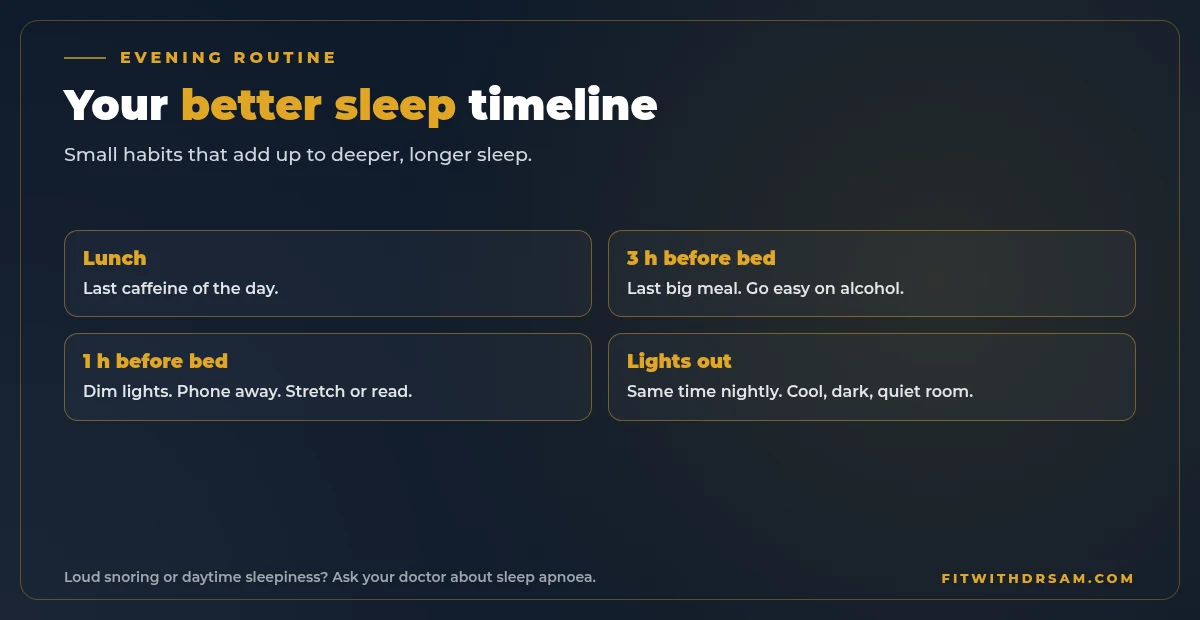
| Lunch | Last caffeine of the day. |
| 3 hours before bed | Last big meal. Go easy on alcohol. |
| 1 hour before bed | Dim lights, phone away, light stretching or reading. |
| Bedtime | Cool, dark room. Same time every night, 7 to 9 hours before your wake time. |
If you lie awake for more than about 20 minutes, get up, do something calm in dim light and go back when you feel sleepy. Lying in bed frustrated teaches your brain that bed means stress. The slow breathing drill from my guide to lasting longer mentally (4 seconds in, 6 seconds out) also works well for falling asleep.
Sleep, body fat and testosterone
Short sleep is linked to more hunger and cravings, which makes it harder to stay lean, and excess body fat is one of the strongest factors linked to lower testosterone. So poor sleep can hurt your hormones twice: directly, and through weight gain. Getting enough sleep makes fat loss easier, and losing excess fat often improves sleep. For food choices that support healthy levels, read my guide to testosterone foods for men.
Snoring, sleep apnoea and low testosterone
Obstructive sleep apnoea is when your airway repeatedly closes during sleep, cutting your breathing for a few seconds at a time. It’s more common in men, especially with excess weight. Signs include loud snoring, gasping or choking at night and feeling exhausted during the day (NHS). Sleep apnoea is linked to lower testosterone and to heart and metabolic problems, so it’s worth getting checked. It’s also very treatable.
When to see a doctor
When to see a doctor
See your doctor (GP in the UK, Hausarzt in Germany) if:
- your partner says you snore loudly, stop breathing or gasp at night
- you feel very sleepy during the day, for example while driving
- you’ve had trouble sleeping for 3 months or more
- you have symptoms of low testosterone such as low sex drive, fewer morning erections or constant fatigue
Long-term insomnia has effective treatments, and CBT for insomnia is usually recommended before sleeping pills (NHS). If you’re worried about testosterone, ask for a morning blood test rather than trying “boosters”.
Frequently asked questions
Does lack of sleep lower testosterone?
Research suggests it can. In a small study, young healthy men who slept 5 hours a night for one week had daytime testosterone levels 10% to 15% lower than after normal sleep. Most testosterone is released during sleep, so regularly short or broken sleep is worth fixing.
How many hours of sleep do men need for healthy testosterone?
Adults are advised to get at least 7 hours a night, and most do best with 7 to 9. There’s no special hormone number beyond that; aim for enough sleep that you wake up without feeling wrecked.
Can sleeping more raise testosterone?
If you’re currently short on sleep, getting enough can help your levels return to where they should be. If you already sleep well and your levels are normal, extra sleep won’t push them higher. Sleep supports normal levels; it isn’t a booster.
Is sleep apnoea linked to low testosterone?
Yes, obstructive sleep apnoea is linked to lower testosterone, partly through broken sleep and partly through excess weight. Loud snoring, gasping at night and daytime sleepiness are reasons to see a doctor.
What time of day is testosterone highest?
Testosterone is usually highest in the morning, which is why blood tests are normally done early in the day. That morning peak builds up during sleep.
The bottom line
Sleep is when your body does much of its testosterone production and recovery. Aim for at least 7 hours, keep a fixed wake time, cut caffeine after lunch, go easy on alcohol and get checked if you snore loudly. It’s free, it works for energy and training, and it supports healthy hormone levels. My book Nutrition, Metabolism & Muscle ($19) covers the diet side so sleep, food and training work together.
Diet, BMR & bodyweight guide · by Sam Smith
Nutrition, Metabolism & Muscle
My practical guide to eating for fat loss or muscle: how to find your BMR and macros, build meals that keep you full and train anywhere. Includes a calculator, tracker and 3 meal plans.
See the bookResults vary. Educational content, not medical or dietary treatment.
References
- Leproult R, Van Cauter E. Effect of 1 week of sleep restriction on testosterone levels in young healthy men. JAMA. 2011;305(21):2173-2174. PubMed Central
- Watson NF, Badr MS, Belenky G, et al. Recommended amount of sleep for a healthy adult: a joint consensus statement of the American Academy of Sleep Medicine and Sleep Research Society. Sleep. 2015;38(6):843-844. PubMed
- Drake C, Roehrs T, Shambroom J, Roth T. Caffeine effects on sleep taken 0, 3, or 6 hours before going to bed. J Clin Sleep Med. 2013;9(11):1195-1200. PubMed
- CDC. About sleep. Read online
- NHS. Sleep apnoea. Read online
- NHS. Insomnia. Read online
- Cleveland Clinic. Testosterone. Read online
All links checked October 17, 2026.