How to Last Longer in Bed Mentally: 5 Skills to Train
Educational content, not medical advice. This article is general information from a fitness coach. It’s not a diagnosis or treatment. If you have a health concern, see a doctor. See “When to see a doctor” below.
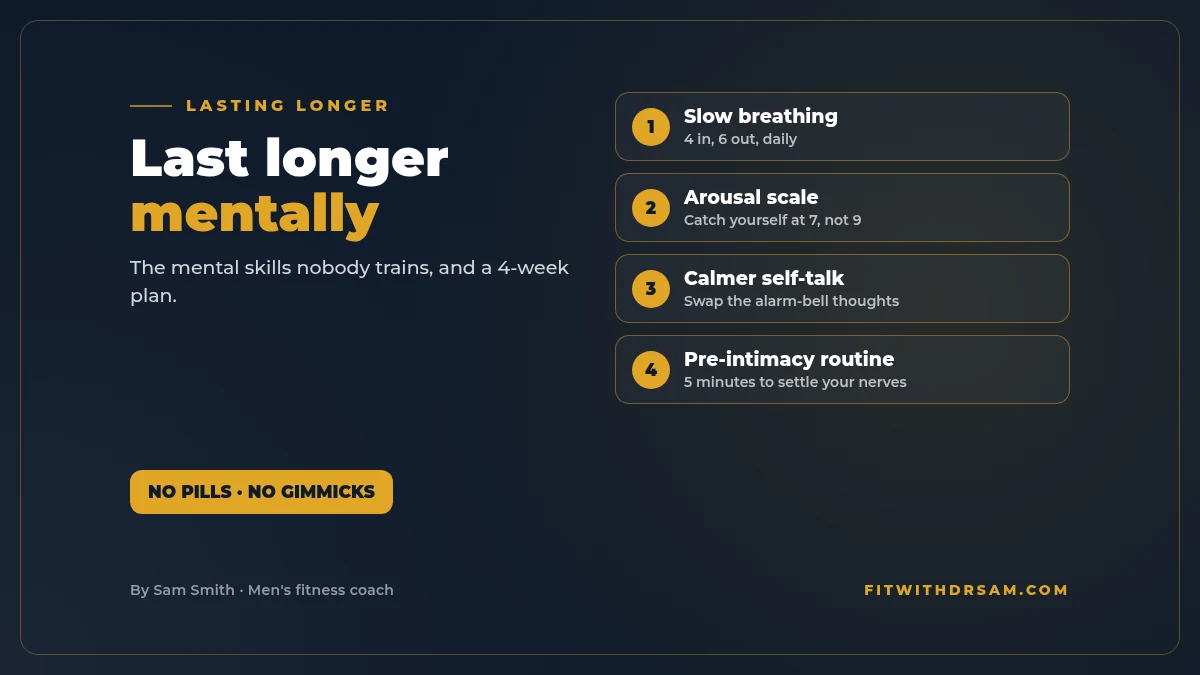
If you want to know how to last longer in bed mentally, you’re asking the right question. A lot of advice focuses on pills, sprays or “tricks”, but for many men the real accelerator is in the head: pressure, worry about finishing too fast, and a body stuck in stress mode. I’ve coached men on stamina for more than 10 years, and the mental side is usually the part nobody trains. This guide gives you a practical routine, built on research and sex-therapy basics, that you can start tonight. Pair it with the physical side in my guide to exercises to last longer in bed.
Key takeaways
- Anxiety speeds arousal up. Calming your nervous system is the first mental skill to train.
- Don’t distract yourself with baseball scores. Stay aware of your arousal so you can slow down in time.
- Slow breathing (about 6 breaths a minute) is a simple, research-backed way to calm the stress response.
- Mental and physical techniques work best together, practised for several weeks.
- If finishing fast happens most of the time and bothers you, a doctor can help. It’s common and treatable.
Why your mind affects how long you last
Ejaculation is a reflex controlled by your nervous system. When you’re relaxed, the “rest and digest” side of the nervous system is in charge. When you’re anxious, the “fight or flight” side takes over: your heart rate rises, your breathing gets shallow and your muscles tense. For many men, that stress state is linked to reaching the point of no return faster. The NHS lists anxiety, stress and relationship problems among the common psychological causes of premature ejaculation (NHS).
That creates a loop. You finish faster than you want once, you worry it will happen again, the worry makes you tense, and the tension makes it more likely. Mayo Clinic describes the same pattern: psychological factors such as anxiety and performance worries often play a role, sometimes alongside physical ones (Mayo Clinic). The good news: a loop driven by your thoughts and nerves can be trained, the same way you train a lift. If anxiety is your main issue, read my full guide to performance anxiety in men as well.
Skill 1: Calm your nervous system with slow breathing
Slow, deep breathing is the fastest way I know to move your body out of stress mode. Breathing at around 6 breaths a minute is linked to greater activity in the calming side of the nervous system and lower stress in studies (Zaccaro et al., 2018). You don’t need an app. Practise this for 5 minutes a day:
- Sit or lie down. Put one hand on your belly.
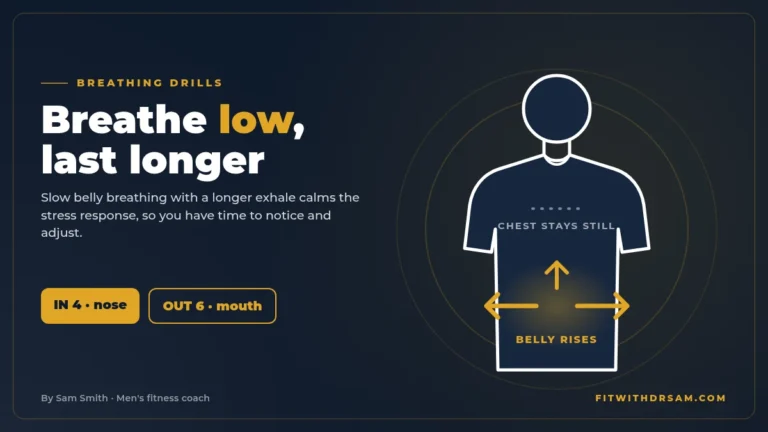
- Breathe in through your nose for 4 seconds, letting your belly rise, not your chest.
- Breathe out slowly through your nose or pursed lips for 6 seconds.
- Repeat for 5 minutes. If your mind drifts, bring it back to counting.
The point is to make this automatic. When it’s a habit, you can drop into 2 or 3 slow breaths during intimacy without thinking about it. For more drills, including box breathing and diaphragm work, see my guide to breathing techniques to last longer.
Skill 2: Swap distraction for awareness
The most common mental “trick” men try is distraction: thinking about work, sports scores or anything unsexy. It feels logical, but it usually backfires. When you tune out, you lose track of your arousal level. By the time you notice you’re close, it’s too late to slow down. Distraction also makes sex less enjoyable for you and less connected for your partner.
Sex therapists teach the opposite: present-moment awareness. A review of mindfulness-based approaches for sexual problems found promising results, mainly in women’s sexual concerns, with growing interest in men (Stephenson & Kerth, 2017). The practical version for lasting longer is simple: learn to rate your arousal and act on it.
The arousal scale
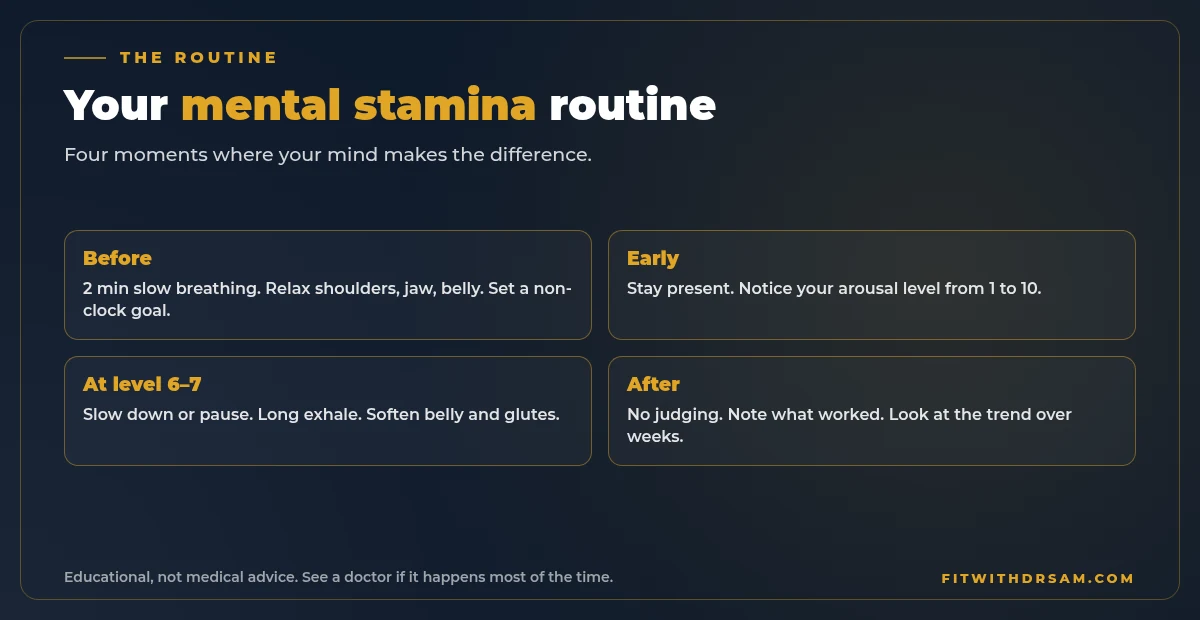
Think of arousal on a scale from 1 to 10, where 10 is the point of no return. Most men only notice 3 and 10. Your goal is to recognise 5, 6 and 7, because that’s where you still have choices.
| Level | What it feels like | What to do |
|---|---|---|
| 1–4 | Relaxed, building slowly | Enjoy it, breathe normally |
| 5–6 | Clearly aroused, still in control | Slow breathing, relax your belly and glutes |
| 7 | Strong urge, breathing speeding up | Slow down or pause, change position, breathe out long |
| 8–9 | Very close | Stop movement fully until you drop to 5 or 6 |
| 10 | Point of no return | Too late to stop; note what came before it |
Practise noticing these levels during solo time first, without any goal except awareness. Over a few weeks, most men find they can catch themselves at 7 instead of 9. This is also the foundation of the start-stop and squeeze techniques, which I explain step by step in a separate guide.
Skill 3: Change the story in your head
What you tell yourself before and during sex affects your nervous system. Thoughts like “Don’t finish early”, “She’ll be disappointed” or “Here we go again” act like alarm bells. Cognitive behavioural therapy (CBT), which the NHS offers for anxiety, works by spotting unhelpful thoughts and testing them (NHS). You can borrow the basic idea:
| Unhelpful thought | More useful thought |
|---|---|
| “I have to last 20 minutes.” | “Most couples’ sex lasts minutes, not hours. Connection matters more than the clock.” |
| “If I finish early, it’s a disaster.” | “If I finish early, we can keep enjoying each other in other ways.” |
| “I always do this.” | “I’m training this. Each time I notice my arousal earlier.” |
| “Don’t think about it.” | “Breathe slowly and stay with the sensation.” |
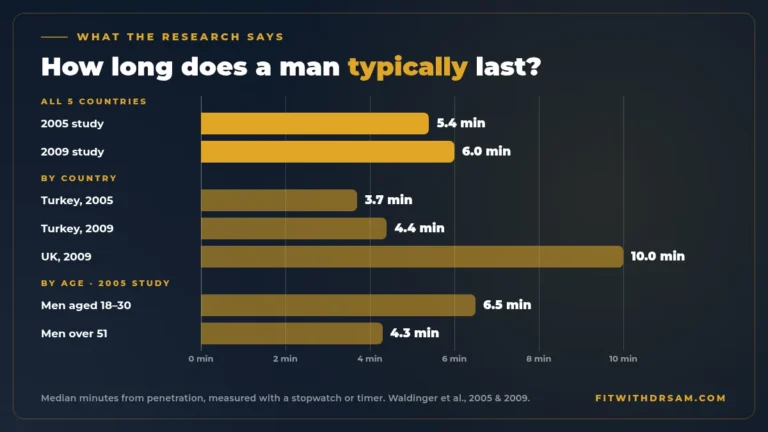
It also helps to know what’s normal. Many men overestimate how long other men last. My article on how long a man should last looks at the research, and it usually takes a lot of pressure off.
Skill 4: Build a pre-intimacy routine
Athletes use routines to settle their nerves before competition. You can do the same. A simple 5-minute routine before intimacy:
- Move first. A short walk or a few minutes of light exercise earlier in the day burns off restless energy.
- Breathe. 2 minutes of the 4-in, 6-out breathing from Skill 1.
- Relax your body. Drop your shoulders, unclench your jaw, soften your belly and glutes. Tension in these muscles tends to speed things up.
- Set a goal that isn’t the clock. For example: “Tonight I’ll notice my arousal at 6 and slow down once.”
- Skip the alcohol crutch. A drink may relax you, but heavier drinking can affect erections and makes it harder to stay aware.
Free plan
Get the 7-Day Stamina Starter
The free 7-Day Stamina Starter gives you 10 to 15 minutes a day of breathing, pelvic-floor basics and mobility, with a tick-box tracker. A simple way to make these skills a habit.
Send me the free planFree. No spam. Unsubscribe anytime.
Skill 5: Talk to your partner
Hiding the problem adds pressure. Telling your partner something like “I’m working on lasting longer, and it helps me to slow down sometimes” turns it into a team project. Pauses become part of sex instead of an awkward stop. Many partners care much more about closeness, attention and foreplay than about how long intercourse lasts. If talking about it feels hard, my guide on how to reconnect with your partner has simple ways to start.
A 4-week mental stamina plan
| Week | Daily practice (10 min) | With a partner |
|---|---|---|
| 1 | 5 min slow breathing + 5 min body scan | Just notice your arousal levels, no pressure |
| 2 | Breathing + solo practice rating arousal 1–10 | Use 2 slow breaths at level 6 |
| 3 | Solo start-stop practice: pause at 7 | One planned pause, relax belly and glutes |
| 4 | Breathing + thought swaps from Skill 3 | Combine pauses, position changes and breathing |
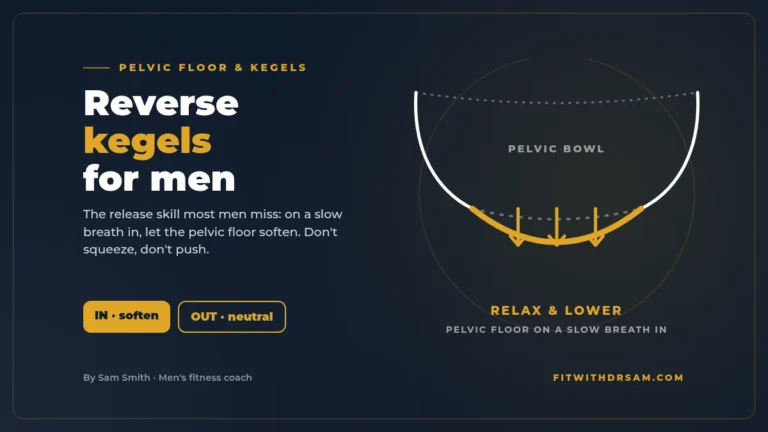
Add the physical side for the best results. Pelvic-floor training, including reverse Kegels to learn how to relax those muscles, gives your mental skills something to work with.
Common mistakes
- Trying everything at once. Pick one skill per week.
- Only practising during sex. Skills need reps when the stakes are low.
- Numbing creams without advice. Some reduce sensation for both partners; ask a pharmacist or doctor.
- Judging every night. Look at the trend over weeks, not one evening.
When to see a doctor
When to see a doctor
Talk to your doctor (GP in the UK, Hausarzt in Germany) if:
- you finish within about a minute most of the time and it has lasted months
- it causes you or your partner distress or puts you off intimacy
- it started suddenly after years without a problem
- you also have erection problems, pain or other symptoms
Premature ejaculation is common and there are effective treatments, including therapy and medicines (Cleveland Clinic). A doctor visit is confidential, and asking is a strong move, not a weak one.
Frequently asked questions
Can you really last longer in bed by changing how you think?
For many men, yes, at least partly. Anxiety and racing thoughts speed up arousal through the stress response. Slower breathing, keeping attention on physical sensation instead of worry, and calmer self-talk help many men feel more in control. Results vary, and if the problem is constant, talk to a doctor.
What should I think about to last longer?
Rather than distracting yourself with unrelated thoughts, most sex therapists suggest staying present: notice your breathing, your partner and your own arousal level. Distraction tends to make you lose track of where you are until it’s too late, while awareness lets you slow down in time.
Does performance anxiety make you finish faster?
It can. Worry activates the body’s fight-or-flight response, which is linked to faster ejaculation in some men and erection problems in others. Reducing pressure, talking with your partner and practising calm breathing all help.
How long does it take to see results from mental techniques?
Most men need several weeks of regular practice. Treat it like training: short daily breathing practice, solo practice with awareness, then applying it with a partner. Combining mental techniques with physical ones such as the start-stop method usually works better than either alone.
When should I see a doctor about finishing too fast?
See a doctor if it happens most of the time, has lasted months, causes you or your partner distress, or started suddenly. Premature ejaculation is common and there are effective, confidential treatments.
The bottom line
Lasting longer is partly a mental skill. Calm your nervous system with slow breathing, stay aware of your arousal instead of tuning out, change the story in your head, and talk to your partner. Practise for 4 weeks and combine it with physical training. My book Increase Stamina in Bed ($39) puts the full mental and physical program together, step by step.
Bestseller · ★ 5.0 from 94 reviews on Gumroad
Increase Stamina in Bed
My complete, step-by-step program for lasting longer: breathing, pelvic-floor training, arousal control drills and the mindset work from this article, organised into a daily plan.
See the bookResults vary. Educational content, not a medical treatment.
References
- NHS. Ejaculation problems. Read online
- Mayo Clinic. Premature ejaculation: symptoms and causes. Read online
- Cleveland Clinic. Premature ejaculation. Read online
- Zaccaro A, Piarulli A, Laurino M, et al. How breath-control can change your life: a systematic review on psycho-physiological correlates of slow breathing. Front Hum Neurosci. 2018;12:353. PubMed Central
- Stephenson KR, Kerth J. Effects of mindfulness-based therapies for female sexual dysfunction: a meta-analytic review. J Sex Res. 2017;54(7):832-849. PubMed
- NHS. Cognitive behavioural therapy (CBT). Read online
All links checked October 17, 2026.