Halloween Candy Calories: A Chart and Smart Treat Plan for Men
Educational content, not medical advice. This article is general information from a fitness coach. It’s not a diagnosis or treatment. If you have a health concern, see a doctor. See “When to see a doctor” below.
Halloween candy calories sneak up on you. One fun-size bar seems harmless; eight of them while handing out treats and watching a horror film is a meal’s worth of sugar. I’m not going to tell you to skip Halloween. I’ve coached men on fat loss for more than 10 years, and the ones who succeed long term enjoy treats without guilt and without losing control. This guide gives you approximate calories for common candy, how much activity they equal, and a simple plan to enjoy Halloween night and get straight back on track tomorrow. My Halloween book sale is also on until October 31; details at the end.
Key takeaways
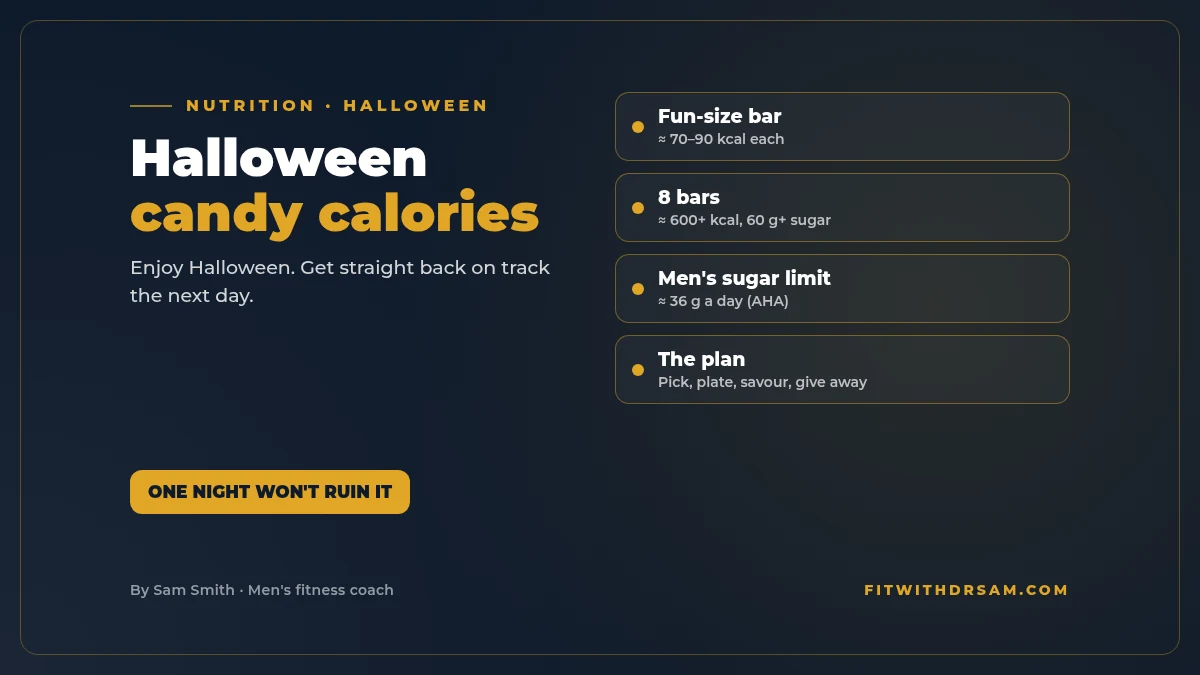
- Most fun-size chocolate bars have roughly 60 to 100 calories each.
- Eight fun-size bars can add up to 600+ calories and over 60 g of sugar.
- Men are advised to keep added sugar to around 36 g a day (AHA).
- One night of treats won’t ruin your progress. A week of leftovers might.
- Plan it: pick favourites, plate them, eat slowly after a proper meal.
Halloween candy calorie chart
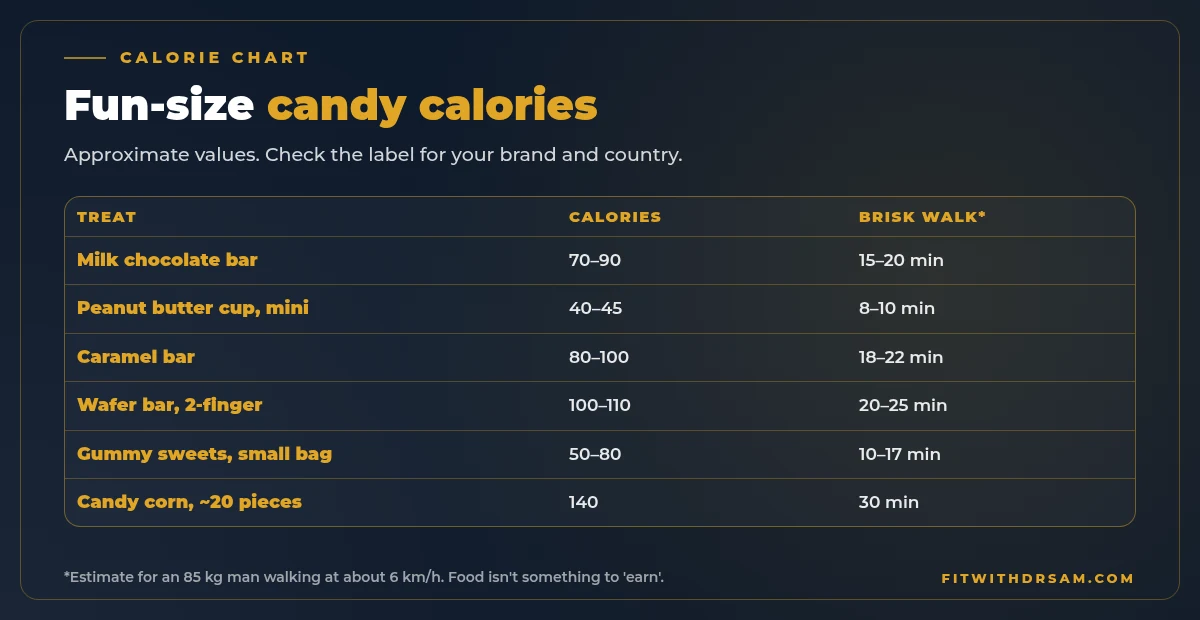
These are approximate values for typical fun-size or mini portions. Brands and sizes vary between the US, Canada, the UK and Germany, so check the label. You can look up specific foods in the USDA FoodData Central database (USDA).
| Treat (fun-size / mini) | Approx. calories | Approx. sugar | Brisk walking to burn* |
|---|---|---|---|
| Milk chocolate bar, fun-size | 70–90 | 8–10 g | 15–20 min |
| Chocolate peanut butter cup, mini | 40–45 | 4–5 g | 8–10 min |
| Chocolate-covered caramel bar, fun-size | 80–100 | 10–12 g | 18–22 min |
| Chocolate wafer bar, 2-finger | 100–110 | 10–11 g | 20–25 min |
| Chocolate with peanuts, fun-size | 80–90 | 8–9 g | 17–20 min |
| Small bag of gummy sweets | 50–80 | 8–14 g | 10–17 min |
| Small box of chewy fruit sweets | 50–60 | 8–10 g | 10–13 min |
| Lollipop | 40–60 | 10–15 g | 8–13 min |
| Candy corn, about 20 pieces | 140 | 28 g | 30 min |
*Rough estimate for an 85 kg (187 lb) man walking briskly at about 6 km/h (3.7 mph). Exercise isn’t a punishment for food, but it helps to see the numbers.
How it adds up
Here’s a typical evening: 4 chocolate bars while handing out treats, a handful of gummies, a few peanut butter cups and some candy corn during a film. That can easily reach 600 to 800 calories and 70 g or more of sugar, about twice the American Heart Association’s suggested daily limit of 36 g of added sugar for men (AHA). The NHS advises adults to have no more than 30 g of free sugars a day (NHS), and the WHO recommends keeping free sugars under 10% of daily energy (WHO).
In fat-loss terms, one night like that might wipe out a day or two of your calorie deficit. Annoying, but not a disaster. The real damage comes when the leftover bowl sits on the kitchen counter for a week.
A simple Halloween plan for men who train
1. Eat a proper meal first
A dinner with protein, vegetables and some carbs before trick-or-treating or the party means you’re not hungry when the candy comes out. My high-protein meal plan has easy options.
2. Buy candy you don’t love to give out
If peanut butter cups are your weakness, hand out fruit sweets instead. And buy on the day, not a week early.
3. Pick your favourites and plate them
Choose 2 to 4 treats you really love, put them on a plate and sit down to eat them. Eating mindfully, without distraction, is linked to eating less later in the day (Robinson et al., 2013). More on this approach in my guide to mindful eating.
4. Go easy on the alcohol
Halloween parties often mean drinks plus candy. Alcohol lowers your resistance to the snack bowl and adds its own calories. Alternate with water. My article on alcohol and muscle growth explains why it’s worth keeping drinks down.
5. Get rid of the leftovers
Give them away, take them to work or freeze a small amount for later. Out of sight, out of mind is surprisingly effective.
6. Move
Take the kids trick-or-treating on foot, or do a walk or workout earlier in the day. Every bit counts towards the 150 minutes a week recommended for adults (CDC).
Free plan
Get the 7-Day Stamina Starter
Back on track tomorrow? The free 7-Day Stamina Starter gives you 10 to 15 minutes a day of breathing, mobility and short bodyweight sessions, with a tick-box tracker.
Send me the free planFree. No spam. Unsubscribe anytime.
The day after: get straight back on track
- Don’t starve yourself or do punishment cardio. Just return to your normal plan.
- Drink water and eat protein and vegetables at every meal.
- Train as planned. The extra carbs might even give you a good session.
- Ignore the scale for 2 or 3 days. Extra carbs and salt hold water; it’s not all fat.
- Look at the weekly average, not one day.
If belly fat is your main goal, my recipes to help you lose belly fat make the days after easy to get right.
Healthier Halloween swaps
| Instead of | Try |
|---|---|
| A handful of mixed candy | 2 squares of dark chocolate (70%+) |
| Candy corn | Popcorn (air-popped, lightly salted) |
| Caramel bars | Apple slices with peanut butter |
| Sugary punch | Sparkling water with orange slices |
| Grazing all night | One plated portion, then the bowl goes away |
When to see a doctor
When to see a doctor
Talk to your doctor if:
- you have diabetes or prediabetes and aren’t sure how to handle treats
- you often feel out of control around food or eat in secret
- you have frequent thirst, tiredness or need to urinate a lot, which can be signs of high blood sugar
- you’re trying to lose a lot of weight and want support
If you have diabetes, plan treats with your care team; many people with diabetes can include small portions of sweets as part of a balanced plan.
Frequently asked questions
How many calories are in fun-size Halloween candy?
Most fun-size chocolate bars have roughly 60 to 100 calories each, and small bags of sweets or gummies often have 50 to 80. Check the label, because sizes differ between brands and countries.
Will one night of Halloween candy ruin my diet?
No. One evening of treats won’t undo weeks of good habits. Fat loss depends on your average intake over weeks. The problem is when one night turns into a week of grazing on leftovers.
How much sugar should a man eat a day?
The American Heart Association suggests men keep added sugar to about 36 g (9 teaspoons) a day. The NHS advises adults to have no more than 30 g of free sugars a day. A few fun-size bars can use up most of that.
What’s the healthiest Halloween candy?
Dark chocolate and options with nuts tend to fill you up more than pure sugar sweets. But portion size matters more than type. Pick the treats you really love and enjoy a few slowly.
How do I stop eating leftover Halloween candy?
Buy candy you don’t love to give out, buy it on the day, give leftovers away or take them to work, and keep any you keep out of sight. Out of sight really does help.
The bottom line
Halloween candy calories add up fast, but one night won’t ruin your progress. Eat a proper meal first, pick your favourites, plate them, enjoy them slowly and get rid of the leftovers. The next day, just go back to your plan. My book Nutrition, Metabolism & Muscle ($19) shows you how to build a diet that has room for treats. My Halloween sale is on until October 31: 50% off with code HALLOWEEN.
Bundle · $79 · by Sam Smith
The Complete Library
All five of my books in one download: stamina, the 30-day Warrior challenge, nutrition, relationships and herbal wellness. Worth $122 bought separately.
Halloween sale: use code HALLOWEEN at checkout for 50% off on Gumroad. Valid until October 31, 2026.
Get the bundle on GumroadResults vary. Educational content, not a medical treatment.
Diet, BMR & bodyweight guide · by Sam Smith
Nutrition, Metabolism & Muscle
My practical guide to eating for fat loss or muscle: how to find your BMR and macros, build meals that keep you full and fit treats in. Includes a calculator, tracker and 3 meal plans.
See the bookResults vary. Educational content, not medical or dietary treatment.
References
- American Heart Association. Added sugars. Read online
- NHS. Sugar: the facts. Read online
- WHO. WHO calls on countries to reduce sugars intake among adults and children. 2015. Read online
- USDA. FoodData Central. Read online
- Robinson E, Aveyard P, Daley A, et al. Eating attentively: a systematic review and meta-analysis of the effect of food intake memory and awareness on eating. Am J Clin Nutr. 2013;97(4):728-742. PubMed
- CDC. Adult activity: an overview. Read online
All links checked October 17, 2026.