Does Exercise Help You Last Longer in Bed? What the Research Says
Educational content, not medical advice. This article is general information from a fitness coach. It is not a diagnosis or treatment. If you have a health concern, see a doctor. See “When to see a doctor” below.
Short answer: probably yes, but not equally for every type of exercise. Regular cardio and strength training clearly improve the fitness, weight and blood flow that support erections and energy in bed. Early studies also suggest that running, interval training and yoga may help ejaculation control. The research is small and still young, so exercise is a sensible part of the plan, not a guaranteed fix.
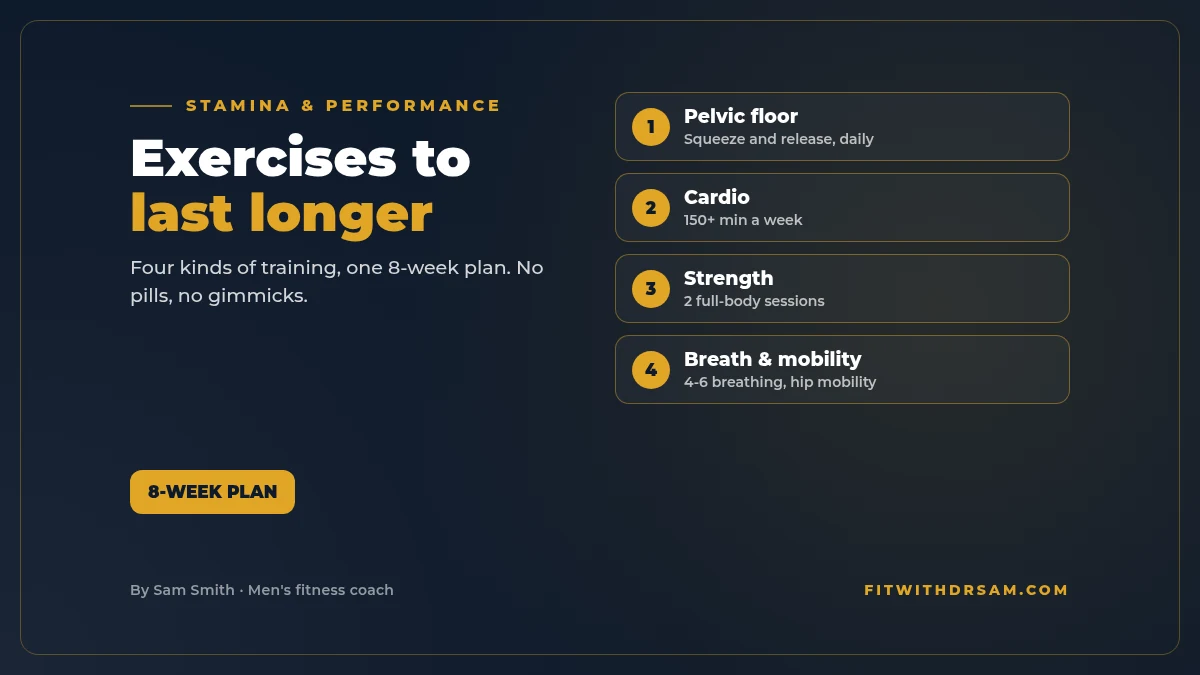
I’m Sam Smith, a fitness coach, and this is the question I get most from men who already train: “I lift four days a week, so why do I still finish too soon?” Below I go through what the studies found, what they did not test, and how to turn it into a week you can actually follow. If you want the routine itself, see my 8-week exercise plan to last longer.
Key takeaways
- A review of six exercise trials (433 men, aged 18 to 50) found that yoga, running and high-intensity interval training (HIIT) eased premature ejaculation symptoms. The studies were small and short.
- Aerobic exercise raised erectile-function scores by about 2.8 points on average across 11 randomised trials. That supports stamina in a different way: firmer, more reliable erections.
- I found no trials of weight training alone on ejaculation timing. Lifting still helps indirectly through fitness, body weight and confidence.
- Pelvic floor training shows promise in small studies, but a 2026 review of randomised trials found it worked less well on its own than dapoxetine.
- If you have always finished very quickly and it bothers you, see a doctor. Exercise can sit alongside medical care.
Stamina and lasting longer are two different things
Most men use “stamina” to mean two things at once. It helps to separate them, because exercise affects them differently.
- Physical stamina: your breathing, heart rate and leg and core endurance during sex. Cardio and strength training directly improve this.
- Ejaculatory control: how long you last before orgasm. This is driven by your nervous system, arousal and anxiety as much as by fitness, so exercise helps here more indirectly.
- Erection quality: firmness and staying power. This depends on blood flow, weight, sleep and stress, all of which respond to training.
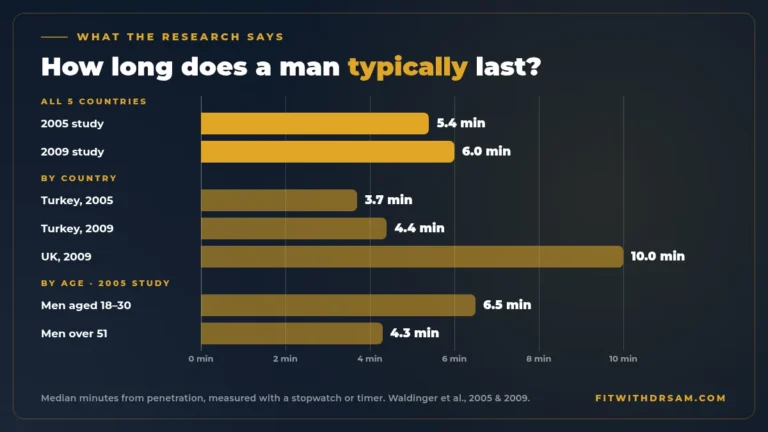
For context on timing, a stopwatch study of 500 couples in five countries found a median of 5.4 minutes from penetration to ejaculation, with a very wide range of 0.55 to 44.1 minutes (Waldinger et al., 2005). Sex therapists surveyed in the US and Canada called 3 to 13 minutes normal and not a reason for clinical concern (Corty and Guardiani, 2008). So you may be closer to normal than you think. More on that in how long a man should last.
What the research actually found
Running, HIIT and yoga: the best-supported options
The most relevant study is a 2023 systematic review in Sexual Medicine Reviews (Niu and Santtila). It pulled together six intervention studies with 433 participants, 307 of whom had premature ejaculation, aged 18 to 50. The authors concluded that yoga, running and HIIT eased premature ejaculation symptoms, and that the size of the benefit looked similar to drug treatment in those studies. They also noted that intensity and effort during training seemed to matter.
Treat that with care. These were small trials, most had no placebo group, and the review only looked at English-language papers. It is encouraging, not conclusive.
One of the trials behind it compared yoga with the antidepressant fluoxetine in 68 men with premature ejaculation. All 38 men in the yoga group improved, as did 25 of 30 (82%) in the fluoxetine group, and the authors called yoga a feasible and acceptable option (Dhikav et al., 2007). Again, a single hospital and no blinding, so I would not call it proof.
Cardio and your erections
Cardio has stronger evidence for the erection side. A meta-analysis of 11 randomised trials found that aerobic exercise improved erectile-function scores by a mean of 2.8 points compared with no exercise, with bigger gains in men who started with more difficulty (Khera et al., 2023). A survey of 3,906 physically active men found lower odds of erectile dysfunction in several of the more active groups, around 22% lower in some of them after adjusting for age, weight and smoking (Fergus et al., 2019). That is an association, not proof of cause.
Weight and fitness matter too. In a trial of 110 obese men aged 35 to 55 with erectile dysfunction, two years of advice on weight loss and activity led to a normal-range score in 17 men, compared with 3 in the control group (Esposito et al., 2004).
Pelvic floor training: promising, but not a magic switch
A small Italian study of 40 men with lifelong premature ejaculation used 12 weeks of pelvic floor rehabilitation. 33 of the 40 gained control, and average time to ejaculation rose from about 40 seconds to about 146 seconds (Pastore et al., 2014). There was no control group, though. A 2026 meta-analysis of five randomised trials (236 men) found that pelvic floor or sphincter training had a smaller effect than dapoxetine and that combining training with a device or diaphragmatic breathing may do better than exercises alone (de Oliveira et al., 2026).
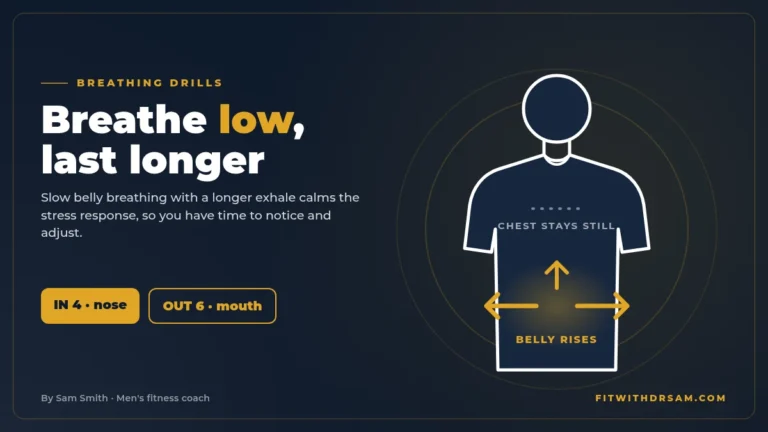
My take: do pelvic floor work, but pair it with breathing and arousal control, which is how I teach it. Start with the Kegel guide for men and reverse kegels, and add breathing drills.
Weight training: helpful, but untested for timing
I searched for trials testing lifting alone on ejaculation time and found none. What lifting does well is build muscle, support a healthy weight, improve sleep and confidence, and help you carry yourself with less tension. Those are real, if indirect, gains. If you lift already, keep going and add the cardio and pelvic floor work below. Our strength training and testosterone guide explains how lifting fits in.
Which type of exercise is worth your time?
| Type | What the evidence suggests | How to use it | Confidence |
|---|---|---|---|
| Running / brisk cardio | Eases erection difficulty; running eased PE symptoms in small trials | 3 sessions a week, 20 to 40 min, at a pace where talking is hard | Moderate |
| HIIT (intervals) | Eased PE symptoms in small trials | 1 to 2 short sessions a week: 30 sec hard, 90 sec easy, 8 rounds | Low to moderate |
| Yoga | One trial vs fluoxetine, 68 men; calming effect | 2 sessions a week, 20 to 30 min, focus on slow breathing | Low to moderate |
| Pelvic floor (kegels and reverse kegels) | Small pilot plus mixed randomised results | Daily, 5 to 10 min, with breathing | Low to moderate |
| Strength training | No timing trials found; supports weight, sleep, confidence | 2 to 3 full-body sessions a week | Indirect |
| Core work (planks, bird-dog) | Practical help with holding positions; not studied for timing | 3 short sets after lifting | Practical only |
A simple weekly plan
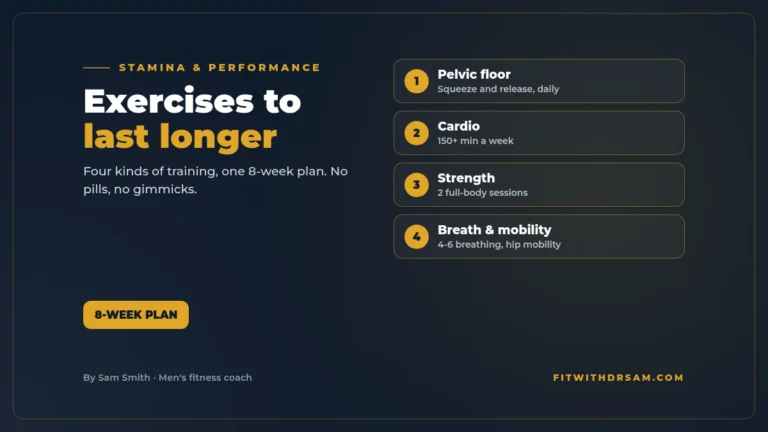
This plan follows the usual public-health advice of 150 minutes of moderate cardio plus two strength sessions a week (WHO guidelines), then adds the pieces above. It takes about 4 to 5 hours a week, with a few 10-minute slots.
| Day | Training | Time |
|---|---|---|
| Mon | Full-body strength + 5 min pelvic floor and breathing | 45 min |
| Tue | Brisk walk or easy run | 30 min |
| Wed | HIIT: 8 rounds of 30 sec hard, 90 sec easy | 20 min |
| Thu | Full-body strength + core | 45 min |
| Fri | Yoga or mobility, slow breathing | 25 min |
| Sat | Longer easy cardio (hike, bike, swim) | 40 to 60 min |
| Sun | Rest, walk, 5 min pelvic floor | 10 to 20 min |
Build up slowly. Add one session or ten minutes a week, not everything at once. If you are over 40, our workout plan for men over 40 shows how to set up the strength days safely. If you cycle a lot and notice numbness in the groin, adjust your saddle and mention it to a doctor.
What exercise cannot do
- It will not change timing overnight. In the trials, benefits showed up over weeks, not days.
- It cannot replace medical care when something else is going on. The American Urological Association lists daily SSRIs, on-demand clomipramine or dapoxetine (where available), and topical anaesthetics as first-line medical options for premature ejaculation, and recommends considering a referral to a sexual-health therapist (AUA/SMSNA guideline, 2020). That is a decision for you and your doctor.
- It does not fix anxiety by itself. If worry is the driver, read performance anxiety in men and how to last longer in bed mentally.
When to see a doctor
Exercise is a good first step, but see your doctor (GP in the UK, Hausarzt in Germany) or a urologist if:
- you have always finished within about a minute or two and it distresses you
- the change was sudden, or erections have become unreliable
- you have pain, blood in your semen, or urinary symptoms
- you get chest pain or unusual breathlessness when you exercise
For help with the emotional side, COSRT lists therapists in the UK and AASECT lists certified sex therapists in the US and Canada.
How to put it together
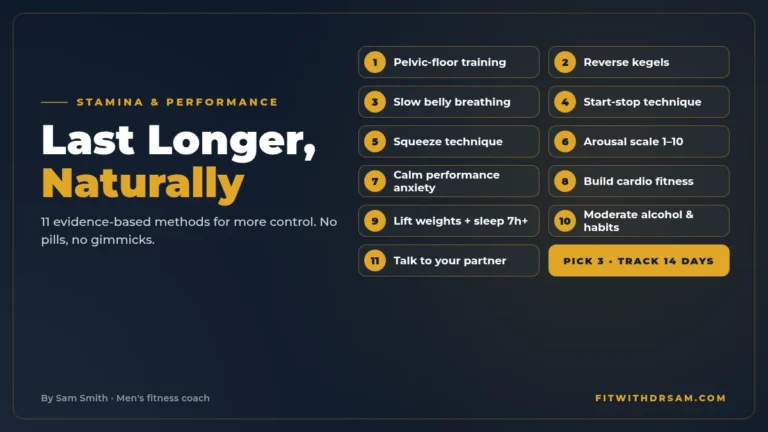
If I had to give one order of priorities, it would be: (1) walk or run most days, (2) lift two to three times a week, (3) practise breathing and pelvic floor control daily, (4) sleep and cut back on alcohol, (5) talk openly with your partner. My book Increase Stamina in Bed turns this into a 30-day, day-by-day program with pelvic floor, breathing, the arousal scale and fitness habits in one place. For a bodyweight endurance challenge, try The Warrior’s Stamina. The full map of this topic is in the complete guide to male sexual stamina.
Free: the 7-Day Stamina Starter
Breathing, pelvic floor control, mobility and three short bodyweight sessions in 10 to 15 minutes a day. Get the free 7-day plan.
Frequently asked questions
Does running help you last longer in bed?
It may. A 2023 review of six exercise studies found that running eased premature ejaculation symptoms in some men, and running improves the heart and circulation that support erections. The studies were small, so think of running as one helpful habit rather than a cure.
Does cardio increase sexual stamina?
Cardio improves physical endurance and, across 11 randomised trials, raised erectile-function scores by about 2.8 points on average. That supports staying power, though direct evidence for ejaculation timing is still limited.
Does lifting weights help you last longer in bed?
There are no trials testing weights alone for ejaculation timing. Lifting helps through fitness, body weight, sleep and confidence, and it works best alongside cardio and pelvic floor practice.
How long does it take for exercise to help?
In the studies, changes took weeks of regular training, commonly around 8 to 12 weeks. Expect gradual change, not a result after one workout.
Is it okay to exercise right before sex to last longer?
I don’t recommend it as a plan. There is no solid evidence for it, and being tired can make erections and enjoyment worse. Regular training across the week is the approach the research supports.
Can exercise replace medication for premature ejaculation?
Not reliably. Exercise may help some men, but medical treatments have stronger evidence. Talk to your doctor if the problem is lifelong or distressing, and use exercise as an addition.
About the author. Sam Smith is a fitness coach with more than 10 years of experience and the author of five books on men’s stamina, fitness, nutrition and relationships. He is not a medical doctor and does not give medical advice.
Sources
- Niu S, Santtila P. Effects of physical exercise interventions on ejaculation control: a systematic review. Sex Med Rev. 2024;12(1):106-113. DOI
- Dhikav V, Karmarkar G, Gupta M, Anand KS. Yoga in premature ejaculation: a comparative trial with fluoxetine. J Sex Med. 2007;4(6):1726-1732. PubMed
- Khera M, Bhattacharyya S, Miller LE. Effect of aerobic exercise on erectile function: systematic review and meta-analysis of randomized controlled trials. J Sex Med. 2023;20(12):1369-1375. PubMed
- Fergus KB, Gaither TW, Baradaran N, et al. Exercise improves self-reported sexual function among physically active adults. J Sex Med. 2019. PubMed
- Esposito K, Giugliano F, Di Palo C, et al. Effect of lifestyle changes on erectile dysfunction in obese men: a randomized controlled trial. JAMA. 2004;291(24):2978-2984. PubMed
- Pastore AL, Palleschi G, Fuschi A, et al. Pelvic floor muscle rehabilitation for patients with lifelong premature ejaculation: a novel therapeutic approach. Ther Adv Urol. 2014;6(3):83-88. PubMed
- de Oliveira FA, Lima LB, da Costa MO, et al. Efficacy of pelvic floor muscle training in the management of premature ejaculation: a systematic review and meta-analysis of randomized controlled trials. J Sex Med. 2026;23(6):qdag131. PubMed
- Waldinger MD, Quinn P, Dilleen M, et al. A multinational population survey of intravaginal ejaculation latency time. J Sex Med. 2005;2(4):492-497. PubMed
- Corty EW, Guardiani JM. Canadian and American sex therapists' perceptions of normal and abnormal ejaculatory latencies: how long should intercourse last? J Sex Med. 2008. PubMed
- American Urological Association. Disorders of ejaculation: AUA/SMSNA guideline (2020). AUA
- World Health Organization. WHO guidelines on physical activity and sedentary behaviour (2020). WHO
All links checked 28 October 2026.