How Often Should Men Do Kegels? Reps, Sets and How Long They Take to Work

Educational content, not medical advice. This article is general fitness information from a coach, not medical advice. Pelvic floor exercises are not a treatment promise for any condition. If you have leaking, pain, erection or ejaculation problems, or you have had prostate surgery, see “When to see a doctor” below and get a proper assessment.
Most men do best with Kegels about three times a day: a set of 8 to 12 squeezes each time, held for up to 5 to 10 seconds, with a full relax between reps. Expect the muscles to feel stronger and easier to control after roughly 4 to 6 weeks, while studies on men usually measure results after about 3 months of steady practice. More is not better. Squeezing all day can leave the pelvic floor tight and tired instead of strong.
This guide is part of my complete guide to male sexual stamina. I’m Sam Smith, a fitness coach with more than 10 years of experience. I treat the pelvic floor like any other muscle group: it needs a clear dose, progression and rest. If you have never done a Kegel before, start with my step-by-step guide to Kegel exercises for men, then come back here for the “how often and how long” part.
Free: the 7-Day Stamina Starter
A short daily plan that combines breathing, pelvic floor work, mobility and bodyweight sessions, so you know exactly what to do each day. Get the free 7-day plan.
Key takeaways
- A sensible starting dose is 3 sets a day of 8 to 12 squeezes, each held for 3 to 5 seconds, then built up to 10 seconds.
- The NHS describes pelvic floor programmes of at least 8 contractions, 3 times a day, for at least 3 months.
- Most men notice better control in 4 to 6 weeks. Studies on men usually report results at about 12 weeks.
- Relaxing the muscle fully after each squeeze matters as much as the squeeze. Reverse Kegels train that release.
- Doing hundreds of reps a day is a common mistake. It can cause tightness, pain or worse control.
- Kegels help most when they are part of a bigger plan: breathing, general fitness, sleep and arousal awareness.
How often should men do Kegels?
For most beginners, three short sessions a day is the sweet spot. Each session takes 3 to 5 minutes. A common routine looks like this:
| Part | Beginner (weeks 1-2) | Building (weeks 3-6) | Maintenance (after week 12) |
|---|---|---|---|
| Sessions per day | 2-3 | 3 | 1, or 3 times a week |
| Slow squeezes per set | 8-10 | 10-12 | 10 |
| Hold time | 3-5 seconds | 5-10 seconds | 10 seconds |
| Rest between reps | Equal to hold time | Equal to hold time | Equal to hold time |
| Quick flicks (1 second) | None | 5-10 after the slow set | 10 after the slow set |
| Positions | Lying down | Sitting, then standing | Standing, walking, lifting |
This matches what health services suggest. The NHS says a pelvic floor programme should include at least 8 contractions at least 3 times a day and last for at least 3 months. Cleveland Clinic describes a similar build-up: start with short holds, work up to 10 reps per set held for about 5 seconds each, and move from twice a day to three times a day.
Why not do them all day?
The pelvic floor is a muscle group like your biceps. It needs rest to adapt. Many men read that Kegels “help you last longer” and start clenching at every red light. That often leads to a tight, tired pelvic floor. Signs of overdoing it include a dull ache in the groin, tailbone or perineum, a feeling that you cannot fully relax, needing to pee more often, or finding it harder to control ejaculation, not easier. If that happens, cut the volume in half and add the relaxation drills from my guide to reverse Kegels for men.
How long do male Kegels take to work?
Think in three stages. The exact timeline differs from man to man, and depends on your starting point and how consistent you are.
- Weeks 1 to 2: finding the muscle. Most of the work is learning to squeeze the right muscle without tensing your glutes, thighs or stomach, and without holding your breath.
- Weeks 3 to 6: control. The squeeze feels stronger and you can hold it longer. Many men say they notice the muscle more easily during the day.
- Weeks 8 to 12 and beyond: real change. This is the window most studies use. Muscle strength and endurance take months, not days, to build.
What the research on men shows
Research on Kegels for men is smaller than for women, but there are useful studies. Treat the findings as encouraging, not as a guarantee:
- In a UK randomised controlled trial, 55 men with erection problems did pelvic floor exercises with biofeedback plus lifestyle advice. After 3 months, the exercise group scored clearly better on erectile function than the lifestyle-only group, and results improved further at 6 months. By the end, 40% had normal function, 34.5% had improved, and 25.5% did not improve (Dorey et al., 2004).
- In an Italian study of 40 men with lifelong early ejaculation, a 12-week pelvic floor rehabilitation programme (exercises plus physiotherapy techniques) helped 33 of them, or 82.5%, gain better control (Pastore et al., 2014). There was no control group, so the results are promising rather than proof.
- For men leaking urine after prostate surgery, a Cochrane review found mixed evidence on how much pelvic floor training adds over time. This is an area where a specialist physiotherapist should guide you (Anderson et al., 2015).
Two points stand out. First, every study ran for about 12 weeks, not 2. Second, the men were usually taught and checked by a professional, often with biofeedback. If you are doing this alone, the best thing you can do is learn the right technique and stay consistent.
How to do a Kegel properly (quick recap)
- Find the muscle. Imagine stopping the flow of urine and holding in wind at the same time. The base of the penis may lift slightly and the testicles draw up a little. Do not practise by stopping your urine regularly. Use it once to find the feeling only.
- Breathe. Breathe out as you squeeze and lift. Breathe in as you let go. Never hold your breath.
- Keep everything else soft. Your buttocks, inner thighs and stomach should stay relaxed. Put a hand on your belly to check.
- Let go completely. After each squeeze, relax for as long as you held it. Feel the muscle drop back down.
- Progress slowly. First lying down, then sitting, then standing, then during everyday moves such as getting up from a chair.
Breathing and the pelvic floor work together. My guide to breathing techniques to last longer shows how to pair slow breathing with pelvic floor relaxation.
A simple 12-week Kegel plan for men
| Weeks | Daily routine | Focus |
|---|---|---|
| 1-2 | 2-3 sets of 8-10 slow squeezes, 3-5 s hold, lying down | Technique and breathing |
| 3-4 | 3 sets of 10 slow squeezes, 5-6 s hold, sitting | Longer holds, full relaxation |
| 5-6 | 3 sets of 10-12, 6-8 s hold, plus 5 quick flicks, standing | Endurance and speed |
| 7-9 | 3 sets of 10-12, 8-10 s hold, plus 10 quick flicks | Use during daily moves, add 1 set of reverse Kegels |
| 10-12 | 3 sets of 10, 10 s hold, plus 10 quick flicks | Control and relaxation on demand |
| 13+ | 1 set daily or 3 times a week | Maintenance |
Keep a simple tick list on your phone. Consistency is what moves the needle. Missing one day does not matter. Missing two weeks does.
Kegels and lasting longer: where they fit
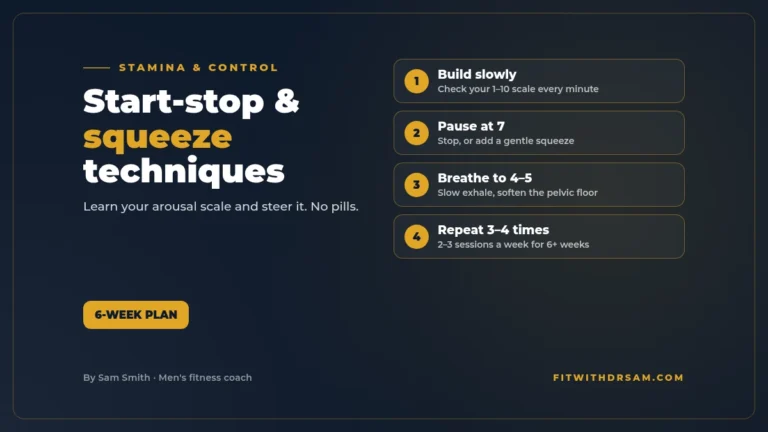
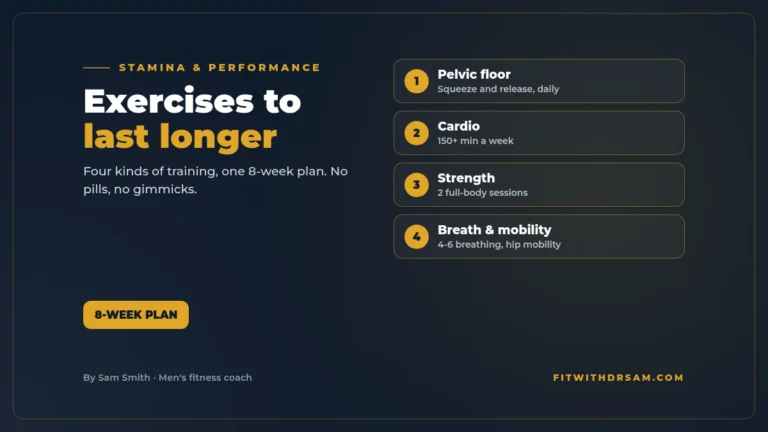
A stronger, more controllable pelvic floor is only one piece of better stamina. In my experience the men who see the most progress combine three things: pelvic floor control, awareness of their arousal level, and general fitness. Techniques such as the start-stop and squeeze technique train arousal awareness, while regular cardio and strength training support blood flow, energy and confidence.
If your pelvic floor already feels tight or you struggle to relax, start with relaxation and breathing before adding more squeezes. Men with a tense pelvic floor often find that learning to let go helps more than squeezing harder.
Common Kegel mistakes men make
- Squeezing the wrong muscles: clenching the buttocks or thighs instead of the pelvic floor.
- Holding your breath: this raises pressure in the belly and works against the pelvic floor.
- Skipping the relax phase: a muscle that never fully relaxes does not get stronger, it just gets tired.
- Doing too much too soon: 100 squeezes a day in week one is a recipe for soreness.
- Giving up after two weeks: real change takes months.
- Ignoring symptoms: pain, leaking or new problems are a reason to see a professional, not to train harder.
When to see a doctor, GP or Hausarzt
- You leak urine, especially after prostate surgery or when you cough, lift or exercise.
- You have pain in the pelvis, perineum, testicles or penis, or pain when you ejaculate.
- You have ongoing erection problems or early ejaculation that worries you.
- You need to pee much more often, urgently, or at night.
- Kegels make your symptoms worse.
A doctor can rule out other causes and may refer you to a pelvic health physiotherapist. In the UK, talk to your GP. In Germany, see your Hausarzt or a urologist. In the US and Canada, see your primary care doctor, who can refer you to a urologist or pelvic floor physical therapist. Erection problems can also be an early sign of heart or blood vessel problems, so they are worth checking.
Want the full stamina plan? My book Increase Stamina in Bed puts pelvic floor training, breathing, arousal control and fitness into one step-by-step programme. Read more about the book. Related reading: reverse Kegels for men · breathing techniques to last longer
Start with the free 7-Day Stamina Starter
Seven short sessions that combine pelvic floor work, breathing and fitness. Get it free. For the full topic map, see my complete guide to male sexual stamina.
Frequently asked questions
How many Kegels should a man do a day?
A common starting point is 3 sets of 8 to 12 squeezes a day, held for 3 to 5 seconds and built up to 10 seconds, with a full relax between each squeeze. That is about 30 squeezes a day in total.
How long do male Kegels take to work?
Most men notice better control within 4 to 6 weeks. Studies on men usually measure results after about 12 weeks of regular practice, so give it at least 3 months.
Can you do too many Kegels?
Yes. Too many squeezes, or never fully relaxing, can leave the pelvic floor tight and tired. Signs include pelvic aches, needing to pee more often or finding control harder. If that happens, do fewer and add relaxation work.
Is it better to do Kegels lying down or standing?
Start lying down because it is easiest to feel the right muscle. Then progress to sitting and standing, and finally use the squeeze during everyday moves.
Do Kegels help you last longer?
Pelvic floor training is one part of better control. A small study found that a 12-week pelvic floor programme helped many men with lifelong early ejaculation, but it had no control group. Kegels work best together with arousal awareness, breathing and general fitness.
Should I keep doing Kegels forever?
After about 12 weeks, many men switch to maintenance: one set a day or three times a week. Like any muscle, the pelvic floor loses strength if you stop completely.
The bottom line. Do Kegels about three times a day, with 8 to 12 controlled squeezes and a full relax each time. Build up slowly, keep breathing, and give it at least 12 weeks. Fewer, better reps beat endless clenching.
About the author. Sam Smith is a fitness coach with more than 10 years of experience and the author of five books on men’s stamina, fitness, nutrition and relationships. He is not a medical doctor and does not give medical advice.
Sources
- NHS. Urinary incontinence: treatment (pelvic floor muscle training). nhs.uk
- Cleveland Clinic. Kegel exercises. clevelandclinic.org
- Mayo Clinic. Kegel exercises for men: understand the benefits. mayoclinic.org
- Dorey G, Speakman M, Feneley R, et al. Randomised controlled trial of pelvic floor muscle exercises and manometric biofeedback for erectile dysfunction. Br J Gen Pract. 2004;54(508):819-825. PubMed
- Pastore AL, Palleschi G, Fuschi A, et al. Pelvic floor muscle rehabilitation for patients with lifelong premature ejaculation: a novel therapeutic approach. Ther Adv Urol. 2014;6(3):83-88. PubMed
- Anderson CA, Omar MI, Campbell SE, et al. Conservative management for postprostatectomy urinary incontinence. Cochrane Database Syst Rev. 2015;1:CD001843. PubMed
All links checked 10 November 2026.