Do Men Last Longer the Second Time? Why It Happens and How to Use It
Educational content, not medical advice. This article is general information from a fitness coach, not a diagnosis or treatment. If you have a health concern, see a doctor.
Do men last longer the second time? Many men say yes, but there is very little research on it. Plausible reasons include lower built-up arousal after the first orgasm, less nervous pressure and a slower build-up while the body recovers. It is a common experience, not a guarantee, and it changes with age and between men.
I’m Sam Smith, a fitness coach, and this question comes up a lot from men who finish quickly the first time and then feel more in control later. Here’s what is likely going on, what we do and don’t know, how long recovery takes, and what to do about round one if you want to feel more in control.
Key takeaways
- No trial I could find tests round one against round two. What follows is explanation plus clinical context, not proven fact.
- After ejaculation there is a refractory period when arousal and erection are harder to get. It gets longer with age, from minutes in the late teens to often 30 to 60 minutes or more in the 30s and 40s, according to a urologist quoted in Men’s Health.
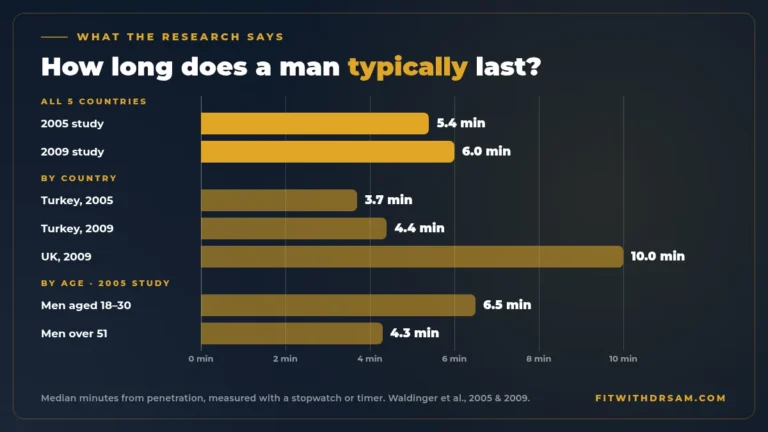
- Timing is very variable. A stopwatch study found a median of 5.4 minutes, with a range of about half a minute to 44 minutes.
- Don’t plan your whole sex life around round two. Train the basics: breathing, pelvic floor, pacing and anxiety management.
- If you have always finished very quickly and it bothers you, talk to a doctor. Effective treatments exist.
Why might round two last longer?
Nobody has measured this carefully, so these are reasons that fit the physiology and what men report. Treat them as possible explanations.
- Less built-up arousal. After a first orgasm, arousal levels start lower. It can take longer to climb, which may give you more room.
- Less pressure. If worry about finishing early is part of the problem, the first round can relieve it. Performance worries tend to speed things up, so lower tension can slow things down. See performance anxiety in men.
- Changes after orgasm. Men’s Health quotes a urologist who explains that, after ejaculation, nerve signals cause the penis to go soft, dopamine and testosterone levels drop and prolactin rises. That mix can dampen arousal for a while, which may slow the build-up later.
- Better pacing. Many couples naturally slow down, add touch, and take more time in round two.
- Less urgency. A first round after a long gap often comes with high excitement. Later rounds are calmer.
What the research does not show
I searched for studies that compare ejaculation time in the first and second round of sex and did not find any. What we do have is general data about timing and ejaculation problems:
- In 500 couples across five countries, the median time from penetration to ejaculation was 5.4 minutes, with a range of 0.55 to 44.1 minutes, and median time was shorter with age: 6.5 minutes for ages 18 to 30 and 4.3 minutes for men over 51 (Waldinger et al., 2005).
- Sex therapists in North America said 3 to 7 minutes is adequate, 7 to 13 desirable, and 1 to 2 too short (Corty and Guardiani, 2008).
- The American Urological Association describes lifelong premature ejaculation as ejaculating within about two minutes of penetration since the first sexual experiences, with bother (AUA/SMSNA guideline, 2020).
So when someone online says “I last twice as long the second time”, treat it as one man’s experience. It might be true for you, or it might not.
First round versus second round
| First round | Second round | |
|---|---|---|
| Arousal at the start | Often high, especially after a gap | Usually lower, builds more slowly |
| Tension about “performing” | Often higher | Often lower once the first is out of the way |
| Erection | Usually easiest | May take longer, especially after 40 |
| Typical gap needed | None | The refractory period: minutes in the late teens, often 30 to 60 minutes or longer in the 30s and 40s |
| What helps most | Pacing, breathing, control practice | Time, touch, novelty, a relaxed pace |
How long is the refractory period?
It varies a lot. Men’s Health quotes a urologist saying that teenagers can recover in minutes while men in their 30s and 40s may need 30 to 60 minutes or longer, and that there is no hard rule. The MSD Manual also lists a longer refractory period among the typical changes in men’s sexual function with age. Fitness, sleep, stress, alcohol and arousal all play a part. If you’re over 40, read sexual stamina after 40 for what to expect.
What can help the second round happen
- Take your time. Rushing tends to make recovery feel longer.
- Keep touching, kissing and talking. Closeness keeps arousal ticking over.
- Try something new: a different position, a different room, dirty talk. An expert quoted in Men’s Health says increasing arousal is the fastest way for men to get ready again.
- Stay active and eat well. A urologist told Men’s Health that the fitter you are, the better your body regulates itself.
- Keep alcohol low. It can dull sensation and affect blood flow.
- Check in with your partner. She or he may be very sensitive after orgasm and may not want more touching straight away, so ask.
How to feel more in control in the first round
If you’d like round one to last longer, don’t rely on a second round to fix it. These are the basics, in the order I teach them:
- Breathe slowly. A long exhale calms the body. Practise the breathing drills daily, then use them during sex.
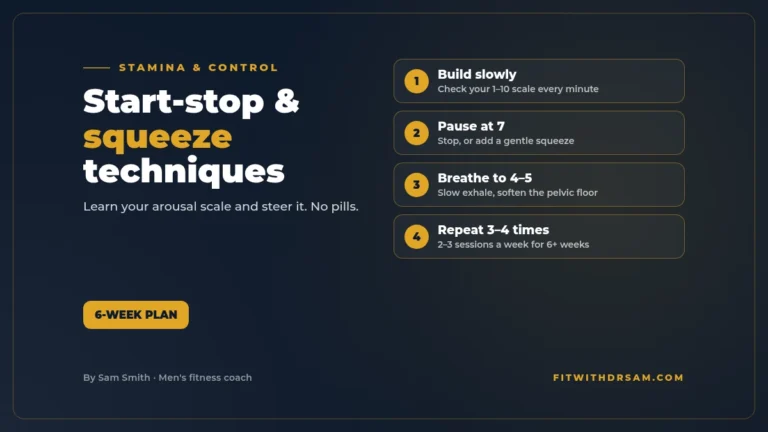
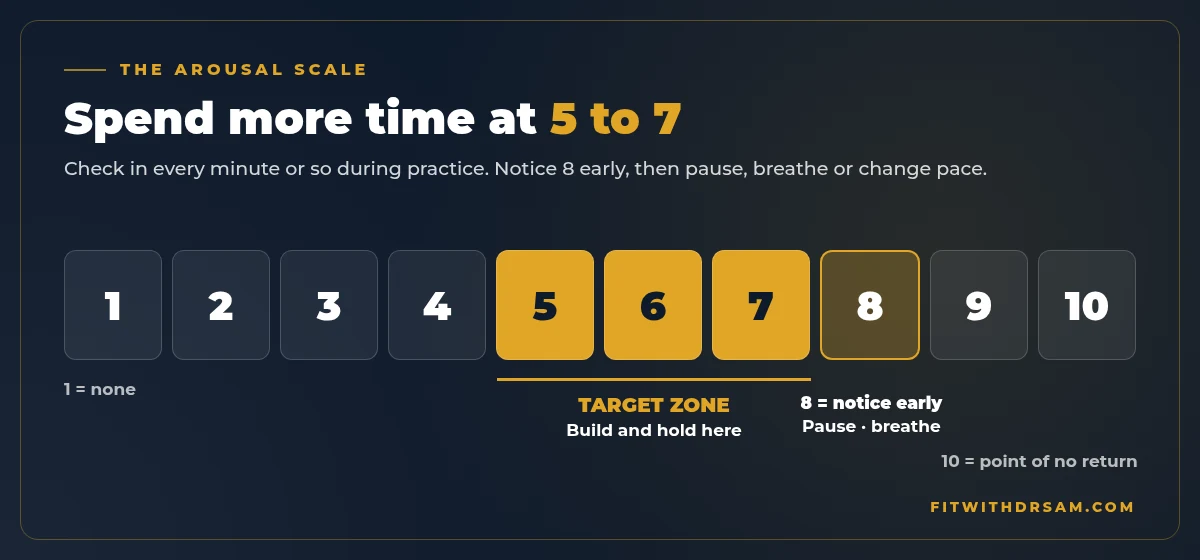
- Learn your arousal scale. Rate your arousal 1 to 10 and slow down at about 7. My book Increase Stamina in Bed teaches this step by step.
- Practise start-stop and squeeze. These are standard behavioural methods. See the start-stop and squeeze guide.
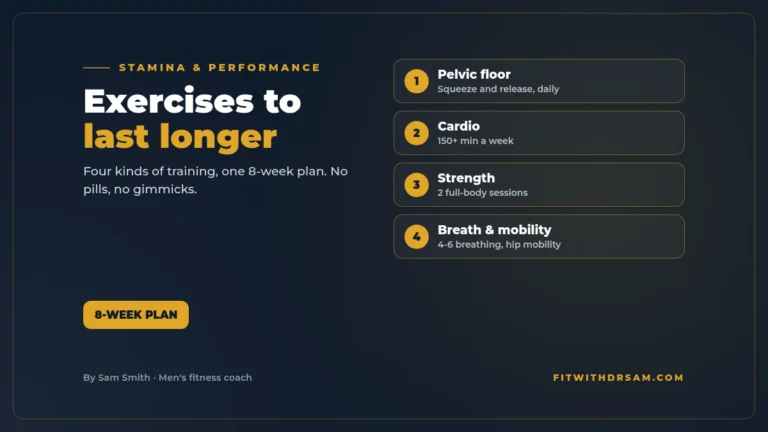
- Train your pelvic floor, both tightening and relaxing. Start with the Kegel guide and reverse kegels.
- Move more, sleep more, drink less. Fitness helps both erections and control. See does exercise help you last longer in bed.
- Talk with your partner. Widening what counts as good sex (touch, oral, time) takes pressure off the clock.
The NHS lists a few things you can try yourself: masturbating an hour or two before sex, using a thick condom to reduce sensation, and having your partner on top so they can pull away when you are close. They are low-risk experiments. Be honest with your partner about what you’re trying, and note that the NHS offers them as practical tips, not as proven treatments, so results vary. For the complete picture of stamina, see the guide to male sexual stamina.
The American Urological Association lists daily SSRIs, on-demand clomipramine or dapoxetine (where available) and topical anaesthetics as first-line medical options for premature ejaculation. That is a conversation to have with a doctor or pharmacist, not something to buy from an unregulated website.
When to see a doctor
See your doctor (GP in the UK, Hausarzt in Germany) or a urologist if:
- you have always finished within a minute or two and it distresses you
- the change was sudden or you also have trouble getting or keeping an erection
- you have pain, blood in your semen, or urinary symptoms
- worry about sex is affecting your mood or relationship
A sex therapist can also help. COSRT lists therapists in the UK and AASECT lists certified therapists in the US and Canada.
Free: the 7-Day Stamina Starter
Breathing, pelvic floor control and short bodyweight sessions, 10 to 15 minutes a day. Get the free plan. If you’d like a full program, see my book Increase Stamina in Bed.
Frequently asked questions
Do guys last longer the second time?
Many say they do, and there are plausible reasons such as lower built-up arousal and less pressure. But I couldn’t find research that tests it, so it varies from man to man.
How long should sex last the first round?
There’s no required length. In a stopwatch study the median time from penetration to ejaculation was 5.4 minutes, and sex therapists consider 3 to 13 minutes typical. What matters is that you and your partner are satisfied.
How long is the refractory period for a man?
It varies. A urologist quoted in Men’s Health said teenagers may recover in minutes while men in their 30s and 40s may need 30 to 60 minutes or longer. It tends to lengthen with age.
How can I delay ejaculation in the first round?
Slow your breathing, learn your arousal levels, use stop-start and squeeze practice, train your pelvic floor and manage anxiety. Medical options exist too, so talk to a doctor if it bothers you.
Does ejaculating earlier in the day help you last longer?
The NHS lists masturbating an hour or two before sex as something men can try. It is a low-risk experiment rather than a proven treatment, and results vary, so try it openly with your partner and see how it goes.
Is it normal to need longer between rounds after 40?
Yes. A longer refractory period is one of the typical changes in men’s sexual function with age. Good fitness, sleep and low alcohol help, and so does patience.
About the author. Sam Smith is a fitness coach with more than 10 years of experience and the author of five books on men’s stamina, fitness, nutrition and relationships. He is not a medical doctor and does not give medical advice.
Sources
- Men's Health. Refractory period: everything to know about male recovery time. Men’s Health
- MSD Manual Consumer Version. Effects of aging on the male reproductive system. MSD Manual
- Waldinger MD, Quinn P, Dilleen M, et al. A multinational population survey of intravaginal ejaculation latency time. J Sex Med. 2005;2(4):492-497. PubMed
- Corty EW, Guardiani JM. Canadian and American sex therapists' perceptions of normal and abnormal ejaculatory latencies: how long should intercourse last? J Sex Med. 2008. PubMed
- American Urological Association. Disorders of ejaculation: AUA/SMSNA guideline (2020). AUA
- NHS. Ejaculation problems. NHS
All links checked 28 October 2026.