Workout Plan for Men Over 50: Strength, Cardio and Balance
Educational content, not medical advice. This article is general information from a fitness coach. It’s not a diagnosis or treatment. If you have a health concern, see a doctor. See “When to see a doctor” below.
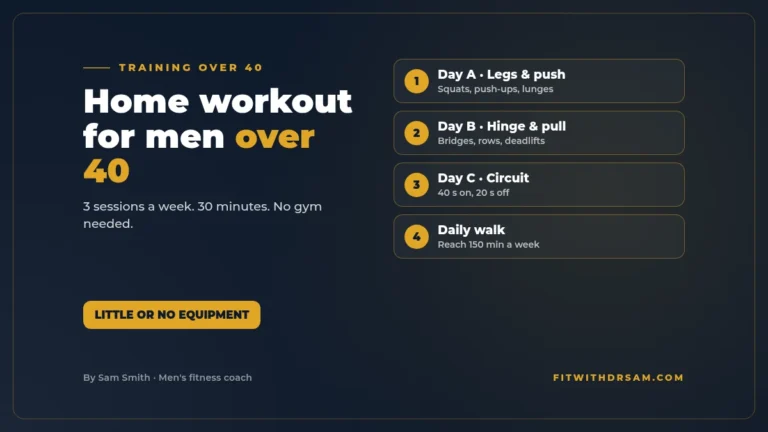
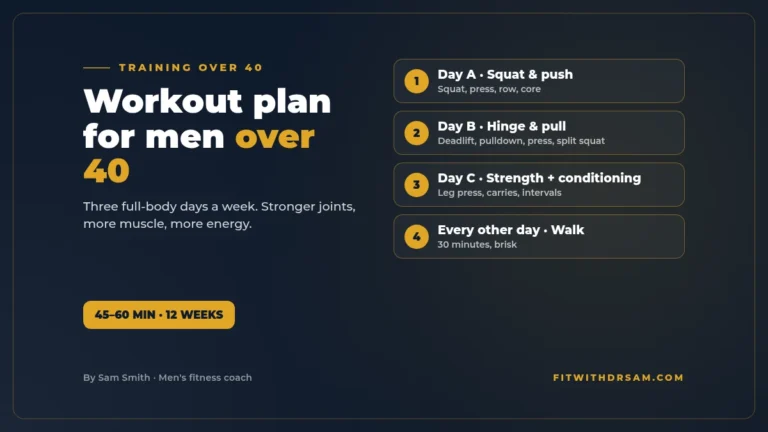
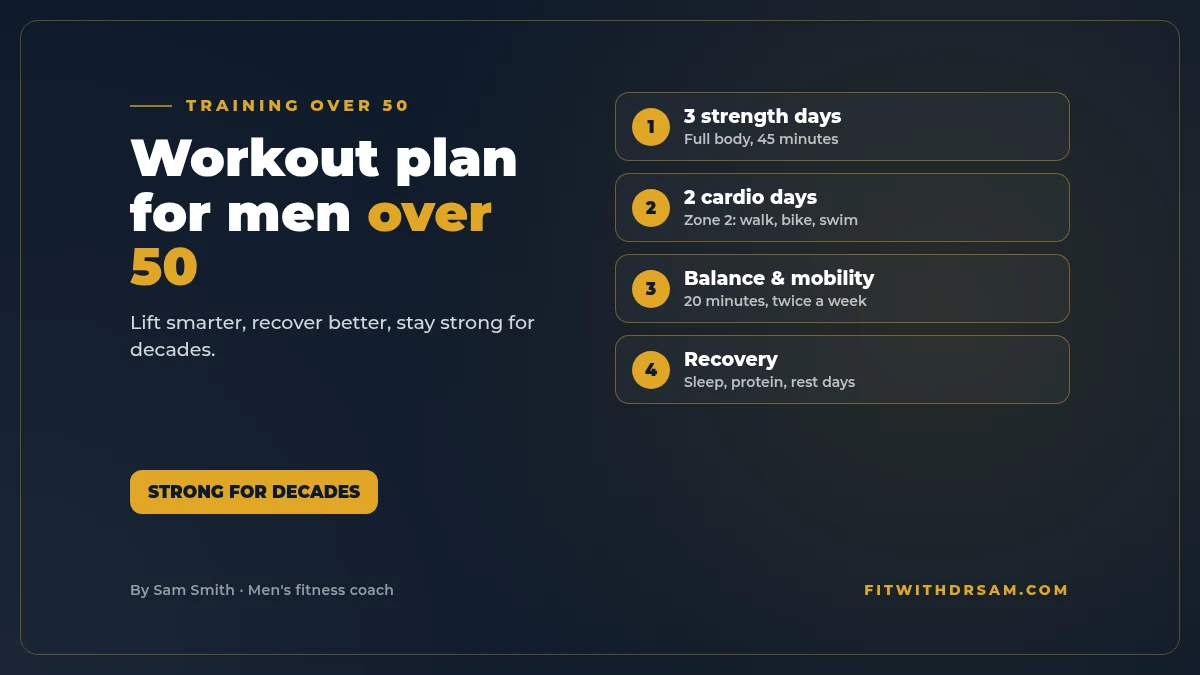
A good workout plan for men over 50 looks different from what you did at 25, but not in the way most people think. You don’t need to stop lifting or switch to gentle classes only. You need to lift smarter, recover better and add the things that keep you moving well for decades: balance, mobility and heart health. I’ve coached many men in their 50s and 60s over 10+ years, and they often make the best progress of anyone because they’re consistent. This plan builds on my workout plan for men over 40, with more emphasis on joints, balance and recovery.
Key takeaways
- Strength training is the most important part of any plan after 50: 2 to 3 sessions a week.
- Add 150 minutes of moderate cardio a week, such as brisk walking or cycling.
- Balance and mobility work helps you stay steady and independent.
- Use moderate weights for 6 to 15 controlled reps, stopping 1 to 3 reps short of failure.
- Recovery matters more: sleep, protein and rest days are part of the plan.
Why training after 50 is different (and why it matters more)
From midlife, muscle mass and strength gradually decline, and the drop speeds up in your 60s and 70s if you don’t train. The good news: resistance training reliably improves strength in older adults (Peterson et al., 2010). Muscle-strengthening activity is also linked to a lower risk of early death, heart disease and diabetes (Momma et al., 2022). More on that in my article about muscle mass and lifespan.
Falls also become a bigger risk with age; the CDC calls them a leading cause of injury in adults 65 and older (CDC). Strength and balance training now is an investment in staying independent later. The NHS recommends that older adults do activities that improve strength, balance and flexibility on at least 2 days a week (NHS).
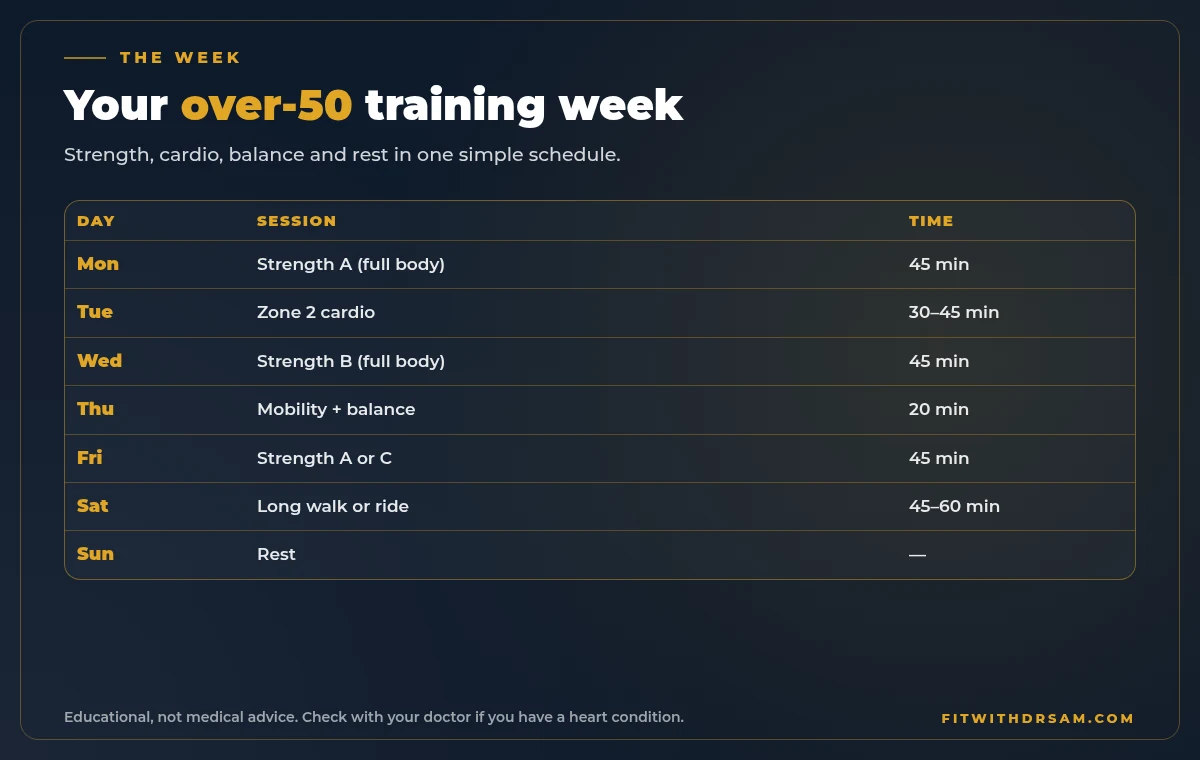
The weekly plan
| Day | Session | Time |
|---|---|---|
| Mon | Strength A (full body) | 45 min |
| Tue | Zone 2 cardio: brisk walk, bike or swim | 30–45 min |
| Wed | Strength B (full body) | 45 min |
| Thu | Mobility + balance | 20 min |
| Fri | Strength A or C | 45 min |
| Sat | Longer walk, hike or bike ride | 45–60 min |
| Sun | Rest (easy walk if you like) | — |
Strength sessions
Warm up for 5 to 8 minutes first: easy cardio, then 1 or 2 light sets of the first exercise. Rest 90 seconds to 2 minutes between sets of big lifts.
Strength A
| Exercise | Sets × reps | Notes |
|---|---|---|
| Goblet squat or leg press | 3 × 8–12 | Squat to a box if your knees prefer |
| Dumbbell bench press or push-up | 3 × 8–12 | Neutral grip is kinder to shoulders |
| Seated cable or dumbbell row | 3 × 10–12 | Squeeze shoulder blades |
| Step-up | 2 × 8 each leg | Builds balance and leg strength |
| Pallof press | 2 × 10 each side | Core control without loading the spine |
Strength B
| Exercise | Sets × reps | Notes |
|---|---|---|
| Trap-bar or dumbbell Romanian deadlift | 3 × 6–10 | Hinge from the hips, flat back |
| Lat pulldown or assisted pull-up | 3 × 8–12 | Full range, controlled |
| Seated dumbbell shoulder press | 2 × 8–12 | Skip if it hurts; do landmine press |
| Split squat | 2 × 8 each leg | Hold a support if needed |
| Farmer carry | 3 × 30–40 m | Grip strength is linked to healthy ageing |
Progress slowly: when you can do the top of the rep range on all sets, add a small amount of weight next time. Protect your back by bracing and hinging well; my post on mistakes that injure your back is worth reading before deadlifts.
Cardio: zone 2 and a bit of intensity
Most of your cardio should be at a pace where you can talk but not sing, often called zone 2. That builds heart and lung fitness without wrecking recovery. The CDC recommends 150 minutes of moderate activity a week (CDC). Once you have a base, add one short interval session: 6 to 8 rounds of 30 seconds faster, 90 seconds easy, on a bike or uphill walk, if your doctor is happy with it.
Mobility and balance (20 minutes)
- Single-leg stand: 3 × 30 seconds each leg, near a wall
- Heel-to-toe walk: 3 × 10 steps
- Hip flexor stretch: 2 × 30 seconds each side
- Thoracic rotations on all fours: 2 × 8 each side
- Calf and hamstring stretch: 2 × 30 seconds each
My stretching routine has more options. Short and regular beats long and rare.
Free plan
Get the 7-Day Stamina Starter
New to training or coming back after a break? The free 7-Day Stamina Starter gives you 10 to 15 minutes a day of mobility, breathing and three short bodyweight sessions, with a tick-box tracker.
Send me the free planFree. No spam. Unsubscribe anytime.
Your first 4 weeks
If you’re new to lifting or returning after years off, don’t start with the full plan. Build into it so your joints and tendons can adapt along with your muscles.
| Week | Strength | Cardio | Mobility |
|---|---|---|---|
| 1 | 2 sessions, 2 sets per exercise, light weights | 3 × 20-minute walks | 10 minutes after each session |
| 2 | 2 sessions, 2–3 sets | 3 × 30-minute walks | 1 dedicated 20-minute session |
| 3 | 3 sessions, 3 sets on main lifts | 2 × 30 min + 1 longer walk | 2 sessions |
| 4 | 3 sessions, add small weight where reps are easy | Full plan: 150 minutes | 2 sessions |
Keep a simple log: exercise, weight, reps and how it felt. Seeing small numbers go up every week is the best motivation I know, and it shows you when to push and when to hold back. Most of my clients over 50 say the log is what kept them going in the first two months.
Recovery after 50
- Sleep 7 to 9 hours. See sleep and testosterone for a simple routine.
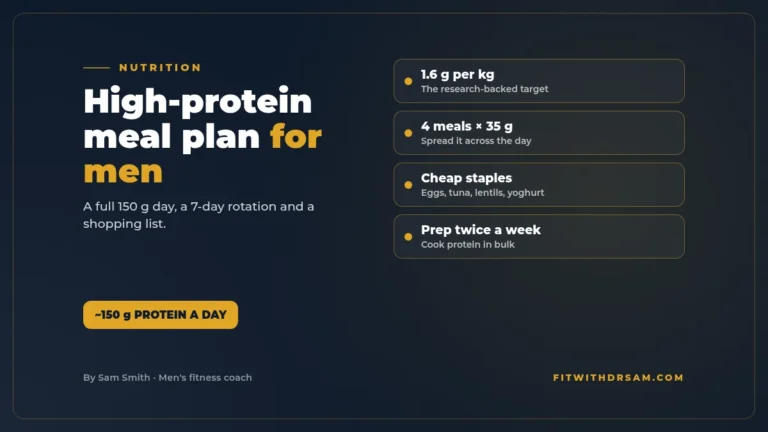
- Prioritise protein: around 1.6 g per kg of body weight a day, with 30 to 40 g per meal.
- Keep 1 to 2 full rest days a week.
- Deload every 6 to 8 weeks: same exercises, half the sets.
- Respect joint pain. Muscle soreness is fine; sharp or lasting joint pain means change the exercise.
Common mistakes men over 50 make
- Only doing cardio and skipping strength training.
- Training like a 25-year-old: too much volume, too little recovery.
- Ego lifting instead of controlled reps.
- Skipping legs and balance, which matter most for independence.
- Waiting for motivation. Book sessions like appointments.
When to see a doctor
When to see a doctor
Check with your doctor before starting if:
- you have heart disease, high blood pressure, diabetes or joint replacements
- you’ve been inactive for a long time
- you get chest pain, unusual breathlessness, dizziness or palpitations with exercise
- you’ve had recent surgery or a fall
For most adults, the benefits of regular activity far outweigh the risks (WHO). Stop and get help straight away if you have chest pain during exercise.
Frequently asked questions
What is the best workout for a man over 50?
A mix of strength training 2 to 3 times a week, moderate cardio such as brisk walking or cycling, and some balance and mobility work. Strength training is the part most men skip, and it’s the most important for keeping muscle and independence.
Can a man over 50 still build muscle?
Yes. Resistance training improves strength and muscle in older adults, including people in their 60s, 70s and beyond. Progress may be a little slower than at 25, but it’s real and very worthwhile.
How often should a 50-year-old man lift weights?
Two to three full-body sessions a week, on non-consecutive days, is ideal for most men. That meets CDC and NHS guidance of at least 2 days of muscle-strengthening activity.
Should men over 50 lift heavy?
Moderate to fairly heavy weights you can lift for 6 to 15 controlled reps work well. You don’t need to test one-rep maxes. Leave 1 to 3 reps in reserve and focus on good form.
How much cardio does a man over 50 need?
Aim for at least 150 minutes of moderate activity a week, such as brisk walking, or 75 minutes of vigorous activity. Splitting it into 30-minute sessions on 5 days is a simple way to get there.
The bottom line
After 50, training is about staying strong, mobile and independent for decades. Lift 2 to 3 times a week, walk or cycle for 150 minutes, add balance and mobility work and treat recovery as part of the plan. My 30-day challenge, The Warrior’s Stamina ($29), gives you daily structure for strength, energy and stamina.
30-day challenge · by Sam Smith
The Warrior’s Stamina
A 30-day challenge with daily bodyweight sessions, breathing and stamina drills, with a printable tracker. Scalable for any fitness level.
See the bookResults vary. Educational content, not medical advice.
References
- Peterson MD, Rhea MR, Sen A, Gordon PM. Resistance exercise for muscular strength in older adults: a meta-analysis. Ageing Res Rev. 2010;9(3):226-237. PubMed Central
- Momma H, Kawakami R, Honda T, Sawada SS. Muscle-strengthening activities are associated with lower risk and mortality in major non-communicable diseases. Br J Sports Med. 2022;56(13):755-763. PubMed Central
- CDC. Adult activity: an overview. Read online
- NHS. Physical activity guidelines for older adults. Read online
- CDC. Older adult fall prevention. Read online
- WHO. Physical activity fact sheet. Read online
All links checked October 17, 2026.