How to Keep the Spark Alive in a Relationship: 9 Habits That Work
Educational content, not medical advice. This article is general relationship information from a coach, not therapy or medical advice. If there is abuse, control or fear in your relationship, contact a support service or the police. See “When to get outside help” below.
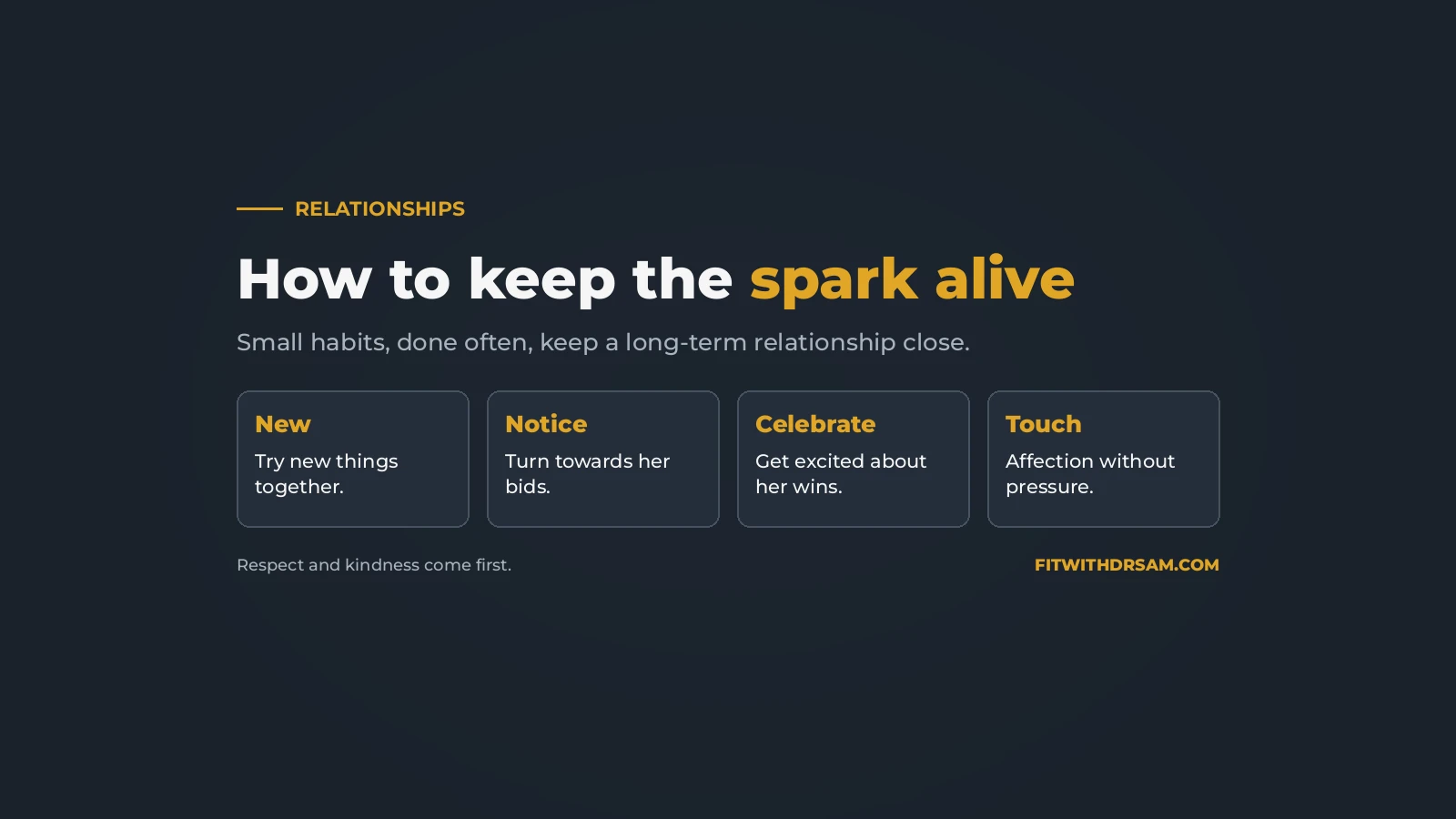
To keep the spark alive in a long-term relationship, do new things together, notice and respond to the small moments your partner reaches out, celebrate their good news, and keep affection going outside the bedroom. The spark rarely dies in one big fight. It fades slowly, through routine, stress and a thousand small moments where you were busy or distracted. The good news is that it comes back the same way: through small, regular actions.
This guide is part of my relationships and confidence hub. I’m Sam Smith, a fitness coach with more than 10 years of experience and the author of a book on modern relationships. I’m not a therapist, but I talk with a lot of men who feel their marriage or long-term relationship has gone flat. It covers what the research says and gives you a practical plan you can start this week.
Free: the 7-Day Stamina Starter
Energy, confidence and mood all affect how present you are with your partner. This free week of short sessions and habits is a simple place to start. Get the free 7-day plan.
Key takeaways
- A fading spark after the first year or two is normal. It is not proof that something is wrong.
- Doing new and exciting things together was linked with higher relationship satisfaction in a set of studies by Aron and colleagues.
- Gottman’s research describes “bids” for connection. Couples who stayed married turned towards each other’s bids far more often than those who divorced.
- How you react to your partner’s good news matters as much as how you support them in hard times.
- Affection, attention and shared fun build desire. Pressure and keeping score kill it.
- Look after yourself too: sleep, fitness and stress all shape how much energy you bring home.
Why the spark fades in long-term relationships
Early in a relationship, everything is new. You are learning about each other, planning dates and putting your best self forward. Over time, life fills up with work, kids, bills and chores. Conversations turn into logistics. Nothing is “wrong”, but the relationship slowly slips down the priority list.
Researchers have a name for part of this: boredom. In a series of studies, Arthur Aron and colleagues found that couples who reported more shared “exciting” activities were more satisfied, and that relationship boredom helped explain the link. When couples did a short, new and slightly challenging task together in the lab, they reported higher relationship quality afterwards than couples who did a dull task (Aron et al., 2000). The lesson is simple: routine is comfortable, but novelty feeds closeness.
9 ways to keep the spark alive
1. Do something new together
Not just a dinner at the same restaurant. Try something neither of you has done: a cooking class, a new hiking trail, a day trip to a town you have never visited, a dance class, an escape room, a climbing wall. It does not have to cost money. It just has to be new and shared.
2. Turn towards her bids for connection
Relationship researcher John Gottman uses the word “bids” for the small ways partners reach out: a comment about something she read, a sigh, a joke, a hand on your shoulder. You can turn towards the bid (respond and engage), turn away (ignore it) or turn against it (respond with irritation). In the Gottman Institute’s newlywed research, couples who were still married six years later had turned towards each other’s bids 86% of the time. Couples who divorced did so only 33% of the time. Put your phone down when she talks to you. It is one of the simplest, most powerful habits there is.
3. Celebrate her good news properly
How you respond when things go right matters. Psychologist Shelly Gable and colleagues found that sharing good news with a partner who responds actively and enthusiastically was linked with more intimacy and higher daily relationship satisfaction (Gable et al., 2004). So when she gets a promotion or finishes a big project, do not just say “nice”. Ask questions, show you are glad, and maybe mark it with something small.
4. Keep up the everyday playfulness
Inside jokes, teasing, a song in the kitchen. A study of newlyweds by Driver and Gottman found that playfulness and enthusiasm in everyday moments at dinnertime were linked with more humour and affection during conflict later (Driver and Gottman, 2004). The study was observational, so it does not prove cause and effect, but it fits what many couples experience: small, light moments make the hard ones easier.
5. Keep the positives well ahead of the negatives
The Gottman Institute describes a “magic ratio” of 5 to 1: in stable, happy couples, there are at least five positive interactions for every negative one during conflict. You will not count them, but you can notice when the balance has tipped. Compliments, thanks, a quick hug and a kind word all count.
6. Plan regular one-on-one time
A weekly or fortnightly date, even at home after the kids are asleep, gives the relationship a fixed place in the calendar. Agree that it is not the time to talk about bills or schedules. Ask real questions: What has been on your mind lately? What are you looking forward to? What would you like more of from me?
7. Keep affection going outside the bedroom
Kissing hello and goodbye, holding hands, a hug that lasts more than two seconds. Physical affection without any expectation of sex builds closeness and trust. If you only touch your partner when you want sex, she will notice. If your sex drives don’t match, my guide to sex drive mismatch in relationships explains how to talk about it without blame.
8. Share the load at home
Many men are surprised by how much this matters. When one partner carries most of the chores and mental load, they have less energy and less interest in romance. Taking things off her plate without being asked, and without expecting a reward, is one of the most romantic things you can do. My guide on how to be a better husband goes deeper.
9. Look after yourself
Attraction is not only about looks, but how you carry yourself matters. Regular training, decent sleep, less alcohol and a plan for stress give you more energy, a better mood and more confidence, and your partner feels that too. Keep growing as a person: hobbies, friends and goals make you more interesting to come home to.
A 4-week plan to rekindle the spark
| Week | Daily | Weekly |
|---|---|---|
| 1 | Phone away at dinner. Turn towards her bids. One genuine thank-you a day. | Ask her what she would love to do together this month. |
| 2 | Six-second kiss when you leave and come home. Take one chore off her list. | Date night at home with no screens and no logistics talk. |
| 3 | Celebrate one piece of good news properly. Send a message in the day that is not about logistics. | Try one new activity together. |
| 4 | Keep the daily habits. Add one small surprise. | Talk about what felt good this month and what you both want to keep. |
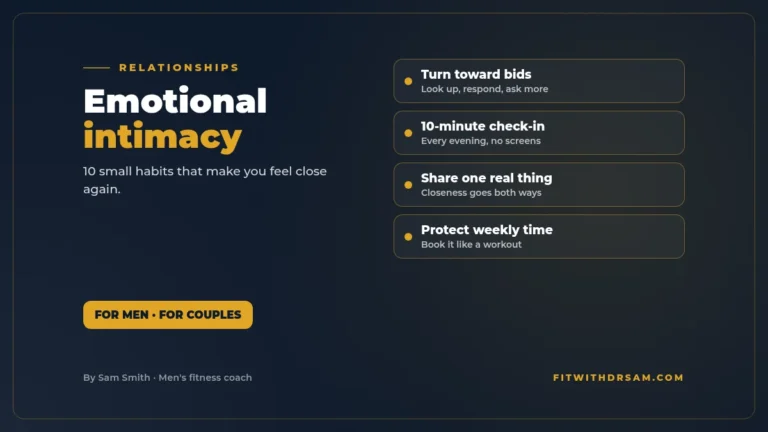
For more small habits, see my guide on how to reconnect with your partner, and on building deeper emotional intimacy.
Common mistakes that put the spark out
- Waiting for big gestures. A grand holiday once a year cannot make up for daily distance.
- Keeping score. “I did the dishes, so you owe me” turns the relationship into a trade.
- Only talking about logistics. If every conversation is about schedules, you become flatmates.
- Criticism and contempt. Eye-rolling, sarcasm and putdowns erode closeness fast.
- Making it all about sex. Pressure usually lowers desire. Connection tends to come first.
- Letting yourself go. Not about looks, but about energy, effort and staying engaged with life.
When to get outside help
- Every conversation turns into a fight, or you have stopped talking altogether.
- There has been an affair or a serious breach of trust.
- One of you feels low, anxious or hopeless most of the time.
- Drinking, gambling or other habits are causing problems.
- You feel afraid of your partner, or controlled by them.
A couples counsellor can help you both feel heard. In the UK, Relate offers relationship counselling. In Germany, many cities have Paar- und Eheberatung services, often through churches or local councils. In the US and Canada, look for a licensed marriage and family therapist. If low mood or anxiety is part of the picture, talk to your doctor, GP or Hausarzt. If you are in danger, contact the police or a domestic abuse helpline.
Want a stronger relationship? My book Mastering Modern Relationships covers communication, conflict, intimacy and keeping a long-term relationship alive, written for men. Read more about the book. Related reading: how to reconnect with your partner · how to be more confident as a man
Start with the free 7-Day Stamina Starter
More energy and less stress make it easier to show up for your relationship. Get it free. More guides on love, dating and confidence are in my relationships hub.
Frequently asked questions
Is it normal for the spark to fade in a relationship?
Yes. The intense excitement of the early months usually settles after the first year or two. That is normal. What matters is whether you keep investing in closeness, fun and affection.
How do you rekindle the spark in a long-term relationship?
Do new things together, put your phone away and respond when your partner reaches out, celebrate their good news, keep affection going without pressure, share the load at home, and plan regular one-on-one time.
How do I keep the spark alive in my marriage with kids?
Protect small moments: a proper hello and goodbye, a short check-in after the kids are in bed, and one date at home each week. Sharing childcare and chores fairly also frees up energy for each other.
Can a relationship get the spark back after it is gone?
Often, yes, if both partners want it. Small daily habits, shared new experiences and honest conversations help. If you feel stuck, a couples counsellor can help you understand what changed.
What kills the spark in a relationship?
Common causes are routine and boredom, stress, poor communication, criticism, unresolved resentment, an unfair split of chores and taking each other for granted.
How often should couples have date night?
There is no magic number. Weekly or every two weeks works well for many couples. Consistency matters more than cost. A screen-free evening at home counts.
The bottom line. The spark is kept alive by small things done often: new experiences together, real attention, enthusiasm for each other’s wins, everyday affection and a fair share of the load. Start with one habit this week.
About the author. Sam Smith is a fitness coach with more than 10 years of experience and the author of five books on men’s stamina, fitness, nutrition and relationships. He is not a medical doctor and does not give medical advice.
Sources
- Aron A, Norman CC, Aron EN, McKenna C, Heyman RE. Couples’ shared participation in novel and arousing activities and experienced relationship quality. J Pers Soc Psychol. 2000;78(2):273-284. PubMed
- Gable SL, Reis HT, Impett EA, Asher ER. What do you do when things go right? The intrapersonal and interpersonal benefits of sharing positive events. J Pers Soc Psychol. 2004;87(2):228-245. PubMed
- Driver JL, Gottman JM. Daily marital interactions and positive affect during marital conflict among newlywed couples. Fam Process. 2004;43(3):301-314. PubMed
- The Gottman Institute. Turn towards instead of away. gottman.com
- The Gottman Institute. The magic relationship ratio, according to science. gottman.com
- Relate. Relationship counselling (UK). relate.org.uk
All links checked 10 November 2026.