How Much Protein Do Men Over 40 Need? A Simple Daily Target
Educational content, not medical advice. This article is general nutrition and fitness information from a coach, not medical or dietetic advice. If you have kidney disease, diabetes, gout or another health condition, or you take regular medicines, ask your doctor or a registered dietitian before you raise your protein intake.
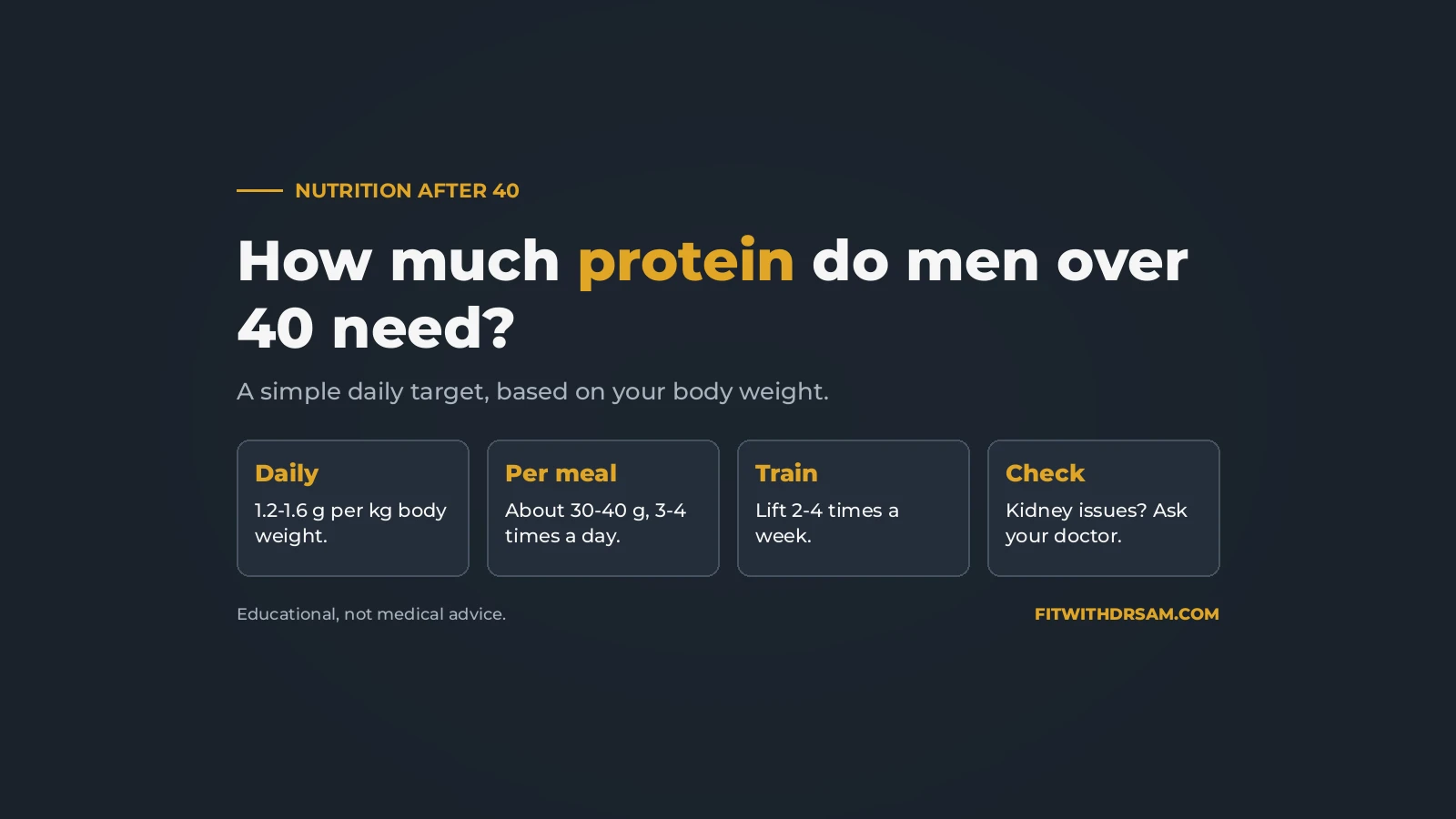
Most active men over 40 do well on about 1.2 to 1.6 grams of protein per kilogram of body weight a day (roughly 0.55 to 0.75 grams per pound), spread over 3 or 4 meals with about 30 to 40 grams each. That is more than the basic government minimum of 0.75 to 0.8 g/kg, which is set to prevent deficiency, not to build or keep muscle while you train. For an 85 kg (187 lb) man, that means roughly 100 to 135 grams a day.
Protein is one of the food levers in my guide to increasing testosterone naturally through food, fat loss, sleep and training. I’m Sam Smith, a fitness coach with more than 10 years of experience coaching men in their 40s and 50s. Protein is one of the first things I check, because most men eat too little at breakfast and lunch and try to catch up at dinner. This article zooms in on protein: how much, when, and how to hit it without living on shakes.
Free: the 7-Day Stamina Starter
A simple week of short workouts, breathing and daily habits to get your energy back on track. Get the free 7-day plan.
Key takeaways
- Government minimums: 0.75 g/kg in the UK, 0.8 g/kg in the US, Canada and Germany. They prevent deficiency. They are not a muscle-building target.
- Expert groups on ageing recommend at least 1.0 to 1.2 g/kg for healthy older adults, and 1.2 g/kg or more for those who exercise.
- For men who lift weights, extra protein stops adding muscle at around 1.6 g/kg a day on average.
- Older muscles need a bigger dose per meal: about 0.4 g/kg per meal in one analysis, roughly 30 to 40 g for most men.
- Spread it over 3 to 4 meals. Breakfast is where most men fall short.
- Protein works with training. Without strength training, extra protein does little for muscle.
How much protein should a 40-year-old man eat?
There are two different numbers, and mixing them up causes most of the confusion.
- The minimum. The UK reference intake for adults is 0.75 g per kg of body weight a day (about 56 g for a 75 kg man), according to the British Nutrition Foundation. The US, Canada and Germany use 0.8 g/kg for adults. The German Nutrition Society (DGE) raises this to 1.0 g/kg from age 65.
- The optimal range for active men. The PROT-AGE study group, a panel of European experts on ageing, recommends at least 1.0 to 1.2 g/kg a day for healthy people over 65, and 1.2 g/kg or more for those who exercise. The ESPEN expert group reached similar numbers. The International Society of Sports Nutrition suggests 1.4 to 2.0 g/kg for people who train.
Men in their 40s and 50s sit between these groups, so I use 1.2 to 1.6 g/kg as a practical target. Use the lower end if you are mainly trying to stay healthy and active, and the upper end if you are lifting weights to build muscle or losing fat and want to protect the muscle you have.
Protein per day by body weight
| Body weight | Minimum (0.8 g/kg) | Active man over 40 (1.2-1.6 g/kg) | Per meal (about 0.4 g/kg, 3-4 meals) |
|---|---|---|---|
| 70 kg / 154 lb | 56 g | 84-112 g | about 28 g |
| 80 kg / 176 lb | 64 g | 96-128 g | about 32 g |
| 90 kg / 198 lb | 72 g | 108-144 g | about 36 g |
| 100 kg / 220 lb | 80 g | 120-160 g | about 40 g |
| 110 kg / 243 lb | 88 g | 132-176 g | about 44 g |
Carrying extra weight? If you have a lot of fat to lose, base your target on your goal weight rather than your current weight. Otherwise the number gets unrealistically high.
Why men need more protein after 40
From around middle age, muscle mass and strength slowly decline, a process that speeds up in later life. Two things help slow it: strength training and enough protein. Older muscles also respond less to small doses of protein, a change researchers call “anabolic resistance”.
A Canadian and UK analysis compared younger men (around 22) with older men (around 71). Younger men reached their maximum muscle-building response at about 0.24 g of protein per kg of body weight in a meal. Older men needed about 0.40 g/kg, almost twice as much (Moore et al., 2015). Men in their 40s are somewhere in between, which is why I suggest 30 to 40 g per meal rather than the 20 g you often see quoted.
The research on training points the same way. A large review of 49 trials found that protein supplements added to the gains from strength training, but the benefit levelled off at a total intake of about 1.6 g/kg a day. The effect was also smaller with age, so the training itself matters even more as you get older (Morton et al., 2018).
How much protein to build muscle after 40?
If building muscle is your goal, aim for the upper end: about 1.6 g/kg a day, together with strength training 2 to 4 times a week. More than that is not harmful for most healthy people, but it is unlikely to add more muscle on average. Your training plan matters more than squeezing in extra grams. My guide to how often men over 40 should lift weights covers the training side, and my workout plan for men over 40 gives you three full-body sessions a week.
How to spread protein across the day
Most men I coach eat 10 to 15 g of protein at breakfast, 20 g at lunch and 60 g or more at dinner. Moving some of that dinner protein to earlier meals is one of the easiest upgrades you can make.
| Meal | Example | Protein (approx.) |
|---|---|---|
| Breakfast | 3 eggs + 150 g Greek yoghurt or skyr | 35 g |
| Lunch | 150 g chicken breast with rice and vegetables | 40 g |
| Snack | 250 ml milk + a handful of nuts, or a protein shake | 15-25 g |
| Dinner | 150 g salmon or lean beef, potatoes and salad | 35 g |
| Total | 125-135 g |
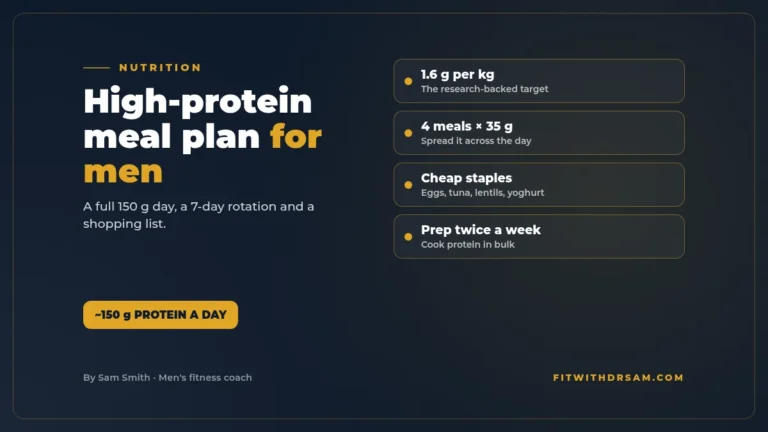
Protein values are approximate and vary by brand and portion. For a full day of meals and a shopping list with UK, US, Canadian and German swaps, see my high-protein meal plan for men.
Best protein sources for men over 40
- Lean meat and poultry: chicken, turkey, lean beef, pork loin. The NHS suggests limiting red and processed meat to about 70 g a day on average.
- Fish: salmon, tuna, cod, sardines. Oily fish also gives you omega-3 fats.
- Eggs and dairy: eggs, Greek yoghurt, skyr, quark (Magerquark in Germany), cottage cheese, milk.
- Plant sources: lentils, chickpeas, beans, tofu, tempeh, edamame. Combine different sources across the day.
- Protein powder: handy, not essential. Whey or a plant blend can fill a gap at breakfast or after training. Choose products tested by a third party.
On a budget? Eggs, milk, tinned fish, frozen chicken, lentils and quark are some of the cheapest protein per gram. My guide to building muscle on a budget has more ideas, and testosterone-friendly foods covers the wider diet.
Is a high-protein diet safe?
For healthy adults, intakes in the 1.2 to 1.6 g/kg range are widely used and considered safe. The important exception is kidney disease. The PROT-AGE group notes that people with severely reduced kidney function who are not on dialysis may need to limit protein. If you have kidney problems, diabetes, gout or high blood pressure that is not under control, talk to your doctor before raising your intake.
When to see a doctor, GP or Hausarzt
- You have kidney disease, or have been told your kidney function is reduced.
- You have diabetes, gout or another long-term condition.
- You are losing weight or muscle without trying.
- You feel unusually tired, weak or short of breath.
- You plan a big change in diet or want to start supplements while taking regular medicines.
In the UK, talk to your GP or ask for a referral to a registered dietitian. In Germany, see your Hausarzt or an Ernährungsberater/in with a recognised qualification. In the US and Canada, see your primary care doctor or a registered dietitian.
Want the full nutrition plan? My book Nutrition, Metabolism & Muscle shows you how to set your calories and protein, plan meals and keep muscle while you lose fat. Read more about the book. Prefer a plan built around you? See the personal nutrition plan. Related reading: high-protein meal plan for men · how to lose belly fat after 40
Get the free 7-Day Stamina Starter
Short daily sessions plus simple habits to build energy and strength. Get it free. For food, sleep and training together, read my guide to increasing testosterone naturally.
Frequently asked questions
How much protein should a 40-year-old man eat a day?
A practical target for an active man over 40 is 1.2 to 1.6 g of protein per kg of body weight a day. For an 80 kg man, that is roughly 96 to 128 g. The basic minimum of 0.75 to 0.8 g/kg prevents deficiency but is not aimed at keeping or building muscle.
How much protein do I need to build muscle after 40?
Aim for about 1.6 g/kg a day together with strength training 2 to 4 times a week. A large review found that, on average, more protein than that did not add further muscle.
How much protein can you absorb in one meal?
Your body absorbs nearly all the protein you eat. The question is how much stimulates muscle building in one sitting. In older men, the maximum response came at about 0.4 g/kg per meal, roughly 30 to 40 g for most men.
Is 150 g of protein a day too much for a man over 40?
For a healthy, active man weighing about 95 kg or more, 150 g falls inside the 1.2 to 1.6 g/kg range. For a lighter man it is more than he needs, but it is not usually harmful if his kidneys are healthy. Check with a doctor if you have kidney disease.
Do I need protein shakes?
No. Shakes are just a convenient way to reach your target. Eggs, dairy, meat, fish and legumes work just as well.
Does protein help with fat loss?
Protein keeps you full and helps protect muscle while you eat less. That makes it useful during fat loss, but you still need an overall calorie deficit.
The bottom line. Aim for 1.2 to 1.6 g of protein per kg of body weight a day, in 3 or 4 meals of about 30 to 40 g each, and pair it with regular strength training. Start with a bigger breakfast, and talk to your doctor first if you have kidney problems.
About the author. Sam Smith is a fitness coach with more than 10 years of experience and the author of five books on men’s stamina, fitness, nutrition and relationships. He is not a medical doctor and does not give medical advice.
Sources
- Bauer J, Biolo G, Cederholm T, et al. Evidence-based recommendations for optimal dietary protein intake in older people: a position paper from the PROT-AGE Study Group. J Am Med Dir Assoc. 2013;14(8):542-559. PubMed
- Deutz NE, Bauer JM, Barazzoni R, et al. Protein intake and exercise for optimal muscle function with aging: recommendations from the ESPEN Expert Group. Clin Nutr. 2014;33(6):929-936. PubMed
- Moore DR, Churchward-Venne TA, Witard O, et al. Protein ingestion to stimulate myofibrillar protein synthesis requires greater relative protein intakes in healthy older versus younger men. J Gerontol A Biol Sci Med Sci. 2015;70(1):57-62. PubMed
- Morton RW, Murphy KT, McKellar SR, et al. A systematic review, meta-analysis and meta-regression of the effect of protein supplementation on resistance training-induced gains in muscle mass and strength in healthy adults. Br J Sports Med. 2018;52(6):376-384. PubMed
- Jäger R, Kerksick CM, Campbell BI, et al. International Society of Sports Nutrition position stand: protein and exercise. J Int Soc Sports Nutr. 2017;14:20. PubMed
- British Nutrition Foundation. Protein. nutrition.org.uk
- Deutsche Gesellschaft für Ernährung (DGE). Referenzwerte: Protein. dge.de
- Harvard Health Publishing. How much protein do you need every day? health.harvard.edu
- NHS. Meat in your diet. nhs.uk
All links checked 10 November 2026.