Stress Belly in Men: Does Cortisol Really Cause Belly Fat?
Educational content, not medical advice. This article is general fitness and lifestyle information from a coach. Belly fat can be linked to medical conditions and medicines. If you notice fast, unexplained weight gain or any of the signs in “When to see a doctor” below, talk to your doctor, GP or Hausarzt.
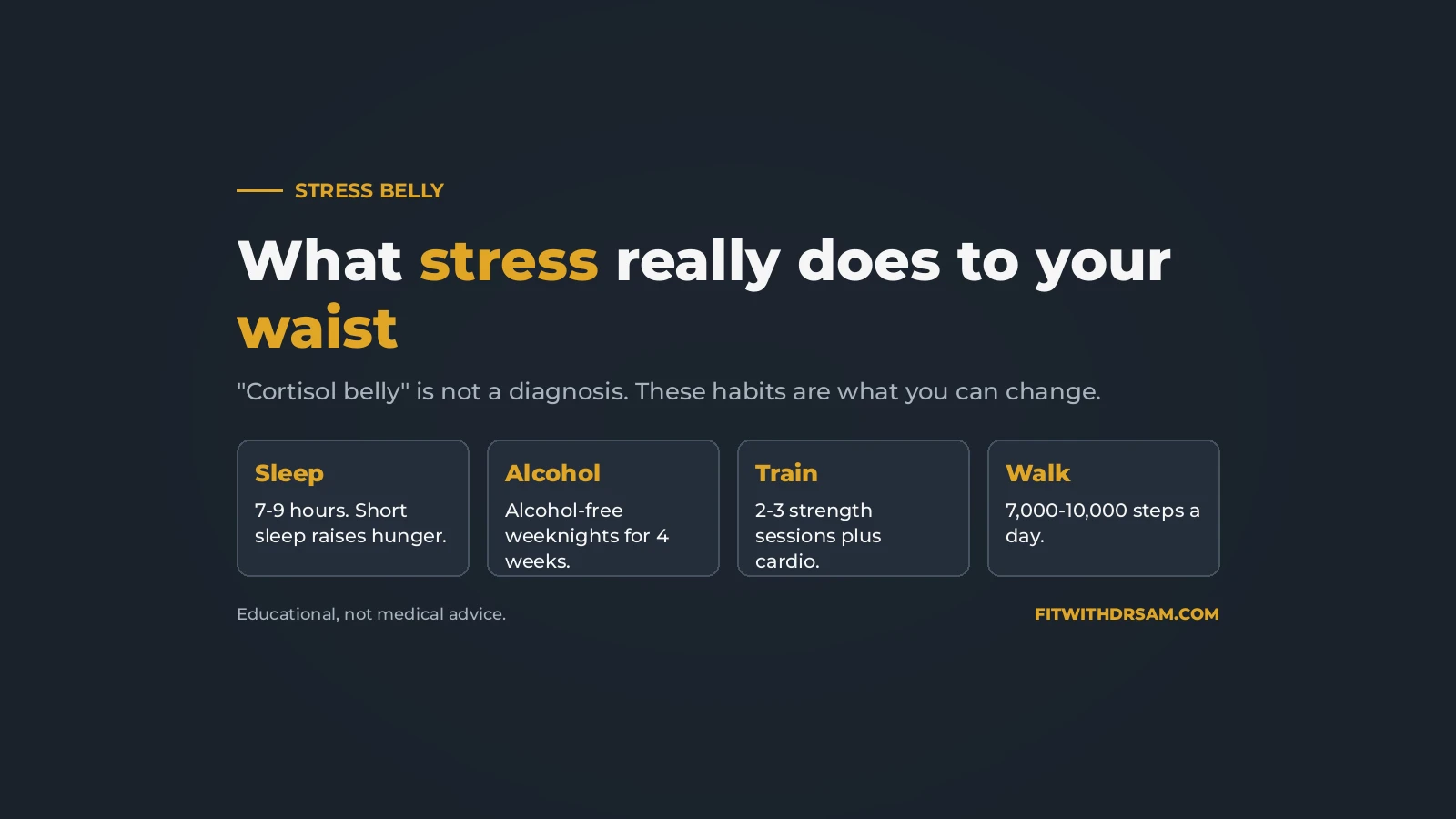
“Cortisol belly” is not a medical diagnosis. It is an internet name for something real, though: many men notice they gain fat around the middle during long stretches of stress, bad sleep and more drinking. Stress hormones may play a part, but the bigger drivers for most men are the habits that stress brings with it: shorter sleep, more snacking, more alcohol, less training and less walking. The good news is that every one of those is something you can change.
I’m Sam Smith, a fitness coach with more than 10 years of experience working with men in their 30s, 40s and 50s. A lot of them arrive saying, “I think it’s my cortisol.” Sometimes stress is clearly part of the story. But in my experience, the fix is almost never a supplement or a special “cortisol detox”. It is a handful of boring, reliable habits, done consistently. This guide explains what the research does and does not show, and gives you a practical 4-week plan.
Key takeaways
- “Cortisol belly” and “stress belly” are popular terms, not diagnoses. No test or doctor will give you that label.
- Studies link higher stress-related cortisol with more abdominal fat in some men and women, but they show an association, not proof that cortisol alone causes belly fat.
- Stress usually works through behaviour: less sleep, more hunger, more alcohol, less movement.
- Short sleep is linked with more hunger hormones and, over years, more visceral fat.
- Regular cardio and strength training, enough sleep, less alcohol and a sensible calorie deficit are what actually shrink a stress belly.
- Rare hormone conditions such as Cushing’s syndrome do cause central weight gain. That needs a doctor, not a fitness plan.
What people mean by “cortisol belly”
Cortisol is a hormone your adrenal glands make. It helps control blood sugar, blood pressure, your sleep-wake rhythm and how your body responds to a threat. It rises in the morning to help you wake up and spikes when you are under pressure. That is normal and healthy.
On social media, “cortisol belly” usually means fat that sits mostly around the waist, often with a firm, rounded stomach, in someone who feels stressed and tired. You will see it blamed for everything, and you will see a lot of products claiming to “lower cortisol” and flatten your stomach. Be careful with those. There is no good evidence that a supplement or tea will remove belly fat.
In men, fat stored deep inside the abdomen around the organs is called visceral fat. Men tend to store more of it than women, and it is linked with higher risk of type 2 diabetes and heart disease. That is the real reason to care about your waist, whatever you call it.
Does cortisol cause belly fat in men?
The honest answer: it may contribute, but it is rarely the whole story.
A Swedish study of 284 men found that those with higher cortisol responses to everyday stress tended to have a larger waist-to-hip ratio and worse metabolic markers (Rosmond et al., 1998). A study in women found that those with more central fat released more cortisol in response to lab stress tests (Epel et al., 2000). These studies are interesting, but they show that two things travel together. They cannot prove which one causes which, and both could be driven by something else, such as poor sleep or low activity.
What we do know is that high cortisol from a medical cause does change where fat sits. Cushing’s syndrome, which is usually caused by long-term steroid medicines or rarely by a tumour, leads to weight gain around the trunk and face. But that is a specific condition with other signs, and it is uncommon. For most men with a stress belly, cortisol levels are within the normal range.
The more useful question: what does stress make you do?
When I look at a client’s week during a stressful period, the pattern is usually obvious: later nights, earlier alarms, coffee to get going, a bigger lunch, snacks in the afternoon, two or three drinks to switch off, and the gym is the first thing to go. You do not need a hormone explanation to see why the waistline grows.
| How stress shows up | What it does | What the research says |
|---|---|---|
| Shorter sleep | More hunger, more cravings for high-calorie food | In a small trial, healthy young men who slept 4 hours for two nights had lower leptin, higher ghrelin and more hunger (Spiegel et al., 2004) |
| Consistently sleeping under 6 hours | More fat gain around the middle over years | In a 6-year study, adults who increased sleep from short to 7 to 8 hours gained less visceral fat than those who kept sleeping short (Chaput et al., 2014) |
| More alcohol | Extra calories, more snacking, worse sleep | Heavy drinking is more consistently linked with weight gain than light drinking (Traversy and Chaput, 2015) |
| More ultra-processed food | Eating more without noticing | In a controlled inpatient trial, people ate about 500 more calories a day on an ultra-processed diet (Hall et al., 2019) |
| Less training and walking | Fewer calories burned, lost muscle | Regular aerobic exercise reduces visceral fat even without big weight loss (Ismail et al., 2012) |
How to tell if stress is part of your belly-fat story
There is no home test for a “cortisol belly”, and saliva cortisol kits sold online are not a reliable way to diagnose anything. Instead, use this simple check-in. If you answer yes to three or more, stress-related habits are probably part of the picture:
- You are averaging under 6.5 hours of sleep most weeknights.
- You drink alcohol on four or more days a week, or more than 14 UK units (about 8 US standard drinks) a week.
- Your training has dropped to one session a week or less.
- You eat most evening snacks when tired or wound up, not hungry.
- Your waist has grown in the last 6 to 12 months while your weight elsewhere has not changed much.
- You wake up tired even after a full night in bed.
A quick way to track progress: measure your waist at the level of your belly button, after breathing out, first thing in the morning. Do it once a week. The NHS suggests that men should aim for a waist below 94 cm (37 inches), whatever their height. Waist size tells you more about visceral fat than the scale does.
The 5-part plan to lose a stress belly
This is the same approach I use with clients. None of it is fancy. All of it works better together than alone.
1. Protect your sleep first
If you only change one thing, make it sleep. Aim for 7 to 9 hours in bed, at roughly the same time every night, including weekends. Stop caffeine after 2 pm, keep the bedroom cool and dark, and leave your phone outside the room if you can. Poor sleep also lowers testosterone, which matters for men over 40. I go through this in more detail in sleep and testosterone.
2. Train three to four times a week
Do two to three strength sessions plus regular cardio. A review of 35 studies found that aerobic exercise reduced visceral fat, and that resistance training on its own had a smaller effect (Ismail et al., 2012). In practice, strength training keeps your muscle while you lose fat, and cardio burns more energy, so combine them. If you need a ready-made routine, use my 12-week workout plan for men over 40 or the home workout for men over 40 if you cannot get to a gym. Exercise is also one of the most reliable ways to feel less stressed.
3. Walk every day
Walking is the most underrated fat-loss and stress tool. A 20 to 30 minute walk after lunch or dinner lowers blood sugar after meals, burns calories without making you hungrier, and gives your mind a break. Aim for 7,000 to 10,000 steps a day, built up slowly.
4. Cut alcohol, not just calories
Alcohol is the stress habit I see most often in men with a growing waist. It adds calories, makes you snack, disrupts deep sleep and lowers next-day motivation. Try alcohol-free weeknights for four weeks and see what happens to your waist and your sleep. If you want the testosterone side of this, read alcohol and testosterone.
5. Eat for fullness
Build meals around protein, vegetables and high-fibre carbohydrates. Protein at every meal helps you stay full and keep muscle. A moderate calorie deficit of about 300 to 500 calories a day is enough for most men; crash diets add stress and usually rebound. My high-protein meal plan for men gives you a simple template, and how to lose belly fat for men over 40 covers the full fat-loss plan.
A simple 4-week stress-belly reset
| Week | Focus | Daily target | Weekly target |
|---|---|---|---|
| 1 | Sleep and steps | Same bedtime ±30 min; 6,000+ steps | 2 strength sessions; measure waist on day 1 |
| 2 | Alcohol and evenings | Alcohol-free Mon to Thu; 7,000+ steps | 2 strength sessions + 1 cardio session |
| 3 | Protein and portions | Protein at every meal; 8,000+ steps | 3 strength sessions + 1 cardio session |
| 4 | Stress skills | 10 minutes of slow breathing or a walk without your phone; 8,000+ steps | 3 strength + 2 cardio; measure waist again |
Expect your waist to drop slowly. Losing 1 to 3 cm in the first month is a good start. The bigger change you will notice first is usually better energy and sleep.
How to lower stress day to day (without a supplement)
You cannot remove all stress from life, but you can change how you respond to it. The NHS recommends practical steps such as staying active, talking to people you trust, setting small goals and taking regular breaks. Things that work well for my clients:
- Slow breathing: 5 minutes of breathing in for 4 seconds and out for 6 seconds. My guide to breathing techniques shows the method.
- A hard stop at night: a fixed time when work messages stop.
- Training as a release: a short session after work instead of a drink.
- Talking: to your partner, a friend, or a professional if stress is constant.
When to see a doctor, GP or Hausarzt
- Your weight is rising fast without an obvious reason, especially with a rounder face, thin skin, easy bruising or purple stretch marks.
- You have new high blood pressure, high blood sugar or very low energy.
- You take steroid tablets, inhalers or creams long-term and have gained weight.
- You feel low, anxious or unable to cope for more than two weeks.
- Your waist is over 102 cm (40 inches). A doctor can check blood pressure, blood sugar and cholesterol.
In the UK, start with your GP. In Germany, see your Hausarzt. In the US and Canada, see your primary care doctor. If you ever feel unsafe or have thoughts of harming yourself, contact emergency services or a crisis line right away.
Frequently asked questions
Is cortisol belly real?
“Cortisol belly” is not a medical diagnosis. Stress can affect sleep, appetite, alcohol use and activity, and some studies link stress-related cortisol with more abdominal fat, but there is no proof that cortisol alone causes belly fat in most men.
How do I get rid of stress belly fat?
Sleep 7 to 9 hours, train three to four times a week with a mix of strength and cardio, walk daily, cut back on alcohol and eat in a modest calorie deficit with protein at every meal. Measure your waist weekly.
Can lowering cortisol flatten my stomach?
Not on its own. Lower stress helps you sleep, eat and train better, and those changes are what reduce belly fat. Be wary of supplements that promise to lower cortisol and burn belly fat.
Should I get my cortisol tested?
Only if a doctor suspects a condition such as Cushing’s syndrome, which has specific signs. Routine cortisol tests are not useful for everyday belly fat, and home saliva kits are not a reliable diagnosis.
Does stress make men gain weight?
It can. Stress often leads to shorter sleep, more snacking and drinking, and less exercise, which all make weight gain more likely, especially around the waist.
How long does it take to lose a stress belly?
Most men see 1 to 3 cm off the waist in the first month with consistent habits, and steady progress over 3 to 6 months. Sleep and energy usually improve first.
Want the full nutrition plan? My book Nutrition, Metabolism & Muscle explains how to eat for fat loss and muscle after 40, with meal templates. Related reading: how to lose belly fat for men over 40 · how to increase testosterone naturally
The bottom line. A stress belly is real in the sense that stressful periods often add fat to your waist. But the cause is usually what stress does to your sleep, eating, drinking and training, not cortisol alone. Fix those, measure your waist, and give it a few months.
About the author. Sam Smith is a fitness coach with more than 10 years of experience and the author of five books on men’s stamina, fitness, nutrition and relationships. He is not a medical doctor and does not give medical advice.
Sources
- Rosmond R, Dallman MF, Björntorp P. Stress-related cortisol secretion in men: relationships with abdominal obesity and endocrine, metabolic and hemodynamic abnormalities. J Clin Endocrinol Metab. 1998;83(6):1853-1859. PubMed
- Epel ES, McEwen B, Seeman T, et al. Stress and body shape: stress-induced cortisol secretion is consistently greater among women with central fat. Psychosom Med. 2000;62(5):623-632. PubMed
- Spiegel K, Tasali E, Penev P, Van Cauter E. Brief communication: sleep curtailment in healthy young men is associated with decreased leptin levels, elevated ghrelin levels, and increased hunger and appetite. Ann Intern Med. 2004;141(11):846-850. PubMed
- Chaput JP, Bouchard C, Tremblay A. Change in sleep duration and visceral fat accumulation over 6 years in adults. Obesity (Silver Spring). 2014;22(5):E9-E12. PubMed
- Traversy G, Chaput JP. Alcohol consumption and obesity: an update. Curr Obes Rep. 2015;4(1):122-130. PubMed
- Hall KD, Ayuketah A, Brychta R, et al. Ultra-processed diets cause excess calorie intake and weight gain: an inpatient randomized controlled trial of ad libitum food intake. Cell Metab. 2019;30(1):67-77.e3. PubMed
- Ismail I, Keating SE, Baker MK, Johnson NA. A systematic review and meta-analysis of the effect of aerobic vs. resistance exercise training on visceral fat. Obes Rev. 2012;13(1):68-91. PubMed
- NHS. Tips to reduce stress. nhs.uk
- NHS. Managing your weight. nhs.uk
All links checked 8 November 2026.