How Often Should Men Over 40 Lift Weights? A Practical Guide
Educational content, not medical advice. This article is general fitness information from a coach. If you have a medical condition, chest pain, joint problems or you are new to exercise, check with your doctor before you start. See “When to see a doctor” below.
Most men over 40 do best lifting weights two to three times a week with at least one rest day between sessions. Two sessions is the minimum that public-health guidance recommends and is enough to keep muscle. Three full-body sessions is the sweet spot for most busy men. Four or more is optional and only works if your sleep, food and joints can keep up.
I’m Sam Smith, a fitness coach with more than 10 years of experience. I get this question constantly, usually from a man who either does too little because he’s worried about getting hurt, or too much because he’s trying to win back his 25-year-old self. Below is what the evidence says, how to choose between a full-body and a split routine, and how to know when you need an extra rest day.
Key takeaways
- The WHO recommends muscle-strengthening on at least 2 days a week, plus 150 to 300 minutes of moderate cardio.
- For muscle size, a meta-analysis found that training each muscle at least twice a week beat once a week when total volume was equal.
- When volume is equal, more sessions did not give extra strength. Frequency is mostly a way to spread the work so you can recover.
- Older lifters may not recover as slowly as people assume. The research is unclear, so judge by your own sleep, soreness and performance.
- Pick the plan you will keep doing: consistency beats a perfect split.
What does the research say about lifting frequency?
The WHO’s 2020 guidelines say adults should do muscle-strengthening activities at moderate or greater intensity on two or more days a week, on top of 150 to 300 minutes of moderate aerobic activity (WHO). That is the floor for health. If you want to build muscle, the details matter a bit more.
A meta-analysis of ten studies on training frequency and muscle growth found that training a muscle twice a week produced better growth than once a week when the total sets were matched. It did not settle whether three times a week beats twice (Schoenfeld et al., 2016). A separate meta-analysis of 22 studies on strength found higher frequencies were linked to bigger gains, but when the studies matched total volume, the effect disappeared (Grgic et al., 2018).
In plain English: the number of weekly hard sets matters most, and spreading them across two to three sessions per muscle group helps you do quality work without wrecking yourself. A National Strength and Conditioning Association position statement describes resistance training as a powerful way to counter the loss of muscle strength and mass that comes with ageing (Fragala et al., 2019).
Do you really recover slower after 40?
Many older lifters feel that they do. A review of the research found a plausible case for slower repair, but also noted that studies often did not account for how active people were, so it is hard to separate ageing from simply doing less training (Fell and Williams, 2008). My practical view: assume you may need a bit more recovery than at 25, then adjust to your own signs, not to the calendar.
How often should you lift? It depends on your situation
| Your situation | Sessions per week | Suggested layout | Time per session |
|---|---|---|---|
| New to lifting or returning after a break | 2 to 3 | Full-body, 6 to 8 exercises, 2 sets each | 40 to 45 min |
| Busy: work, kids, travel | 2 | Two full-body sessions, 5 key lifts each | 30 to 40 min |
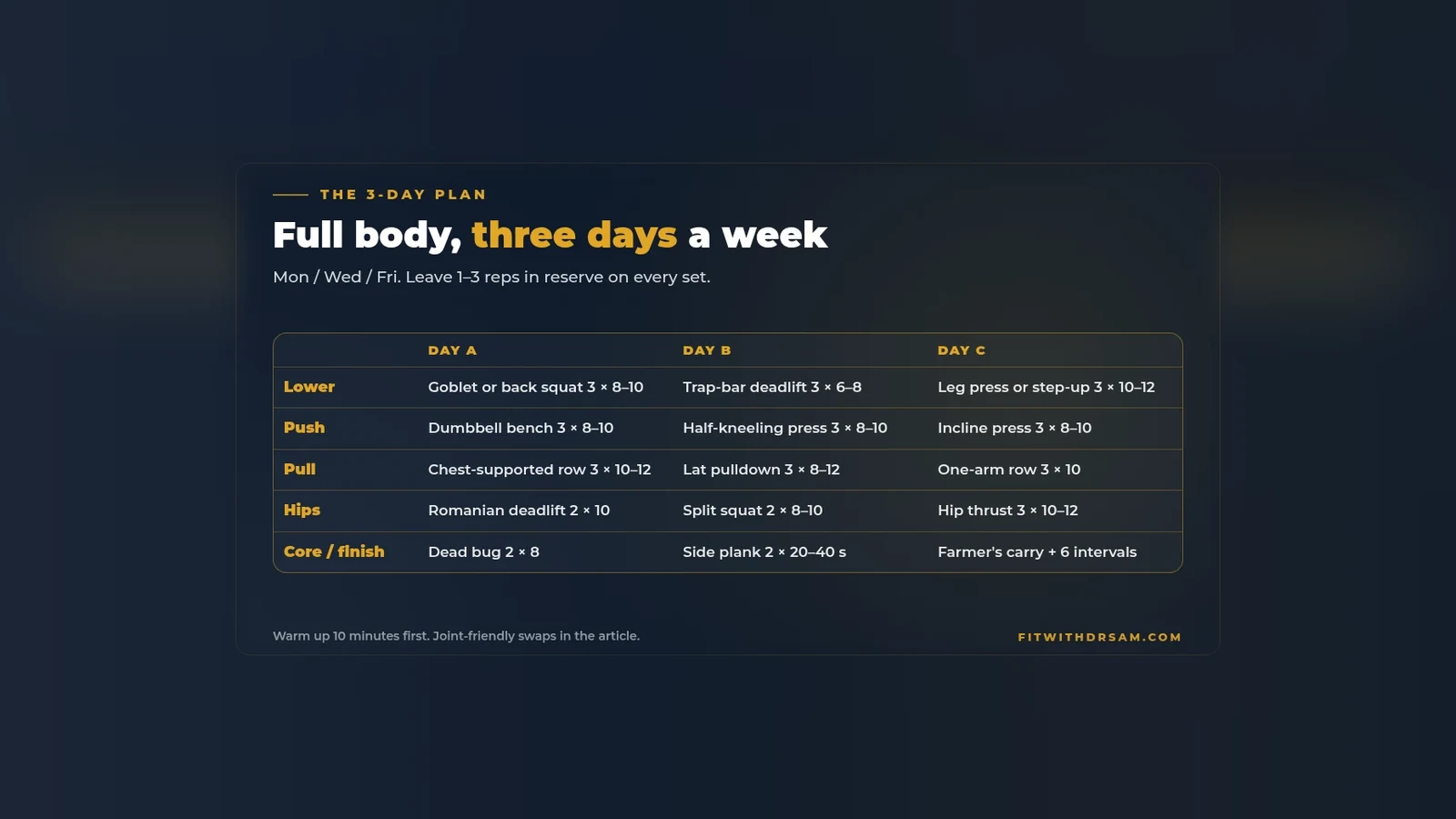
| Most men over 40 (the sweet spot) | 3 | Full-body Mon / Wed / Fri, or Tue / Thu / Sat | 45 to 60 min |
| Training for 2+ years, good sleep, want more volume | 4 | Upper / lower split, 2 upper and 2 lower days | 45 to 60 min |
| Over 50, or dealing with joint niggles | 2 to 3 | Full-body with machines or dumbbells, longer warm-up | 40 to 50 min |
| Advanced, flexible schedule | 4 to 5 | Upper / lower plus one extra day; deload every 4 to 6 weeks | 45 to 60 min |
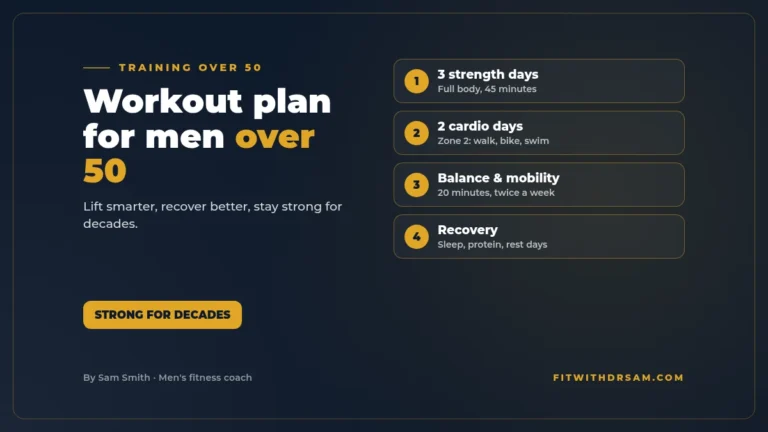
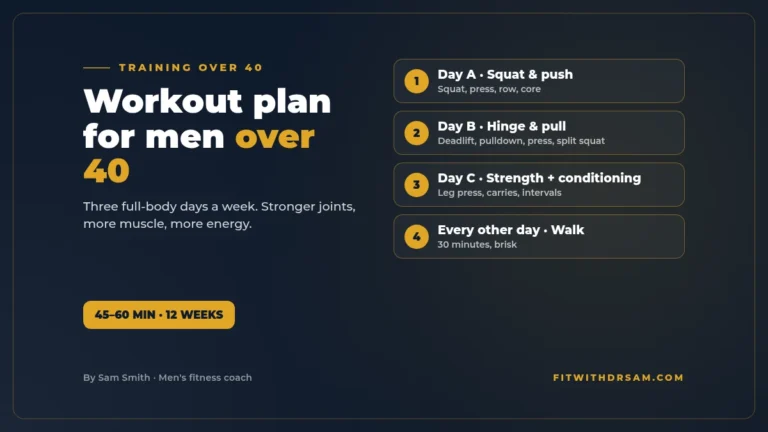
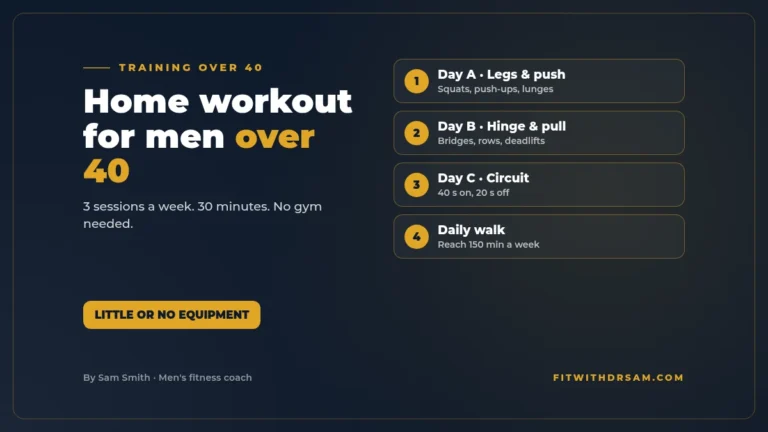
If you are not sure, start with three full-body sessions. It lets you practise each lift often, keeps rest days built in, and is simple to follow. My 12-week workout plan for men over 40 is built this way, and the 30-minute home workout works with just dumbbells. If you are in your 50s, see the plan for men over 50.
What a week can look like
Three days a week (recommended for most)
| Day | Plan |
|---|---|
| Mon | Full-body strength: squat or leg press, press, row, hinge, core |
| Tue | Walk 30 minutes |
| Wed | Full-body strength with different exercises or rep ranges |
| Thu | Walk or easy cycle 30 minutes |
| Fri | Full-body strength, finish with carries and core |
| Sat | Longer easy cardio or sport, 40 to 60 minutes |
| Sun | Rest and mobility |
Two days a week (when time is tight)
Do two full-body sessions with big lifts only: a squat or leg press, a press, a row, a hip hinge and a carry. Three sets of 6 to 10 reps each. Keep 150 minutes of walking or cycling through the week. This is enough to maintain and build muscle if you push the sets hard.
Four days a week (upper / lower)
Train upper body on Mon and Thu, lower body on Tue and Fri, with Wed and weekend for cardio and rest. This lets you do more sets per muscle without 90-minute sessions. Only move here once three days feels easy and your joints are happy.
Rest days and recovery: simple rules
These are coaching rules of thumb that I use with clients, not research findings:
- Leave at least one rest or easy day between hard sessions for the same muscle group.
- Keep one or two sets “in the tank” on most lifts. Leave the all-out sets for the last set of a few key exercises.
- Take a lighter week (roughly half the volume) every 4 to 6 weeks, or sooner if you feel flat.
- Treat walking as recovery. It helps you feel better without adding stress.
- Eat enough protein. A meta-analysis found gains from protein supplementation levelled off at about 1.6 g per kg of bodyweight per day (Morton et al., 2018). See my high-protein meal plan for men.
- Sleep seven or more hours. It is the cheapest recovery tool there is, and it is also linked to hormones, as I explain in sleep and testosterone.
Signs you are doing too much, or too little
| Too much | Too little |
|---|---|
| Soreness lasting more than 3 days | You finish a session feeling fresh and could easily do more |
| Weights dropping week after week | Same weights and reps for 6+ weeks |
| Sleep gets worse or you wake up tired | No muscle soreness at all, ever |
| Persistent joint or tendon pain | Skipping sessions and no plan for catching up |
| Dreading every session for weeks | Photos and measurements have not changed in 3 months |
If you spot the left column, cut one session or a few sets and sleep more for a week. If you spot the right column, add a set per exercise or another day. Make one change at a time.
Warm up, protect your joints, and stay consistent
- Spend 5 to 8 minutes on a general warm-up, then 1 or 2 lighter sets of your first lift.
- Choose joint-friendly variations: goblet squats, neutral-grip presses, supported rows, hip hinges rather than heavy back squats if your back or knees complain.
- Stop a set when your form slips, not when you hit a number.
- Add weight in small steps, 1 to 2 kg or one extra rep.
Lifting also supports general energy and drive, which many men over 40 care about. For the hormone angle, read strength training and testosterone. For a bodyweight option that builds endurance as well, my 30-day program The Warrior’s Stamina takes 20 to 30 minutes a day with no gym. And if the question is how this connects to energy in the bedroom, see sexual stamina after 40.
When to see a doctor
See your doctor before you start or increase training if:
- you have chest pain, dizziness, or unusual breathlessness
- you have heart disease, high blood pressure, diabetes, or you take medicines that affect exercise
- you have joint, back or tendon pain that doesn’t settle after a few days
- you have not exercised for a long time and want to start hard
A doctor or physiotherapist can help you plan training around an injury or condition.
Want a plan you can follow?
My 12-week workout plan for men over 40 lays out three full-body sessions a week. For the free starter, grab the 7-Day Stamina Starter.
Frequently asked questions
Is lifting three times a week enough after 40?
Yes for most men. Three full-body sessions give each muscle a good weekly dose with rest days between, and you can progress for years on that schedule. Add a fourth day only if you have the time and recovery.
Can a man over 40 lift weights every day?
It’s possible with careful split programming, but it isn’t necessary or ideal for most. Daily heavy lifting increases fatigue and injury risk. If you enjoy daily training, keep most days light or alternate muscle groups and keep at least one full rest day.
How many rest days do men over 40 need?
At least one full rest or easy day between hard sessions for the same muscles, and one or two completely easy days a week. Use walking and mobility on those days.
How long should a workout be at 40 or 50?
Most good strength sessions take 40 to 60 minutes including warm-up. Longer isn’t better unless the extra time is extra hard sets that you can recover from.
Is lifting twice a week enough to build muscle?
It can be. Research suggests training each muscle at least twice a week works well, and two full-body sessions do that. Push your sets close to failure and increase weights gradually.
How often should a 50-year-old man work out?
Two to three strength sessions plus regular walking or cardio is a good target, the same as for 40. Spend longer warming up and choose joint-friendly exercises.
About the author. Sam Smith is a fitness coach with more than 10 years of experience and the author of five books on men’s stamina, fitness, nutrition and relationships. He is not a medical doctor and does not give medical advice.
Sources
- World Health Organization. WHO guidelines on physical activity and sedentary behaviour (2020). WHO
- Schoenfeld BJ, Ogborn D, Krieger JW. Effects of resistance training frequency on measures of muscle hypertrophy: a systematic review and meta-analysis. Sports Med. 2016;46(11):1689-1697. PubMed
- Grgic J, Schoenfeld BJ, Davies TB, et al. Effect of resistance training frequency on gains in muscular strength: a systematic review and meta-analysis. Sports Med. 2018;48(5):1207-1220. PubMed
- Fragala MS, Cadore EL, Dorgo S, et al. Resistance training for older adults: position statement from the National Strength and Conditioning Association. J Strength Cond Res. 2019;33(8):2019-2052. PubMed
- Fell J, Williams D. The effect of aging on skeletal-muscle recovery from exercise: possible implications for aging athletes. J Aging Phys Act. 2008;16(1):97-115. PubMed
- Morton RW, Murphy KT, McKellar SR, et al. A systematic review, meta-analysis and meta-regression of the effect of protein supplementation on resistance training-induced gains in muscle mass and strength in healthy adults. Br J Sports Med. 2018;52(6):376-384. DOI
All links checked 28 October 2026.