Cardio for Men Over 40: How Much, Which Type, and a Weekly Plan
Educational content, not medical advice. This article is general fitness information from a coach. If you have heart disease, high blood pressure, diabetes, chest pain, dizziness, or you have been inactive for a long time, check with your doctor before starting harder cardio. See “When to see a doctor” below.
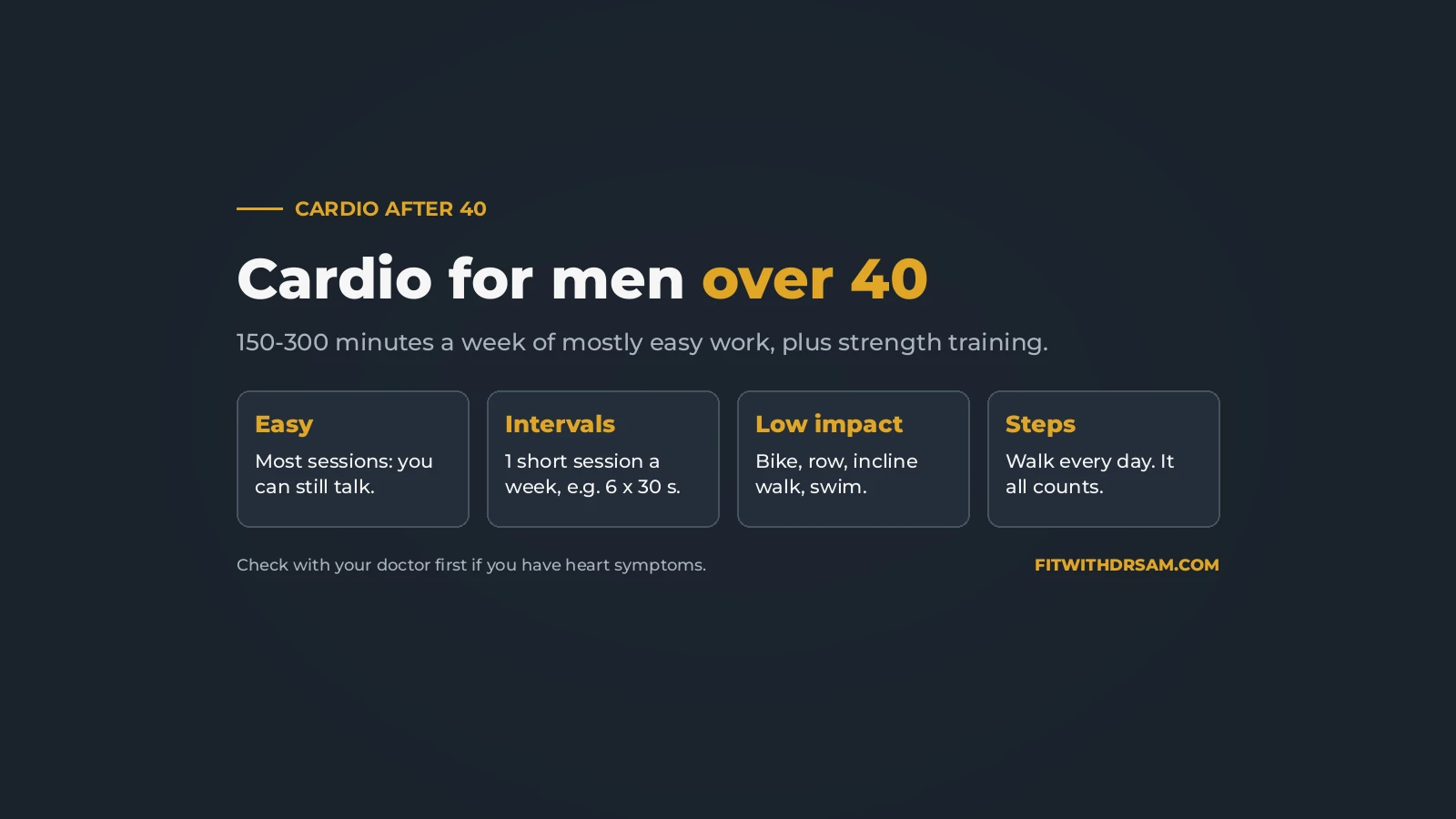
Most men over 40 should aim for 150 to 300 minutes of moderate cardio a week, or 75 to 150 minutes of vigorous cardio, alongside two or more strength sessions. For most busy men that means three to five cardio sessions: mostly easy, steady work you can talk through, plus one short interval session. Walking counts. You do not need to run if your knees hate it.
I’m Sam Smith, a fitness coach with more than 10 years of experience training men in their 40s and 50s. Cardio is where I see the most confusion: some men only lift and get out of breath on the stairs; others run themselves into injury trying to undo a decade in six weeks. Here is what the guidelines and research actually say, the best types of cardio after 40, and a weekly plan you can start this week.
Key takeaways
- The WHO and NHS recommend 150 to 300 minutes of moderate or 75 to 150 minutes of vigorous aerobic activity a week, plus strength training on 2+ days.
- In a study of more than 120,000 adults, higher cardiorespiratory fitness was linked with lower long-term mortality, with no upper limit of benefit (Mandsager et al., 2018).
- Daily steps matter: in a meta-analysis of 15 cohorts, more steps per day were linked with lower risk of death, levelling off at around 6,000 to 8,000 steps in adults over 60 (Paluch et al., 2022).
- Build most of your cardio on easy, conversational sessions. Add one short interval session a week once you have a base.
- Pick low-impact options (cycling, rowing, incline walking, swimming) if your joints complain.
- Better fitness also helps stamina in the bedroom; heart health and erection health are closely linked.
How much cardio should a man over 40 do?
The World Health Organization’s 2020 guidelines and the NHS physical activity guidelines say adults should do at least 150 minutes of moderate-intensity activity a week, or 75 minutes of vigorous activity, or a mix (WHO; NHS). The WHO adds that going up to 300 minutes moderate or 150 vigorous brings extra benefit. US and Canadian guidance uses the same 150-minute baseline.
Moderate means you breathe faster but can still hold a conversation. Vigorous means you can only say a few words before you need a breath. A simple rule: 1 minute of vigorous work counts roughly the same as 2 minutes of moderate work.
| Your goal | Weekly cardio | How it looks |
|---|---|---|
| Health minimum | 150 min moderate | 5 × 30 min brisk walks or easy bike rides |
| Fat loss | 200 to 300 min moderate, plus daily steps | 4 × 40 min easy cardio + 1 interval session; 8,000+ steps a day |
| Better fitness and stamina | 150 to 200 min, including 1 to 2 harder sessions | 3 easy sessions + 1 interval session + 1 longer walk or ride |
| Busy week | 75 min vigorous | 3 × 25 min harder sessions (bike, rower, hill walks) |
| Returning after a long break | Start at 60 to 90 min moderate | 3 × 20 to 30 min walks; add 10% a week |
Why cardio matters more after 40
From your 40s onward, your maximum heart rate and aerobic fitness gradually fall if you do nothing about it. The encouraging part is how much training can slow that. A large study of more than 120,000 adults who did treadmill tests found that people with higher cardiorespiratory fitness had lower long-term mortality, and the fittest group did best of all (Mandsager et al., 2018). That was an observational study, so it cannot prove cause and effect, but the link is strong and consistent.
Cardio also helps with the things my clients care about every day:
- Belly fat: aerobic exercise reduces visceral fat, the deep fat around the organs, even when the scale barely moves (Ismail et al., 2012). See how to lose belly fat for men over 40.
- Energy and recovery: a better aerobic base helps you recover between sets and between workouts.
- Sexual stamina: good blood flow and heart fitness support erections and endurance. I cover the research in does exercise help you last longer in bed?
- Stress and sleep: regular moderate exercise is one of the most reliable ways to sleep better.
The best types of cardio for men over 40
The best cardio is the kind you will do three or four times a week for years. Here is how the main options compare:
| Type | Joint impact | Best for | Notes |
|---|---|---|---|
| Brisk walking / incline walking | Low | Everyone, fat loss, recovery days | Underrated. Add hills or a treadmill incline to raise effort. |
| Cycling (outdoor or stationary) | Very low | Bad knees, intervals, longer sessions | Easy to control intensity. |
| Rowing | Low | Full-body conditioning, intervals | Learn the technique: legs, then body, then arms. |
| Swimming | Very low | Joint pain, back issues | Needs decent technique to get a real training effect. |
| Running | High | Fitness, time-efficiency | Build up slowly; mix with walking at first. |
| Elliptical / cross-trainer | Low | Easy steady cardio | Good stepping stone back to running. |
| Circuits, sled pushes, carries | Low to medium | Busy men, conditioning | Mixes strength and cardio; keep form strict. |
Is HIIT good for men over 40?
Yes, in sensible doses. A meta-analysis of studies in people with lifestyle-related heart and metabolic conditions found that high-intensity interval training improved aerobic fitness about twice as much as moderate continuous training (Weston et al., 2014). The catch: intervals are hard on the body, and doing them every day leads to fatigue and injury. One or two short interval sessions a week is plenty. Build a few weeks of easy cardio before you start, and get medical clearance first if you have a heart condition.
A simple first interval session: on a bike or rower, warm up for 8 minutes, then do 6 rounds of 30 seconds hard and 90 seconds easy, then cool down for 5 minutes. Build to 8 to 10 rounds over a few weeks.
Cardio vs strength training over 40: do you need both?
Yes. They do different jobs. Strength training keeps and builds muscle and bone, which you lose with age if you do not train. Cardio trains your heart, lungs and blood vessels. The guidelines recommend both for a reason.
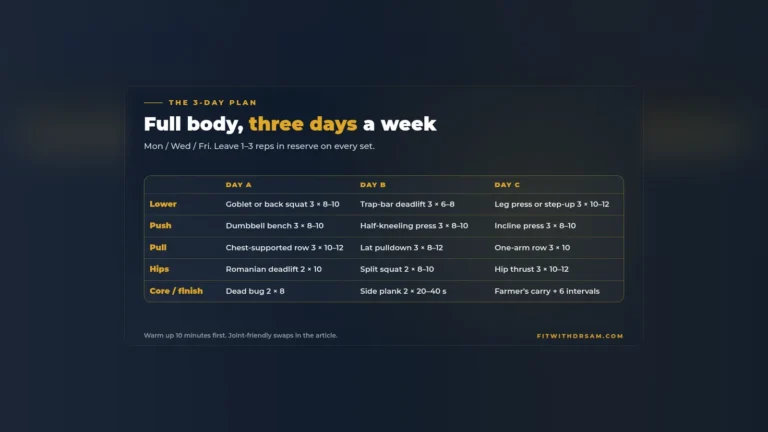
If you are short on time, prioritise two to three strength sessions and fit cardio around them as walks, easy rides and one interval session. I explain how to plan the lifting side in how often should men over 40 lift weights? To stop cardio from eating into your strength gains, do intervals on a different day from heavy leg training, or after your lifting, not before.
A weekly cardio plan for men over 40
This plan fits around three strength sessions. Easy means conversational. Hard means you can only say a few words.
| Day | Strength | Cardio |
|---|---|---|
| Monday | Full-body strength | 10 min easy walk or bike to cool down |
| Tuesday | None | 30 to 40 min easy cardio (bike, incline walk, row) |
| Wednesday | Full-body strength | None, or a 20 min walk |
| Thursday | None | Intervals: 6 to 10 × 30 s hard / 90 s easy (20 to 25 min total) |
| Friday | Full-body strength | 10 min easy cool-down |
| Saturday | None | 45 to 60 min long walk, hike or easy ride |
| Sunday | Rest | Gentle walk and mobility |
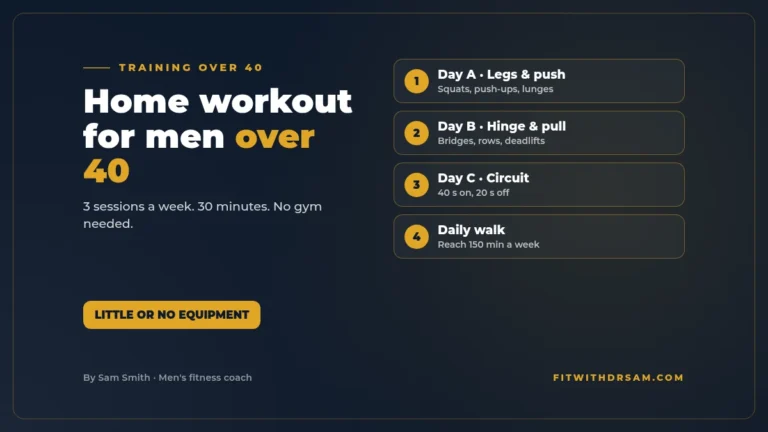
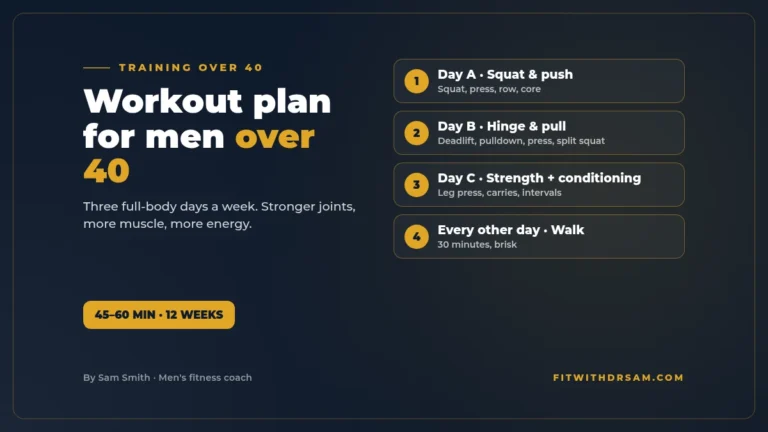
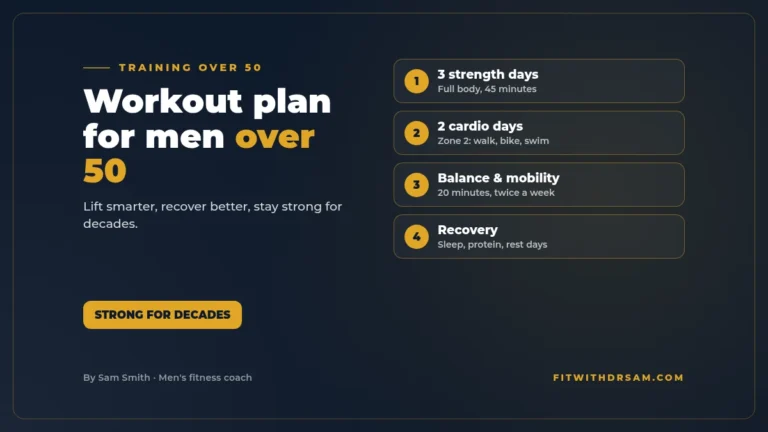
That adds up to roughly 150 to 200 minutes of cardio. If you are just starting, cut every session in half for the first two weeks. Need the strength sessions too? Use the 12-week workout plan for men over 40 or, if you are older, the workout plan for men over 50.
How to start cardio safely after 40
- Start easier than you think. Your heart and lungs adapt faster than your tendons and joints.
- Increase by about 10% a week. Add time before you add intensity.
- Warm up for 5 to 10 minutes. Start slowly and build.
- Use the talk test. Most sessions should let you speak in full sentences.
- Track your resting heart rate. If it is noticeably higher than normal in the morning, take an easier day.
- Walk every day. Steps add up: 7,000 to 10,000 a day is a good target for most men.
When to see a doctor, GP or Hausarzt before or during cardio
- You have chest pain, pressure or tightness during exercise, or at rest.
- You get unusually short of breath, dizzy or faint, or notice a racing or irregular heartbeat.
- You have known heart disease, high blood pressure, diabetes or kidney disease and want to start harder exercise.
- You have been inactive for years, smoke, or have a strong family history of early heart disease.
- You have new joint pain that does not settle with rest.
In the UK, talk to your GP. In Germany, see your Hausarzt. In the US and Canada, see your primary care doctor. If you have chest pain that does not go away, call emergency services (999 in the UK, 112 in Germany, 911 in the US and Canada).
Frequently asked questions
What is the best cardio for men over 40?
The best cardio is the type you will do consistently. Brisk or incline walking, cycling and rowing are excellent low-impact choices. Running works well if you build up slowly. Add one short interval session a week once you have a base.
How much cardio should a 40-year-old man do?
At least 150 minutes of moderate or 75 minutes of vigorous cardio a week, according to WHO and NHS guidance, plus strength training on two or more days. Up to 300 minutes of moderate activity gives extra benefit.
Is walking enough cardio after 40?
Brisk walking counts as moderate activity and is enough to meet the guidelines if you do 150 minutes a week. To improve fitness further, add hills, a faster pace or one interval session.
Is HIIT safe for men over 40?
For most healthy men, yes, if you build an easy base first and keep it to one or two sessions a week. If you have a heart condition or other risk factors, ask your doctor before starting interval training.
Should I do cardio before or after weights?
After weights, or on a different day, if strength is your main goal. Easy cardio as a warm-up is fine. Avoid hard intervals right before heavy leg training.
Does cardio burn muscle after 40?
Not if you keep lifting and eat enough protein. Moderate cardio alongside strength training supports fat loss and fitness without costing you muscle.
Want a full stamina and conditioning program? My book The Warrior’s Stamina combines cardio, strength and recovery in one plan. Related reading: the complete guide to male sexual stamina · home workout for men over 40
The bottom line. Aim for 150 to 300 minutes of mostly easy cardio a week, add one short interval session, keep lifting two to three times a week, and walk every day. Start easy, build slowly, and choose the cardio your joints enjoy.
About the author. Sam Smith is a fitness coach with more than 10 years of experience and the author of five books on men’s stamina, fitness, nutrition and relationships. He is not a medical doctor and does not give medical advice.
Sources
- World Health Organization. WHO guidelines on physical activity and sedentary behaviour. Geneva: WHO; 2020. who.int
- NHS. Physical activity guidelines for adults aged 19 to 64. nhs.uk
- Mandsager K, Harb S, Cremer P, et al. Association of cardiorespiratory fitness with long-term mortality among adults undergoing exercise treadmill testing. JAMA Netw Open. 2018;1(6):e183605. PubMed
- Paluch AE, Bajpai S, Bassett DR, et al. Daily steps and all-cause mortality: a meta-analysis of 15 international cohorts. Lancet Public Health. 2022;7(3):e219-e228. PubMed
- Weston KS, Wisløff U, Coombes JS. High-intensity interval training in patients with lifestyle-induced cardiometabolic disease: a systematic review and meta-analysis. Br J Sports Med. 2014;48(16):1227-1234. PubMed
- Ismail I, Keating SE, Baker MK, Johnson NA. A systematic review and meta-analysis of the effect of aerobic vs. resistance exercise training on visceral fat. Obes Rev. 2012;13(1):68-91. PubMed
All links checked 8 November 2026.