
Original data analysis · 1 November 2026
The Men’s Strength Gap 2026: Which US States and European Countries Lift the Least?
We ranked 49 US states and 30 European countries by how many men do muscle-strengthening exercise at least twice a week, using official CDC and Eurostat survey data. The spread is huge: from 3% to 48%.
By Sam Smith, men’s fitness coach (10+ years coaching, 56.5K followers on X and 40.7K on Instagram). Movember is the month men are told to look after themselves, so we looked at one simple, measurable habit: do men actually do the strength training that public-health guidelines ask for? The data comes entirely from official government surveys. Nothing here is a poll we ran ourselves, and nothing here is medical advice.
Key findings
- 45.1% of American men did muscle-strengthening activity on two or more days a week in 2023, against 37.0% of American women (CDC, BRFSS).
- The state gap is 17.6 points. West Virginia is lowest at 33.3%, then Oklahoma (37.8%), North Carolina (38.0%), Missouri (38.7%) and Iowa (39.2%). Hawaii is the highest state at 50.9%, and the District of Columbia is highest overall at 55.3%.
- Men who lift less also move less overall. Across the 49 areas with data, the share of men doing muscle-strengthening is negatively correlated with the share of men doing no leisure-time physical activity (r = −0.56). In Oklahoma 28.1% of men report no leisure-time activity, in Arkansas and Mississippi 29.1%, in DC 12.3%. This is an association, not proof of cause and effect.
- Europe’s gap is far wider: 2.9% to 47.8%. Among EU countries with data, Romania has the lowest share of men doing strength work twice a week (2.9%) and Sweden the highest (44.3%), a 15-fold difference. Türkiye is second lowest of all 30 countries at 3.8%. The EU-27 men’s average is 22.4% (2019).
- Germany ranks 5th of 30 at 38.9%, behind Iceland (47.8%), Sweden (44.3%), Finland (43.2%) and Denmark (40.9%).
- Men reported more strength training than women almost everywhere: in all 49 US areas and in 29 of 30 European countries (Iceland is the exception).
- Context from two more countries: in the Health Survey for England 2021, 36% of men aged 16+ met the muscle-strengthening guideline. In Canada’s 2020 survey, 61.2% of men aged 18 to 64 did. The Canadian question was broader (it counts carrying heavy loads and shovelling), so the two cannot be ranked against each other or against the figures above.
US map: men and strength training by state, 2023
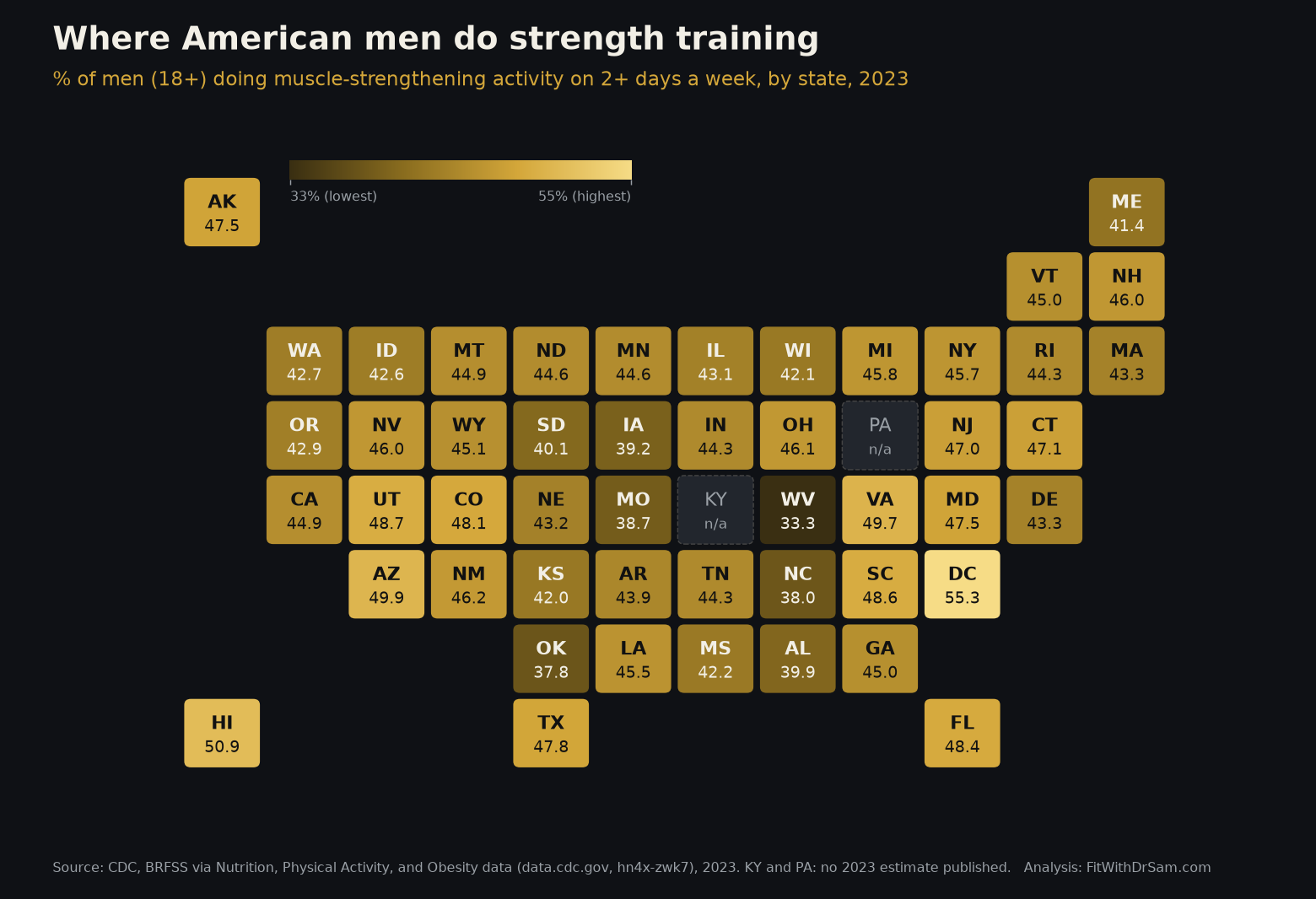
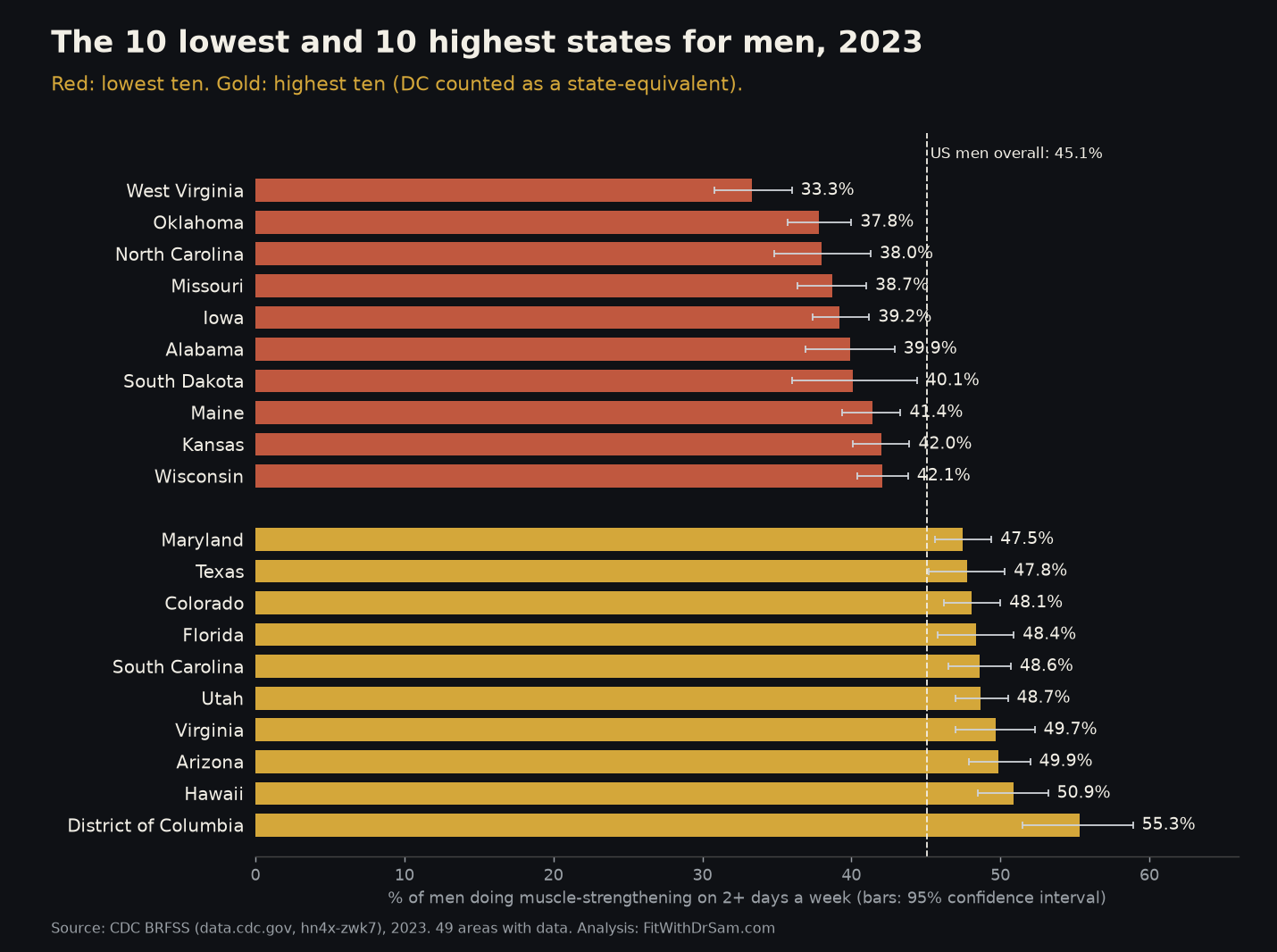
Several neighbouring states are statistically hard to separate (the confidence intervals overlap), so treat ranks in the middle of the table as approximate. The extremes are clear: West Virginia is significantly below the national figure, and DC, Hawaii, Arizona and Virginia are above it.
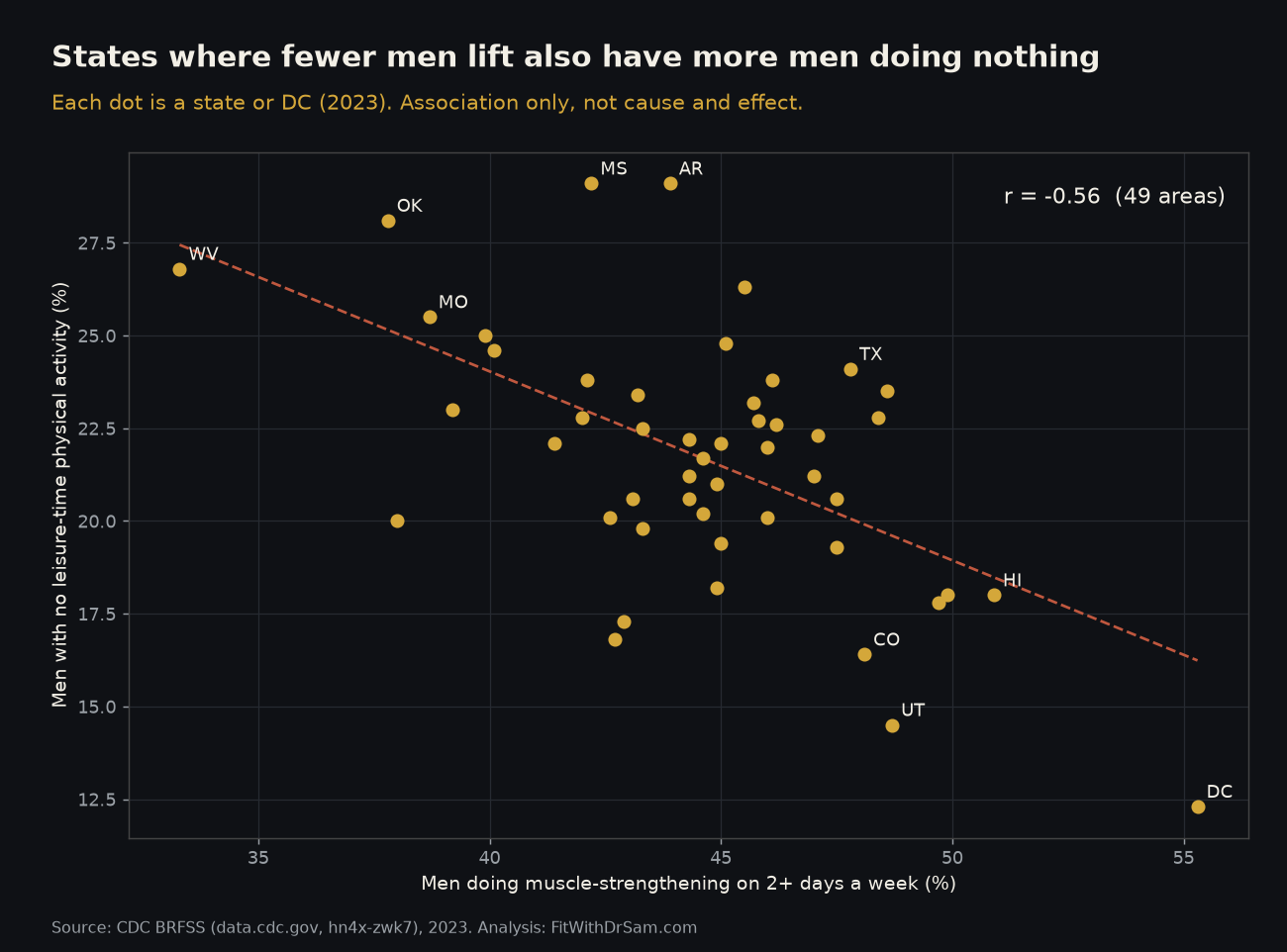
Full table: US men by state, 2023
| # | State | Men: strength 2+ days | 95% CI | Women | Men minus women (pts) | Men: no leisure-time activity |
|---|---|---|---|---|---|---|
| 1 | District of Columbia | 55.3% | 51.5 to 58.9 | 43.8% | +11.5 | 12.3% |
| 2 | Hawaii | 50.9% | 48.5 to 53.2 | 35.6% | +15.3 | 18.0% |
| 3 | Arizona | 49.9% | 47.9 to 52.0 | 40.1% | +9.8 | 18.0% |
| 4 | Virginia | 49.7% | 47.0 to 52.3 | 35.4% | +14.3 | 17.8% |
| 5 | Utah | 48.7% | 47.0 to 50.5 | 40.4% | +8.3 | 14.5% |
| 6 | South Carolina | 48.6% | 46.5 to 50.7 | 40.4% | +8.2 | 23.5% |
| 7 | Florida | 48.4% | 45.8 to 50.9 | 39.3% | +9.1 | 22.8% |
| 8 | Colorado | 48.1% | 46.2 to 50.0 | 41.5% | +6.6 | 16.4% |
| 9 | Texas | 47.8% | 45.2 to 50.3 | 38.2% | +9.6 | 24.1% |
| 10 | Alaska | 47.5% | 44.9 to 50.1 | 40.4% | +7.1 | 20.6% |
| 11 | Maryland | 47.5% | 45.6 to 49.4 | 37.7% | +9.8 | 19.3% |
| 12 | Connecticut | 47.1% | 44.8 to 49.4 | 39.5% | +7.6 | 22.3% |
| 13 | New Jersey | 47.0% | 44.9 to 49.1 | 39.9% | +7.1 | 21.2% |
| 14 | New Mexico | 46.2% | 42.3 to 50.1 | 36.8% | +9.4 | 22.6% |
| 15 | Ohio | 46.1% | 44.3 to 47.9 | 38.8% | +7.3 | 23.8% |
| 16 | Nevada | 46.0% | 41.6 to 50.5 | 39.9% | +6.1 | 22.0% |
| 17 | New Hampshire | 46.0% | 43.2 to 48.8 | 40.9% | +5.1 | 20.1% |
| 18 | Michigan | 45.8% | 43.8 to 47.9 | 38.3% | +7.5 | 22.7% |
| 19 | New York | 45.7% | 44.0 to 47.3 | 38.3% | +7.4 | 23.2% |
| 20 | Louisiana | 45.5% | 42.9 to 48.2 | 36.5% | +9.0 | 26.3% |
| 21 | Wyoming | 45.1% | 42.4 to 47.8 | 38.9% | +6.2 | 24.8% |
| 22 | Georgia | 45.0% | 42.5 to 47.5 | 38.5% | +6.5 | 22.1% |
| 23 | Vermont | 45.0% | 42.5 to 47.5 | 38.8% | +6.2 | 19.4% |
| 24 | California | 44.9% | 43.1 to 46.8 | 34.5% | +10.4 | 21.0% |
| 25 | Montana | 44.9% | 42.9 to 47.0 | 41.5% | +3.4 | 18.2% |
| 26 | Minnesota | 44.6% | 42.9 to 46.2 | 37.7% | +6.9 | 21.7% |
| 27 | North Dakota | 44.6% | 42.2 to 47.0 | 37.7% | +6.9 | 20.2% |
| 28 | Indiana | 44.3% | 42.6 to 46.1 | 36.5% | +7.8 | 20.6% |
| 29 | Rhode Island | 44.3% | 41.5 to 47.1 | 37.5% | +6.8 | 22.2% |
| 30 | Tennessee | 44.3% | 41.7 to 46.9 | 37.3% | +7.0 | 21.2% |
| 31 | Arkansas | 43.9% | 41.2 to 46.6 | 35.5% | +8.4 | 29.1% |
| 32 | Delaware | 43.3% | 39.9 to 46.7 | 34.3% | +9.0 | 22.5% |
| 33 | Massachusetts | 43.3% | 41.1 to 45.5 | 39.5% | +3.8 | 19.8% |
| 34 | Nebraska | 43.2% | 41.6 to 44.9 | 35.4% | +7.8 | 23.4% |
| 35 | Illinois | 43.1% | 40.6 to 45.7 | 36.7% | +6.4 | 20.6% |
| 36 | Oregon | 42.9% | 40.6 to 45.3 | 39.1% | +3.8 | 17.3% |
| 37 | Washington | 42.7% | 41.6 to 43.8 | 39.1% | +3.6 | 16.8% |
| 38 | Idaho | 42.6% | 40.3 to 44.8 | 35.7% | +6.9 | 20.1% |
| 39 | Mississippi | 42.2% | 39.1 to 45.3 | 28.9% | +13.3 | 29.1% |
| 40 | Wisconsin | 42.1% | 40.4 to 43.8 | 36.4% | +5.7 | 23.8% |
| 41 | Kansas | 42.0% | 40.1 to 43.9 | 35.0% | +7.0 | 22.8% |
| 42 | Maine | 41.4% | 39.4 to 43.3 | 36.6% | +4.8 | 22.1% |
| 43 | South Dakota | 40.1% | 36.0 to 44.4 | 36.6% | +3.5 | 24.6% |
| 44 | Alabama | 39.9% | 36.9 to 42.9 | 29.5% | +10.4 | 25.0% |
| 45 | Iowa | 39.2% | 37.4 to 41.2 | 33.7% | +5.5 | 23.0% |
| 46 | Missouri | 38.7% | 36.4 to 41.0 | 32.1% | +6.6 | 25.5% |
| 47 | North Carolina | 38.0% | 34.8 to 41.3 | 30.6% | +7.4 | 20.0% |
| 48 | Oklahoma | 37.8% | 35.7 to 40.0 | 30.6% | +7.2 | 28.1% |
| 49 | West Virginia | 33.3% | 30.8 to 36.0 | 28.2% | +5.1 | 26.8% |
Europe: men and strength training by country, 2019
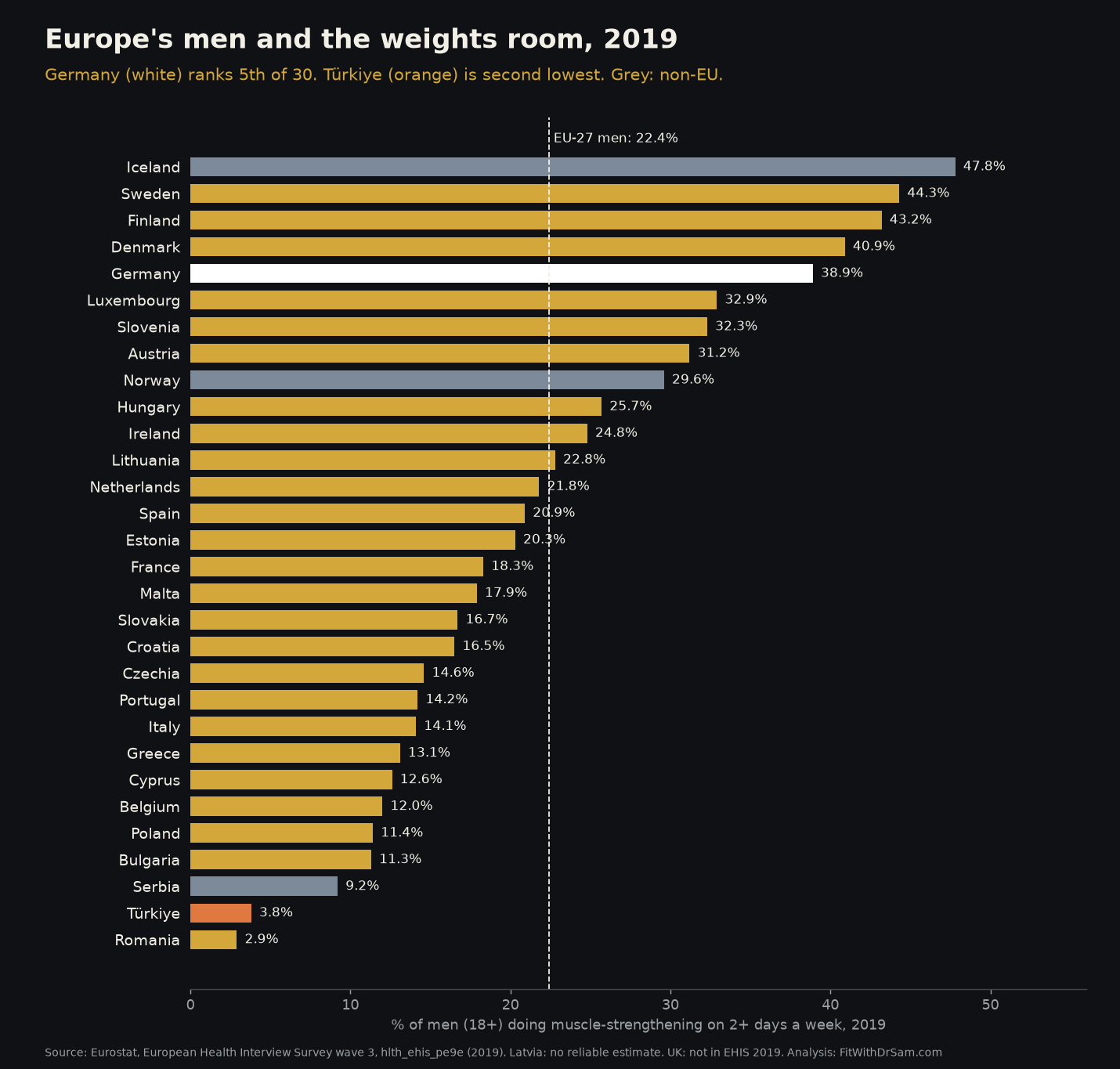
The Nordic countries lead, and Germany sits just behind them. At the bottom, Romania (2.9%) and Türkiye (3.8%) are far below every other country. The survey cannot tell us why the gap exists, and the answers depend partly on how people interpret a question about “muscle-strengthening”, so the lowest figures are best read as “far lower than elsewhere” rather than exact counts.
Full table: European men by country, 2019
| # | Country | Men: strength 2+ days | Women | Men minus women (pts) | Men: aerobic guideline | Men: both guidelines |
|---|---|---|---|---|---|---|
| 1 | Iceland | 47.8% | 56.8% | -9.0 | 52.7% | 36.5% |
| 2 | Sweden | 44.3% | 42.1% | +2.2 | 50.9% | 32.4% |
| 3 | Finland | 43.2% | 38.7% | +4.5 | 52.8% | 29.4% |
| 4 | Denmark | 40.9% | 39.6% | +1.3 | 47.4% | 26.5% |
| 5 | Germany | 38.9% | 33.7% | +5.2 | 50.5% | 28.9% |
| 6 | Luxembourg | 32.9% | 29.3% | +3.6 | 41.5% | 22.6% |
| 7 | Slovenia | 32.3% | 32.1% | +0.2 | 28.0% | 14.1% |
| 8 | Austria | 31.2% | 26.3% | +4.9 | 45.8% | 24.1% |
| 9 | Norway | 29.6% | 25.2% | +4.4 | 58.3% | 26.7% |
| 10 | Hungary | 25.7% | 21.3% | +4.4 | 32.1% | 17.6% |
| 11 | Ireland | 24.8% | 20.1% | +4.7 | 36.4% | 17.5% |
| 12 | Lithuania | 22.8% | 16.3% | +6.5 | 23.5% | 13.5% |
| 13 | Netherlands | 21.8% | 17.7% | +4.1 | 63.0% | 19.0% |
| 14 | Spain | 20.9% | 14.6% | +6.3 | 39.9% | 15.9% |
| 15 | Estonia | 20.3% | 14.0% | +6.3 | 27.7% | 11.0% |
| 16 | France | 18.3% | 13.4% | +4.9 | 32.2% | 11.6% |
| 17 | Malta | 17.9% | 9.5% | +8.4 | 13.9% | 7.9% |
| 18 | Slovakia | 16.7% | 8.8% | +7.9 | 35.8% | 13.5% |
| 19 | Croatia | 16.5% | 15.1% | +1.4 | 21.5% | 11.8% |
| 20 | Czechia | 14.6% | 9.8% | +4.8 | 29.9% | 8.8% |
| 21 | Portugal | 14.2% | 10.0% | +4.2 | 18.8% | 8.5% |
| 22 | Italy | 14.1% | 9.2% | +4.9 | 23.1% | 10.3% |
| 23 | Greece | 13.1% | 7.8% | +5.3 | 22.7% | 9.7% |
| 24 | Cyprus | 12.6% | 6.8% | +5.8 | 26.0% | 7.9% |
| 25 | Belgium | 12.0% | 9.2% | +2.8 | 32.1% | 6.4% |
| 26 | Poland | 11.4% | 6.2% | +5.2 | 22.5% | 8.6% |
| 27 | Bulgaria | 11.3% | 4.5% | +6.8 | 15.2% | 8.4% |
| 28 | Serbia | 9.2% | 3.4% | +5.8 | 19.3% | 5.8% |
| 29 | Türkiye | 3.8% | 1.5% | +2.3 | 7.6% | 1.9% |
| 30 | Romania | 2.9% | 0.7% | +2.2 | 11.1% | 2.5% |
How does your state or country compare?
Quick look-up
Pick a place to see the share of men doing strength training twice a week there.
What the guideline actually says
The World Health Organization’s 2020 guidelines recommend that adults do muscle-strengthening activities involving the major muscle groups on two or more days a week, in addition to aerobic activity. The US, England and Canada use the same two-days-a-week yardstick, and so does the European survey. That is why we used it: it is a public benchmark, easy to check, and the question was asked consistently within each country survey.
What this means in practice (Sam’s coaching view)
In my coaching, the hardest part is usually getting the first two sessions a week into the calendar. A few practical points, from coaching experience and not from this dataset:
- Two full-body sessions of 30 to 45 minutes meet the “two days” yardstick. You do not need five gym days.
- Bodyweight and home work counts too. See the 3-day, 30-minute home workout and the 3-day plan for men over 40.
- Over 50? Start with the strength, cardio and balance plan.
- Prefer a simple structure to follow? The free 7-Day Stamina Starter is another way in.
- If you have a health condition or you have not trained for a long time, speak to a qualified clinician before you begin.
Methodology and limitations
- US data. CDC “Nutrition, Physical Activity, and Obesity” indicator data from the Behavioral Risk Factor Surveillance System (BRFSS), question Q046: percent of adults who engage in muscle-strengthening activities on 2 or more days a week, stratified by sex. 2023 is the latest year with this indicator. Also used: Q047 (no leisure-time physical activity), Q043 (aerobic guideline) and Q044 (aerobic plus muscle-strengthening). Kentucky and Pennsylvania have no 2023 estimate and are excluded. Puerto Rico, Guam and the US Virgin Islands are published but left out because this is a states ranking. Adults are 18 and over. The state estimates come with confidence intervals; ranks inside the middle of the table are not statistically distinct.
- European data. Eurostat table hlth_ehis_pe9e (European Health Interview Survey, third wave, 2019), “muscle-strengthening”, males, 18 and over, all education levels. The 30 countries are the EU-27 minus Latvia (no reliable estimate), plus Iceland, Norway, Serbia and Türkiye. The UK was not part of this wave. This is the latest wave available in Eurostat’s database.
- Not directly comparable. The US figures (2023, phone survey) and the European figures (2019, interview survey) use different questionnaires and years, so we do not rank the US against Europe. We also show England (Health Survey for England 2021, men 16+) and Canada (Canadian Community Health Survey 2020, men 18 to 64) only as context. The Canadian and English questions count a wider range of activities than a strict “lifting” definition, and a strict lifting-only definition would give lower figures.
- Trend caution. The CDC series for US men shows 34.4% in 2011 and 45.1% in 2023, but the survey has changed over the years, so we do not call that a measured change in behaviour.
- Self-reported. All figures are self-reported survey answers. Self-reports can over- or under-state real behaviour. Nothing here estimates health outcomes or gives medical advice.
- Our calculations. The correlation (r = −0.56) is a simple Pearson correlation across 49 areas using the 2023 BRFSS values for men. Rankings are by the published point estimate. “Men minus women” is the difference in percentage points. Raw numbers are in the two CSV files above.
Sources
- CDC: Nutrition, Physical Activity, and Obesity, Behavioral Risk Factor Surveillance System (data.cdc.gov)
- Eurostat: Performing health-enhancing physical activity by sex, age and educational attainment level (hlth_ehis_pe9e) and Eurostat Statistics Explained: Health-enhancing physical activity statistics
- NHS England Digital: Health Survey for England 2021, Adult physical activity
- Prince SA et al. Strength-training and balance activities in Canada: historical trends and current prevalence. Health Promotion and Chronic Disease Prevention in Canada, 2023
- World Health Organization: Guidelines on physical activity and sedentary behaviour (2020)
Use our charts and data
Journalists, bloggers and teachers are welcome to use the charts and tables, free of charge, with a link back to this page. Copy and paste:
US map
Europe chart
Press summary
Press contact: Sam Smith, [email protected]. Available for comment on men’s strength training, training over 40, and why men skip the “two days a week” habit. State-level or country-level figures for any locality are available on request, and the full dataset is in the two CSV files above.
Summary: Using official CDC and Eurostat surveys, FitWithDrSam found that the share of men who do muscle-strengthening exercise on two or more days a week ranges from 33.3% in West Virginia to 50.9% in Hawaii (55.3% in Washington DC), and from 2.9% in Romania to 47.8% in Iceland. 45.1% of US men met the guideline in 2023. Germany ranks 5th of 30 European countries at 38.9%.
Last updated 1 November 2026. Questions, corrections or a newer data release? Email [email protected] and we will update this page.